
Gondos
Well-known member
Hi,
I'm trying to integrate proper time on vessels in Orbiter but I'm not sure about the time scales involved.
The goal is to have the computed proper time on a vessel landed on Earth elapse at a similar rate as Terrestrial Time.
Here is what I tried :
- integrate τ from a weak-field approximation:
dτ/dt = sqrt(1-v²/c²+2U/c²)
with
U=-Σi(GMi/ri) over all planets/moons + the sun
- dt is SimDT and v and ri are velocities and positions in the "global frame" of Orbiter.
If we plot the resulting τ-simt for a DG landed at Cape Canaveral over several years it gives this:
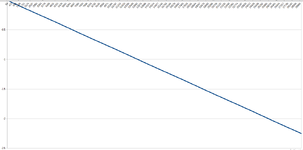
The slope is about 0.49s per year, suspiciously close to the scaling factor between TCB and TDB.
Now it's not clear to me what exactly is the ephemeris time used in Orbiter's VSOP, but I think it's ET=TDB. I'm not sure how it should affect the formula.
I guess the formula computes dτ/dTCB instead of dτ/dTDB.
Anyway, let's see what happens if we scale our equation, given the definition of TDB : TDB = TCB − LB×(JDTCB − T0)×86400 + TDB0
dτ/dt = sqrt(1-v²/c²+2U/c²) / (1-LB)
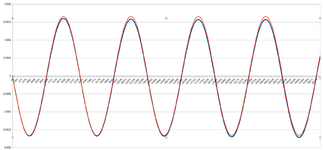
Now this looks close to the TT-TDB formula (-0.001658 * sin(g) - 0.000014 * sin(2.0*g) shown in red)
Over a longer time span (244 years here), we can notice a drift of 9.20μs/year (enjoy the pretty aliasing^^) :
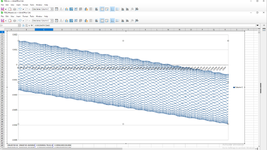
It looks like τ-simt ≈ TT-TDB + drift error, and if simt = TDB then τ = TT + drift error
So the questions are :
Thanks
I'm trying to integrate proper time on vessels in Orbiter but I'm not sure about the time scales involved.
The goal is to have the computed proper time on a vessel landed on Earth elapse at a similar rate as Terrestrial Time.
Here is what I tried :
- integrate τ from a weak-field approximation:
dτ/dt = sqrt(1-v²/c²+2U/c²)
with
U=-Σi(GMi/ri) over all planets/moons + the sun
- dt is SimDT and v and ri are velocities and positions in the "global frame" of Orbiter.
If we plot the resulting τ-simt for a DG landed at Cape Canaveral over several years it gives this:
The slope is about 0.49s per year, suspiciously close to the scaling factor between TCB and TDB.
Now it's not clear to me what exactly is the ephemeris time used in Orbiter's VSOP, but I think it's ET=TDB. I'm not sure how it should affect the formula.
I guess the formula computes dτ/dTCB instead of dτ/dTDB.
Anyway, let's see what happens if we scale our equation, given the definition of TDB : TDB = TCB − LB×(JDTCB − T0)×86400 + TDB0
dτ/dt = sqrt(1-v²/c²+2U/c²) / (1-LB)
Now this looks close to the TT-TDB formula (-0.001658 * sin(g) - 0.000014 * sin(2.0*g) shown in red)
Over a longer time span (244 years here), we can notice a drift of 9.20μs/year (enjoy the pretty aliasing^^) :
It looks like τ-simt ≈ TT-TDB + drift error, and if simt = TDB then τ = TT + drift error
So the questions are :
- what's actually computed by the first equation?
- is applying the scale factor a valid way of realizing TT?
- what could account for the 9.20μs/year drift?
Thanks


