
MontBlanc2012
Active member
- Joined
- Aug 13, 2017
- Messages
- 144
- Reaction score
- 47
- Points
- 28
In this post, I'll revisit an old topic: finding the points of intersection of two co-planar orbits. This question was asked in a much earlier post [Calculating intersection of two Orbits]. However, the solution provided in that post, although functional, was not aesthetically appealing and, moreover, used a technique that I couldn't really extended to more complicated and interesting (but related) questions.
So, I've been looking at this anew. To solve the orbit intersection problem, I make use of pre-existing programming routines built into software such as SageMath, which provides a much more elegant coding solution. Moreover, the same mathematical and coding approach can be extended to consider more complicated problems involving intersecting and tangent ellipses. These solutions have relevance to achieving target orbits with specified semi-major axis, orbital eccentricity, and argument of periapsis. In turn, these solutions have practical application in orbital manoeuvring to achieve a 'close co-elliptical orbit' with, say, the ISS as a precursor to final approach and docking. Hence the reason for re-visiting this topic.
Attached is a PDF file produced from a Jupyter .ipynb file. It contains a brief mathematical introduction and then presents some code (written in SageMath - which is a free software download, by the way). Finally, a quick example of running the code is given. In this example, orbit parameters ( semi-major axis, orbital eccentricity and argument of periapsis are provided). The results are returned as a plot of the two orbits (in the perifocal reference frame of the first orbit) together with the intersection points (if any) and the location of the central gravitating body. Finally, the values of the intersection points in the perifocal reference frames of both the first orbit and the second orbit are given.
In the example given, the inputs are:
The plot of the two orbits with intersection points is as follows:
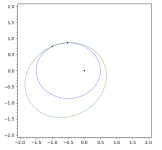
And the actual intersection points are:
Although this doesn't by itself reveal anything profound, it does provide a framework for solving more complex tangent orbit problems.
If anyone wants a copy of the .ipynb file itself, let me know in comments below.
So, I've been looking at this anew. To solve the orbit intersection problem, I make use of pre-existing programming routines built into software such as SageMath, which provides a much more elegant coding solution. Moreover, the same mathematical and coding approach can be extended to consider more complicated problems involving intersecting and tangent ellipses. These solutions have relevance to achieving target orbits with specified semi-major axis, orbital eccentricity, and argument of periapsis. In turn, these solutions have practical application in orbital manoeuvring to achieve a 'close co-elliptical orbit' with, say, the ISS as a precursor to final approach and docking. Hence the reason for re-visiting this topic.
Attached is a PDF file produced from a Jupyter .ipynb file. It contains a brief mathematical introduction and then presents some code (written in SageMath - which is a free software download, by the way). Finally, a quick example of running the code is given. In this example, orbit parameters ( semi-major axis, orbital eccentricity and argument of periapsis are provided). The results are returned as a plot of the two orbits (in the perifocal reference frame of the first orbit) together with the intersection points (if any) and the location of the central gravitating body. Finally, the values of the intersection points in the perifocal reference frames of both the first orbit and the second orbit are given.
In the example given, the inputs are:
a1 = 1.0; e1 = 0.5; w1 = 0.0;a2 = 1.3; e2 = 0.5; w2 = 0.15 * pi.n()The plot of the two orbits with intersection points is as follows:
And the actual intersection points are:
Code:
The intersection points (in the coordinate system of the perifocal frame of the first orbit) are:
[-0.5223316608958554?, 0.8658094320872373?]
[-0.9955975379617520?, 0.7521883476062942?]

The intersection points (in the coordinate system of the perifocal frame of the second orbit) are:
[-0.07233166089585532?, 1.008575464453451?]
[-0.5455975379617519?, 1.122196548934395?]
Although this doesn't by itself reveal anything profound, it does provide a framework for solving more complex tangent orbit problems.
If anyone wants a copy of the .ipynb file itself, let me know in comments below.


