Project Hybrid airship

Update:

Making some progress.

At the moment the ballonet is automatically adjusted to keep the pressure difference inside the envelope at 500 Pa above the outside pressure. A warning is displayed at 600 Pa and the airship starts venting gas at 750 Pa. These 600 and 750 Pa values are guesses so I'll have to dig out some references and maybe adjust these.

The 500 Pa in my spreadsheet comes from Zepplin-NT (5 millibar overpressure). Airlander uses about twice as much overpressure. This is just from Wikipedia

I was rather surprised when warnings were given when the airship climbs faster than a few metres per second. This is because the simple algorithm I have used doesn't change the ballonet size quickly enough to maintain the correct pressure. I am wondering if real airships climb or descent rates are have to be limited in a similar way due to a limit on the rate of air pumped into or out of the ballonet. Something to look into.

I'm sure "pumping out" is fast and easy because you are just releasing pressure through a valve. The old Goodyear blimp used its propwash to inflate its ballonets. I'm not sure what is done these days.
 
And yes, ascent and descent rates are limited for various factors that could harm structural integrity.

Especially the high altitude Zeppelins used in WW1 required very careful handling there and only launched in good weather. Actually that is one of the apocryphical etymologies for the German term "Bombenwetter", which describes a warm, sunny, almost windstill day with little clouds.
 
That was great video, thanks! Now I know how to pronounce ballonet. It was good to see the inlet scoops for the ballonets.

I'm starting to getting an idea of the general properties of the valves, i.e. ballpark size and quantity, for releasing air and fan systems for pumping air into the ballonet after reading a few things. It seems quite simple stuff but not really that obvious.
 
Update:

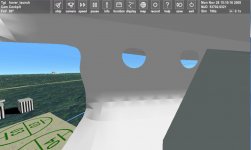
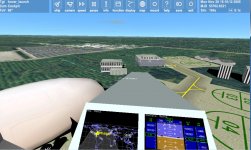
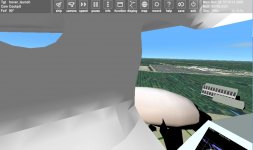
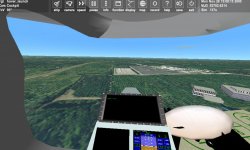
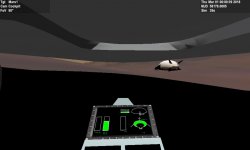
Working on a virtual cockpit at the moment. Everything else seems to be working fine.

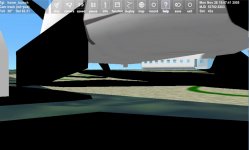
airship1.jpg

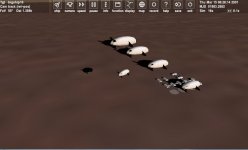
airship2.jpg

airship3.jpg

airship4.jpg

airship5.jpg

airship6.jpg
 
What about including a vessel specific MFD for handling the bouyancy management?
 
What about including a vessel specific MFD for handling the bouyancy management?

Interesting idea.

I have an MFD for the airship which displays some useful flight information. I'll have a look at modifying it for the buoyancy management.
 
One manages the pressure as much as anything; the buoyancy falls out.
 
Update:

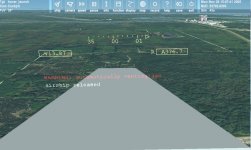
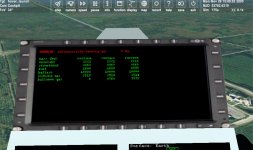
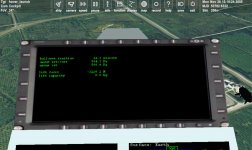
I have changed the HUD into a big MFD screen to print all the information clearly.

I am thinking about making a proper virtual cockpit based on real airship instrumentation panels and controls. For now however I will try to upload this version soon for some test flights before doing any more.

Various types of information can be displayed on the big MFD, e.g. mass, volume, forces etc.

The gauge pressure can be displayed and the its setting altered. This helps fine tune the buoyancy.

airship_vc1.jpg

airship_vc2.jpg

airship_vc3.jpg
 
A bit much text to read... what about for example having a balance like display?
Top: lifting factors
bottom: gravity factors
Center: A simple arrow showing if the airship is flying LTA or HTA.

Maybe split into two halves:

Left: Current balance
Right: A plot of the altitude trend: Starts at now (Origin) +30m +1h, +2h, +4h current altitude is the reference altitude, ground and pressure height are shown as limits.

The left half would make it easier to plan maneuvers (eg, landing, takeoff, turns)
The right half would be good for cruising or landing approaches (eg, predicting too rapid descend rates)

Or maybe have both halves in individual MFDs below and be configured as needed for the current situation, eg.:

Left: Vertical situation (Short-term bouyancy or long-term trend)
Right: Horizontal situation (Map, maybe overlaid with a weather chart)

Am I annoying with my feedback? :hmm:
 
No not annoying really.

I wasn't expecting to get feedback so quickly but that's ok and appreciated.
 
No not annoying really.

I wasn't expecting to get feedback so quickly but that's ok and appreciated.

I just wait for the first bug to appear while a new installation script is running for tests, I am deeply bored watching another setup.exe getting called again and again. :lol:
 
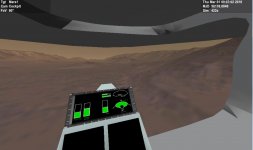
This is what I have so far for the airship screen, i.e. the big MFD:

Left indicator bar is ballast change, next indicator is for the gauge pressure and the next indicator is the apparent vertical force on the airship calculated from vertical acceleration and mass. This is useful for balancing the vertical forces to zero and helping to keep altitude constant when adjusting the ballast, gauge pressure or aerodynamic forces.

The airship diagram bottom right shows buoyancy, weight, ballonet size and landing gear status.

The top right diagram shows direction of thrust. Top horizontal bars indicate engine thrust (top) and fuel remaining.

Cockpit2.jpg

Cockpit3.jpg
 
That looks pretty :)
 
Thanks, I was thinking it looked similar to the graphics of a 1980s 8-bit home computer ...
 
Thanks, I was thinking it looked similar to the graphics of a 1980s 8-bit home computer ...


Well, just look at the Zeppelin NT for comparison...


2003-07-26_18-06-46_Germany_Baden-W%C3%BCrttemberg_Hagnau.JPG
 
I have uploaded the latest version to post #1.

I'm still working on the base building side of the addon. The buildings are not included in this version.

Also cargo transport in general needs a bit more thought, i.e. perhaps adding a crane.

I haven't really thought how it would be transported to different planets. I am wondering if it could be launched into orbit in a stowed configuration, travel to the planet and then inflate its envelope and deploy its fins and wings before entering the atmosphere. If it can't enter inflated then it'll have to be inflated and reconfigured during the descent or on the surface.
 
Well, for Mars, the plan is to use vacuum blimbs, since the pressure difference is so low. Those are supposed to be inflated in the sense of inflating narrow struts and rings around the vacuum, or be assembled from smaller rigid elements brought from Earth.

See here for a overview poster for Mars:

http://sci.esa.int/science-e/www/object/doc.cfm?fobjectid=46147]
 
Thanks that looks interesting.

btw I have included the newest C++ code in the latest version addon. I have commented it the best as I can.
 
It's magnificent, but I think there are a few bugs that I need to check on if I get time...
 
Back
Top