Engineers at Baikonur and other various places will be anxious to see the Proton takes flight tomorrow and deploys the fifth Intelsat communication satellite taking flight in 2012 perfectly. After all, with 3 serious mishaps in 18 launch campaigns for the past 20 months (ironically all hitting hard on satellites either built for or built by Russia), the Proton rocket and its developer Khrunichev is in one of the largest crisis for a long time of space launch operations. The successful launch of Intelsat 23 directly into geostationary orbit is thus vital to re-gain confidence from different customers to use the veteran Proton rocket again.
The Intelsat 23 mission will be the 8th Proton launch of 2012 and the 380th Proton flight overall.
This will be the sixth commercial mission of the year for ILS and the 75th ILS Proton mission since the Proton April 1996 first commercial flight.
This will also be the 11th Intelsat satellite launched with Proton. In addition, Intelsat 23 will become the 5th Orbital Science Corporation-built satellite launched on Proton, as well as the 4th direct-geostationary orbit insertion mission on an ILS Proton.
The launch was postponed from August 23
due to the failure of the Breeze-M upper stage on the last Proton launch with two Russian-built satellites on August 6. The failure was eventually traced to a a small metallic orifice inside a fuel line that was not manufactured according to specifications (by a manufacturer that got the job only a year ago), causing the pressurization system of the upper stage to leak, eventually shutting down the engine.
Launch location:
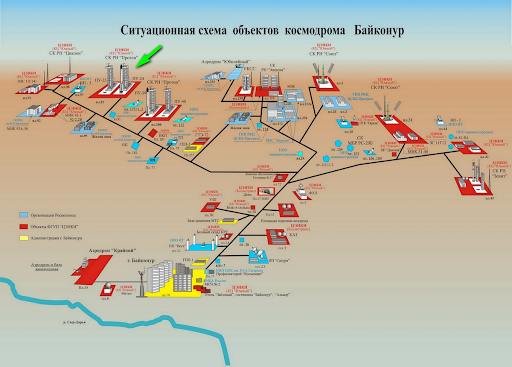
Baikonur Launch pad no. 81/24 46°4'15.38"N, 62°59'5.11"E
Launch dates and times:
[table="head"]{colsp=6}Launch times
Time Zone|
Baikonur / UTC+6
|
Luxembourg / CEDT
|
Universal / UTC
|
Washington / EDT
|
Los Angeles / PDT
Launch time (Primary):
|
14:37:00
|
10:37:00
|
08:37:00
|
04:37:00
|
00:37:00
on:
|
Oct. 14, 2012
|
Oct. 14, 2012
|
Oct. 14, 2012
|
Oct. 14, 2012
|
Oct. 14, 2012
{colsp=6}
[highlight][eventTimer]2012-10-14 08:37:00?before|after;%dd% Days %hh% Hours %mm% Minutes %ss% Seconds %c%[/eventTimer] Intelsat 23 Launch[/highlight]
[/table]
Live Coverage Of The Launch:
PAYLOAD
Intelsat 23 communication satellite:
Mission Summary
Orbital is building the Intelsat-23 (IS-23) GEO communications satellite for Intelsat, LLC. IS-23 will generate 4.8 kilowatts of electrical payload power and carry 15 active Ku-band and 24 active C-Band transponders. The spacecraft will provide communications services for the Americas, Caribbean, Western Europe, Africa and selected islands of the Pacific and Atlantic oceans. Designed for a useful life of at least 15 years, the IS-23 satellite will be located in orbit at 307 degrees East Longitude following its launch in late 2012. The IS-23 is the 10th Orbital-built geosynchronous communications satellite in the Intelsat fleet.
[table="head"]{colsp=2}Summary
Parameter|
Value
Working Orbit:
|
GEO
Orbital Location:
|
53° West
Coverage:
|
North/Central/South America, West Europe/Africa
ApA at separation:
|
37180 km
PeA at separation:
|
37180 km
Inc at separation:
|
0.0°
[/table]
[table="head"]Characteristics|
Intelsat 23
Customer:
|
Prime contractor:
|
- Orbital Sciences Corporation
Platform:
|
Mass at Separation:
|
Dry Mass:
|
Stabilization:
|
Dimensions (stowed):
|
Batteries:
|
Payload:
|
- 24 C-band transponders
- 15 Ku-band transponders
Life time:
|
Ku-band coverage:
|
C-band coverage:
|
|
[/table]
Launch Vehicle:
[table="head"]{colsp=2}Characteristics
|[table="head"]{colsp=2}
Proton-M / Briz-M
Prime contractor:
|
GRAU Index:
|
Height:
| 58.2 m with upper stage and payload fairing
Diameter:
| max 7.4 m
Liftoff mass:
| 705 metric tonnes
Payload mass:
| ~22 tonnes at LEO
1st stage:
|
- 6 X RD-275 engines
- Empty 30.6 tonnes
- Propellants 419.41 tonnes (UDMH and NTO)
- Thrust in vacuum 1069.8 tonnes of force
- Thrust at sea level 971.4 tonnes of force
2nd stage:
|
- 1 X RD-0211 engine 3 X RD-0210 engines
- Empty 11.4 tonnes
- Propellants 156.113 tonnes (UDMH and NTO)
- Thrust in vacuum 237.4 tonnes of force
3rd stage:
|
- 1 X RD-0213 engine & 1 X RD-0214 vernier engine
- Empty 3.7 tonnes
- Propellants 46.562 tonnes (UDMH and NTO)
- Thrust in vacuum 59.36 (core) + 3.15 (vernier) tonnes of force
Upper Stage:
|
- GRAU Index: 14S43
- Common Name: Briz-M
- Designer & Manufacturer: Khrunichev Space Centre
- Dimensions: Length 2.654 m, Diameter 4 m
- Empty Mass 2.2 tonnes
- Propellants 6 660 kg UDMH + 13 260 kg N2O4
- Flight time: no less than 24 hours
- Main Engine: 1 X 14D30
- Thrust in vacuum 2.0 tonnes of force
- ISP 328.6 s
- Main engine restarts: up to 8 times
- Precision Manoeuvering Engines: 4 X 11D458
- Thrust in vacuum 400 N each
- ISP 252 s
- RCS Engines: 12 X 17D58E
- Thrust in vacuum 13.3 N each
- ISP 274 s
Payload Fairing:
|
- Diameter 4.35 m
- Length 11.6 m
[/table]
[/table]
The vehicle's
reliability statistics according to
http://www.spacelaunchreport.com/log2012.html#rate:
Code:
================================================================
Vehicle     Successes/Tries Realzd Pred  Consc. Last     Dates
                             Rate  Rate* Succes Fail
================================================================
Proton-M/Briz-M  53    58    .91  .90      0    08/06/12 2001-
Intelsat 23 Ascent Profile
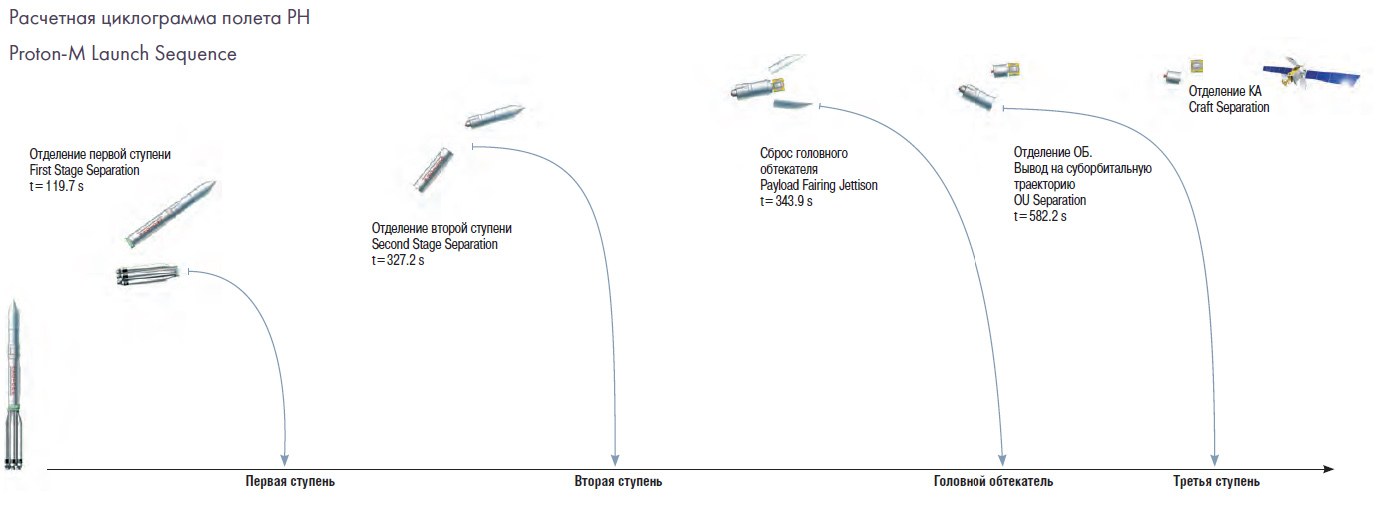
The Proton-M first three stages place the orbital unit (OU), which consists of a Breeze-M upper stage, adapter system and SES-5, into a 51.5° inclination suborbital trajectory.
Proton-M powered flight lasts 582 seconds. The OU powered flight begins at the moment of the third stage separation.
Immediately after the separation of the third stage booster, the Breeze-M stability engines start, damping the angular velocities of the third stage separation and then providing orbital unit orientation and stability during coast flight along a suborbital trajectory to await the first burn. The upper stage follows a four-burn injection profile.
Intelsat 23 Ascent Timeline
[TABLE="head"]Event|Time rel lift-off|Time UTC|Comment
Ignition Start Sequence|-00:00:02.5|08:36:57.5|
Stage 1 Ignition (40% thrust)|-00:00:01.75|08:36:58.25|
Command Stage 1 (100% thrust)|-00:00:00.9|08:36:59.1|
Maximum Dynamic Pressure|00:01:02|08:38:02|
1st/2nd Stage Separation|00:02:00|08:39:00|
2nd/3rd Stage Separation|00:05:27|08:42:27|
Payload Fairing Separation|00:05:42|08:42:42|
3rd Stage/Breeze M Separation|00:09:41|08:46:41|
1st Burn Ignition|00:11:15|08:48:15|
1st Burn Shutdown|00:15:05|08:52:05|1st Burn's Duration 00:03:50
2nd Burn Ignition|01:08:21|09:45:21|
2nd Burn Shutdown|01:27:10|10:04:10|2nd Burn's Duration 00:18:49
3rd Burn Ignition|03:26:56|12:03:56|
3rd Burn Shutdown|03:45:12|12:22:12|3rd Burn's Duration 00:18:16
APT Jettison|03:46:33|12:23:33|
4th Burn Ignition|09:03:59|17:40:59|
4th Burn Shutdown|09:15:45|17:52:45|4th Burn's Duration 00:11:46
Spacecraft Separation|09:30:00|18:07:00|
[/TABLE]
Weather forecast for Baikonur, Kazakhstan on October 14, 2012 (2 p.m.)
Overcast. High of 21C. Winds from the North at 5 to 15 km/h shifting to the WNW in the afternoon.
References
http://www.federalspace.ru
http://tvroscosmos.ru
http://www.khrunichev.ru
http://www.ilslaunch.com
http://tihiy.fromru.com/Rn/RN_Proton.htm
http://www.intelsat.com/_files/resources/satellites/IS-23-factsheet.pdf
http://www.orbital.com/NewsInfo/Publications/Intelsat23_Fact.pdf
http://www.tsenki.com
http://forum.nasaspaceflight.com
http://www.novosti-kosmonavtiki.ru
http://www.spacelaunchreport.com
http://english.wunderground.com/cgi-bin/findweather/getForecast?query=44.84999847,65.50000000



 Intelsat 23 fact sheet