

-
ORBITER-FORUM will be temporarily closed at 2026-07-23 18:00 UTC while we complete some OF maintenance tasks. The amount of downtime is expected to take up to one hour, but probably less.
You are using an out of date browser. It may not display this or other websites correctly.
You should upgrade or use an alternative browser.
You should upgrade or use an alternative browser.
Updates NASA's Mars 2020 Rover
- Thread starter Unstung
- Start date


- Joined
- Nov 20, 2007
- Messages
- 11,969
- Reaction score
- 768
- Points
- 188
Making Oxygen from the Martian Atmosphere: An Experiment on a Mars Rover Paves the Way for Human Visitors
The Mars Oxygen In-Situ Resource Utilization Experiment (MOXIE), installed on the NASA Perseverance rover, is a significant step towards human travel to Mars.
 uk.mathworks.com
A bit old now, but still an interesting view from the "marscopter"
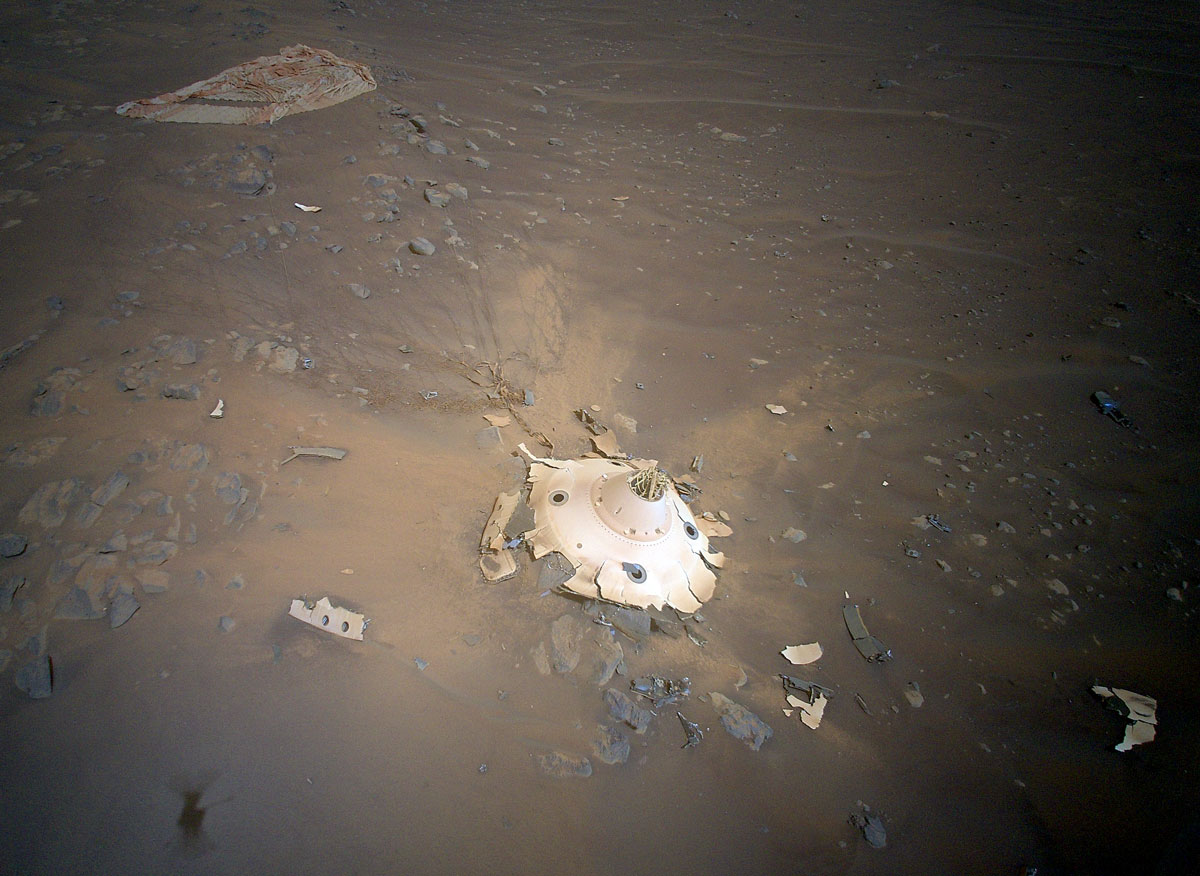
(hires in the link)
 mars.nasa.gov
This image of Perseverance’s backshell sitting upright on the surface of Jezero Crater was collected from an altitude of 26 feet (8 meters) by NASA’s Ingenuity Mars Helicopter during its 26th flight at Mars on April 19, 2022. Engineers working on the Mars Sample Return program requested images be taken from an aerial perspective of the components because they may provide insight into the components’ performance during the rover’s entry, descent, and landing on Feb. 18, 2021.
(hires in the link)
Rover's Backshell Seen From the Air – NASA Mars Exploration
This image of Perseverance’s backshell and parachute was collected by NASA’s Ingenuity Mars Helicopter during its 26th flight on April 19, 2022. Images obtained during the flight may provide insight into the components’ performance during the rover’s entry, descent, and landing on Feb. 18, 2021.
mars.nasa.gov
This image of Perseverance’s backshell sitting upright on the surface of Jezero Crater was collected from an altitude of 26 feet (8 meters) by NASA’s Ingenuity Mars Helicopter during its 26th flight at Mars on April 19, 2022. Engineers working on the Mars Sample Return program requested images be taken from an aerial perspective of the components because they may provide insight into the components’ performance during the rover’s entry, descent, and landing on Feb. 18, 2021.

One of the navigation system’s main requirements was to provide velocity estimates that would enable the helicopter to land within a small envelope of vertical and horizontal velocities. Data sent down during Flight 72 shows that, around 20 seconds after takeoff, the navigation system couldn’t find enough surface features to track.
Photographs taken after the flight indicate the navigation errors created high horizontal velocities at touchdown. In the most likely scenario, the hard impact on the sand ripple’s slope caused Ingenuity to pitch and roll. The rapid attitude change resulted in loads on the fast-rotating rotor blades beyond their design limits, snapping all four of them off at their weakest point — about a third of the way from the tip. The damaged blades caused excessive vibration in the rotor system, ripping the remainder of one blade from its root and generating an excessive power demand that resulted in loss of communications.

Buck Rogers
Major Spacecadet
- Joined
- Feb 26, 2013
- Messages
- 1,233
- Reaction score
- 1,650
- Points
- 128
Always interesting to hear the trials and tribulations of such experiments, and it's still running supplying scientific data!
Chopper looks cool! Was thinking about that as UACS cargo expansion
Chopper looks cool! Was thinking about that as UACS cargo expansion
Last year, we reported on the discovery of an intriguing arrow-shaped rock on Mars by NASA's Perseverance rover. The rock contained chemical signatures and structures that could have been formed by ancient microbial life. Granted, this was not slam-dunk evidence of past life on Mars, and the results were preliminary, awaiting peer review. But it was an intriguing possibility nonetheless.
Now further analysis and peer review are complete, and there is a new paper, published in the journal Nature, reporting on the findings. It's still not definitive proof that there was water-based life on Mars billions of years ago, but the results are consistent with a biosignature. It's just that other non-biological processes would also be consistent with the data, so definitive proof might require analysis of the Martian samples back on Earth.

Here's the paper (Nature) : https://www.nature.com/articles/s41586-025-09413-0
Abstract
And a dedicated Startalk episode :
Redox-driven mineral and organic associations in Jezero Crater, Mars
Joel A. Hurowitz, M.M. Tice, A.C. Allwood && aliiAbstract
The Perseverance rover has explored and sampled igneous and sedimentary rocks within Jezero Crater to characterize early Martian geological processes and habitability and search for potential biosignatures. Upon entering Neretva Vallis, on Jezero Crater’s western edge, Perseverance investigated distinctive mudstone and conglomerate outcrops of the Bright Angel formation. Here we report a detailed geological, petrographic and geochemical survey of these rocks and show that organic-carbon-bearing mudstones in the Bright Angel formation contain submillimetre-scale nodules and millimetre-scale reaction fronts enriched in ferrous iron phosphate and sulfide minerals, likely vivianite and greigite, respectively. This organic carbon appears to have participated in post-depositional redox reactions that produced the observed iron-phosphate and iron-sulfide minerals. Geological context and petrography indicate that these reactions occurred at low temperatures. Within this context, we review the various pathways by which redox reactions that involve organic matter can produce the observed suite of iron-, sulfur- and phosphorus-bearing minerals in laboratory and natural environments on Earth. Ultimately, we conclude that analysis of the core sample collected from this unit using high-sensitivity instrumentation on Earth will enable the measurements required to determine the origin of the minerals, organics and textures it contains.
And a dedicated Startalk episode :
Last edited:
Buck Rogers
Major Spacecadet
- Joined
- Feb 26, 2013
- Messages
- 1,233
- Reaction score
- 1,650
- Points
- 128
Similar threads

- Replies
- 2
- Views
- 1K


- Replies
- 64
- Views
- 15K


- Replies
- 3
- Views
- 3K