
General Question Pressure-dependent Isp

martins

Orbiter Founder
Orbiter Founder
Joined
Mar 31, 2008
Messages
2,447
Reaction score
474
Points
83
Website
orbit.medphys.ucl.ac.uk
In answering this issue, I noticed that my current Isp pressure model is linear:
[math]
I(p) = I_0 \max\left(0, 1-p \frac{I_0 - I_r}{p_r I_0}\right)
[/math]
for vacuum Isp I_0, and Isp I_r at reference pressure p_r. This means that a thruster will not generate any thrust at ambient pressures
[math]
p \ge \frac{p_r I_0}{I_0-I_r}
[/math]
I wonder if an exponential model would be more appropriate:
[math]
I(p) = I_0 \exp(-\alpha p)
[/math]
with
[math]
\alpha = -\frac{1}{p_r} \ln \frac{I_r}{I_0}
[/math]
Any opinions?
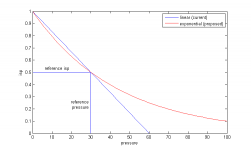
 

Attachments

  • isp.png
    isp.png
    6.1 KB · Views: 19
This would certainly seem to make more sense. I wonder if it would be good to have a value for maximum pressure potential of the engine? A rocket wouldn't create thrust if the external pressure equaled or exceeded the internal pressure.

Then again, most rockets can generate a LOT of internal pressure, so how often would the external pressure exceed the internal pressure - without the craft being crushed?
 
Having a maximum pressure potential was my original reason for using the linear model. With an exponential model the engine will continue to produce a small amount of thrust even at very high external pressures.
 
I would think that at very high external pressures the thrust would be so small as to be inconsequential for all practical purposes - pressure implies an atmosphere (or liquid) so it would take a very long period of time to overcome the drag enough to generate a mathematically noticeable motion - but I suppose you could add a threshhold below which the thrust would be set to zero.

That might be slightly more accurate than the current model, but would likely only be noticeable to people trying to use Orbiter for serious scientific purposes.
 
Then again, most rockets can generate a LOT of internal pressure, so how often would the external pressure exceed the internal pressure - without the craft being crushed?

Venus or one of the gas giants certainly have the capability of generating intense pressures, but the crush point is the limiting factor, as most engines run at over 25 atmospheres, IIRC. So, the only thing that woudn't crush would be the engines!
 
It is in reality approximately linear and if I am not mistaken, a polynomial approximation works better for most effects, there is only very little exponential in it.

---------- Post added at 11:30 AM ---------- Previous post was at 11:19 AM ----------

Having a maximum pressure potential was my original reason for using the linear model. With an exponential model the engine will continue to produce a small amount of thrust even at very high external pressures.

But that is not realistic. At one point, the back pressure would not be compensated by using less nozzle length for the expansion (flow separates earlier from the nozzle walls and is grossly overexpanded), but it will simply make it impossible to ignite the fuel since the throat and the injector plate are also affected. There will usually not even be thrust by the unburned propellants, since the turbopumps will fail to function and flow could even invert at too high pressures.

There is a hard limit of how much backpressure you could tolerate at a power level. Igniting engines at too high pressure is impossible, even if it would be possible to operate engines at full thrust at this ambient pressure - you simple never reach the needed stable power levels.
 
Back
Top