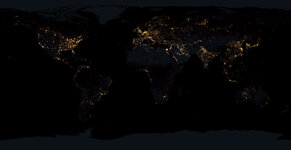
Alright, some new development again.
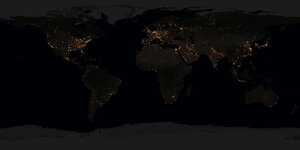
Actually I was looking for another source of daylight maps because I was unhappy with the fact that I have to heavily edit the ocean of google maps images because it has this strangely coloured bathymetry map. But while searching for a better daylight map I found something very interesting: The "OSM dark" map. I did not find any internet page displaying it, but it is accessible through qgis. It seems to be a derivative of the well-known version of OpenStreetMap, where the density and type of road is translated into a brightness value, giving an impression of night lights. It's pretty amazing, giving a much more high resolution impression, which is a huge advantage over VIIRS imagery. But of course (because of the lack of actual image data at this resolution) it is computer generated, not a real image. And the amount of illumination only depends on the density and type of road, so even every dirt road and forest track mapped in OSM is illuminated here, which of course (fortunately!!!) is not the case in the real world. This would literally be the end of the night if come true. Goodbye insects, goodbye healthy sleep.
But it looks awesome anyway.
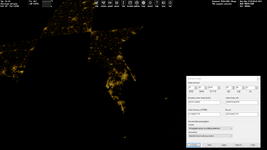
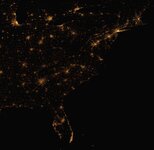
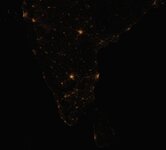
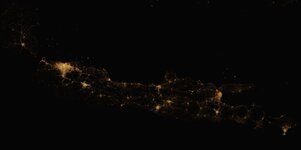
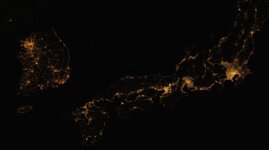
This is what it looks like:
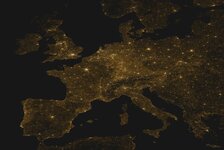
Even though this is not how the real world actually looks like, for populated areas it gives quite a realistic nighttime look, so it's a huge opportunity to improve our new night lights map if we combine it with the VIIRS data.
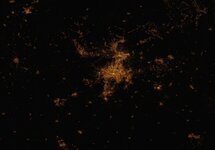
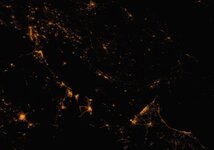
This for example is a view of Paris in the OSM dark map:
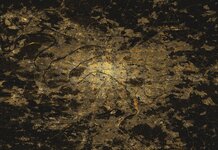
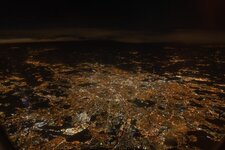
Compare it with an actual image of Paris I took a few years ago. Yeah, there is of course some differences, but in general it's quite similar. Be aware, that the overall brightness of the image is completely arbitrary and only depends on camera exposure or the sensitivity of your eyes. From space and in the absence of any other light sources you would probably perceive it much brighter.
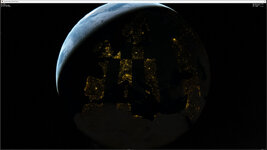
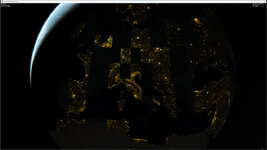
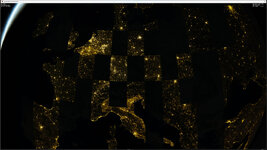
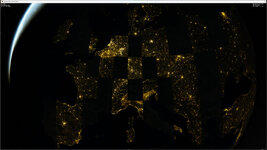
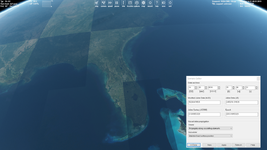
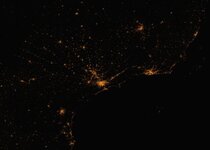
So now I took this data to make a new version of night map for Orbiter and here's a comparison of different versions.
1) The (already shown earlier) Google maps + VIIRS blend version
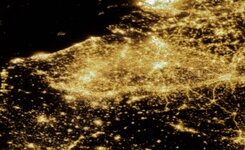
2) A more aggressive blend of OSM dark and VIIRS
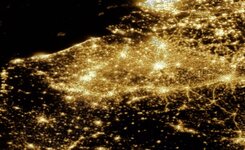
3) A more nuanced blend of OSM dark and VIIRS
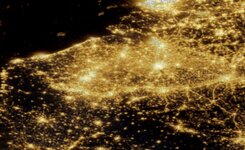
4) Only OSM dark with some brightness adjustments
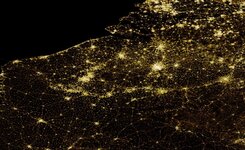
5) Only VIIRS for comparison
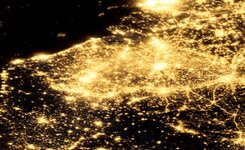
In my opinion number 3 is the best one as a compromise between VIIRS actual recorded brightness and some higher resolution features.
And here is a view of version 3 in full resolution as the above images lost some detail to resizing and compression:
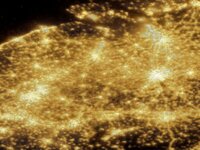
Now I'm very interested, what your opinion is. Which one is the best version?
Actually I was looking for another source of daylight maps because I was unhappy with the fact that I have to heavily edit the ocean of google maps images because it has this strangely coloured bathymetry map. But while searching for a better daylight map I found something very interesting: The "OSM dark" map. I did not find any internet page displaying it, but it is accessible through qgis. It seems to be a derivative of the well-known version of OpenStreetMap, where the density and type of road is translated into a brightness value, giving an impression of night lights. It's pretty amazing, giving a much more high resolution impression, which is a huge advantage over VIIRS imagery. But of course (because of the lack of actual image data at this resolution) it is computer generated, not a real image. And the amount of illumination only depends on the density and type of road, so even every dirt road and forest track mapped in OSM is illuminated here, which of course (fortunately!!!) is not the case in the real world. This would literally be the end of the night if come true. Goodbye insects, goodbye healthy sleep.
But it looks awesome anyway.
This is what it looks like:
Even though this is not how the real world actually looks like, for populated areas it gives quite a realistic nighttime look, so it's a huge opportunity to improve our new night lights map if we combine it with the VIIRS data.
This for example is a view of Paris in the OSM dark map:
Compare it with an actual image of Paris I took a few years ago. Yeah, there is of course some differences, but in general it's quite similar. Be aware, that the overall brightness of the image is completely arbitrary and only depends on camera exposure or the sensitivity of your eyes. From space and in the absence of any other light sources you would probably perceive it much brighter.
So now I took this data to make a new version of night map for Orbiter and here's a comparison of different versions.
1) The (already shown earlier) Google maps + VIIRS blend version
2) A more aggressive blend of OSM dark and VIIRS
3) A more nuanced blend of OSM dark and VIIRS
4) Only OSM dark with some brightness adjustments
5) Only VIIRS for comparison
In my opinion number 3 is the best one as a compromise between VIIRS actual recorded brightness and some higher resolution features.
And here is a view of version 3 in full resolution as the above images lost some detail to resizing and compression:
Now I'm very interested, what your opinion is. Which one is the best version?

 )... the same happens with the Moon surface: what is its color? Probably the reason why the Artemis II astronauts were asked to describe the colors they saw (and they saw braun-ish and green-ish features).


 It would probably be waaaay easier to just paint it in with the good old brush and just use the satellite views as a reference location-wise.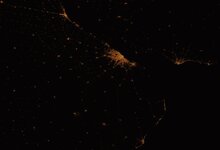
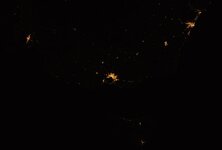
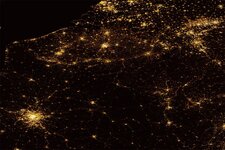
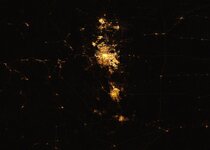
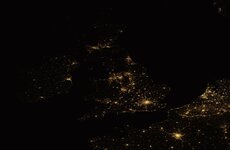
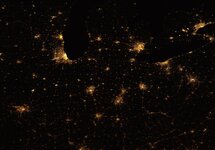
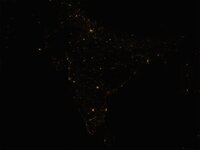
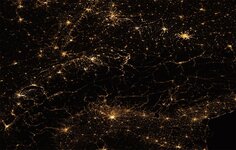
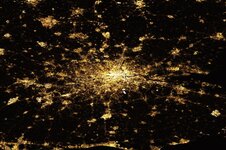
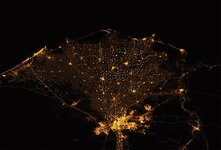
 That looks acceptable to me.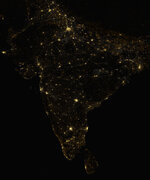
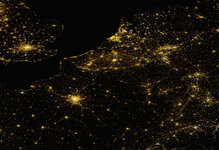
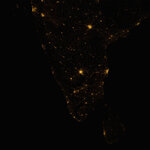
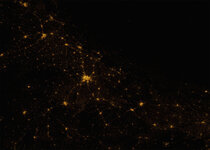
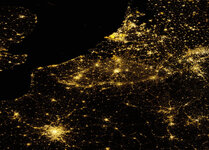
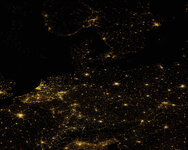
 ) I'm going to make a level 11 preview version (without land-sea mask). That's the best I can get to in a reasonable amount of time. Making level 12 will be a lot of work and probably a couple of hours of computing time, so before I do that I have to finish the land-sea mask, which requires me to finish the daylight textures before that.
  But I'm very happy we got here and actually faster than I had thought possible. Thank you all for your valuable inputs!