

-
ORBITER-FORUM will be temporarily closed at 2026-07-23 18:00 UTC while we complete some OF maintenance tasks. The amount of downtime is expected to take up to one hour, but probably less.
You are using an out of date browser. It may not display this or other websites correctly.
You should upgrade or use an alternative browser.
You should upgrade or use an alternative browser.
Updates Who stole Marvin's water? The MAVEN investigation updates and discussion thread
- Thread starter Notebook
- Start date


- Joined
- Oct 30, 2009
- Messages
- 14,018
- Reaction score
- 4
- Points
- 0
The Planetary Society Blog - Emily Lakdawala: Why are MAVEN and Mars Orbiter Mission taking such different paths to Mars?
- Joined
- Oct 30, 2009
- Messages
- 14,018
- Reaction score
- 4
- Points
- 0

Unstung
Active member
MAVEN is still doing well, with under 100 days until Mars Orbital Insertion on 21 September. The next course correction will occur on 23 July.
AmericaSpace: "MAVEN Celebrates 100 Days From Mars Orbit Insertion on Friday the 13th"
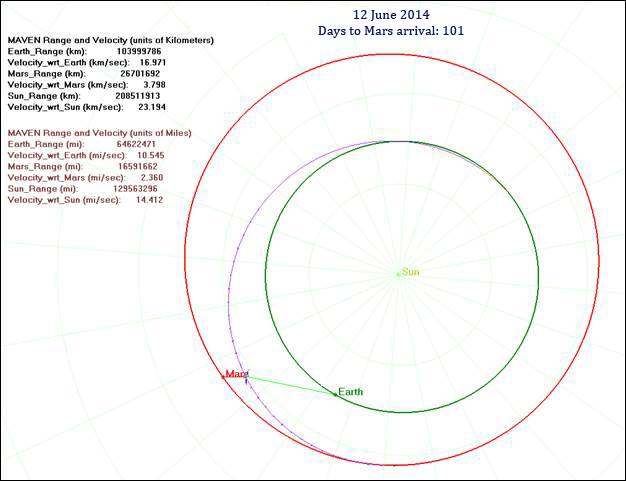
AmericaSpace: "MAVEN Celebrates 100 Days From Mars Orbit Insertion on Friday the 13th"
Are you Friggatriskaidekaphobic (suffering from the irrational fear of Friday the 13th)?
Supremely defying any hints of superstition, the fearless team directing MAVEN—NASA’s next orbiter bound for the Red Planet—celebrated this Friday the 13th of June as a noteworthy mission milestone marking just 100 days to the crucial Mars Orbital Insertion (MOI) engine firing scheduled for Sept. 21, 2014.
“Happy Friday the 13th, everyone!” the team excitedly announced.
See above NASA’s cool new mission poster released for the agency’s newest Mars orbiter, the Mars Atmosphere and Volatile Evolution (MAVEN), which will investigate the planet’s thin upper atmosphere and begin solving the riddles of Mars’ climate mysteries, atmospheric loss, and habitability.
“Where did the water go and where did the carbon dioxide go from the early atmosphere? What were the mechanisms?” asks Bruce Jakosky, MAVEN’s Principal Investigator from the University of Colorado at Boulder.
“The spacecraft remains on schedule for Mars orbit insertion on September 21, 2014,” the MAVEN team reports.
As of today, June 15, it’s T-Minus 98 days and counting to MOI!
On June 12, MAVEN was 103,999,786 km (64,622,471 miles) from Earth, with an Earth-centered velocity of 17.0 km/s (10.5 mi/s or 38,000 mph) and a Sun-centered velocity of 23.2 km/s (14.4 mi/s or 51,800 mph).
“I’m delighted that we’re operating in space so well,” Jakosky told me. “We’re on our way!”
Each day it gets 1.4 million km farther away from Earth.
MAVEN has now traveled over 515,271,717 km (320,174,387 miles) on its heliocentric transfer path. The spacecraft is currently less than 26,700,000 km (16,500,000 miles) from Mars.
[...]
After 10 months of cruise MAVEN is only less than 4 days from entering Martian orbit!  The 33 minute long MOI burn will start at 9:33 pm Eastern on September 21 (01:33 UTC on Sept. 22) about 380 km over the Martian north pole and will put it into a 35 hour period elliptical orbit. Afterward it will lower its orbit in 6 weeks to a ~150 x 6300 km orbit where it will start its mission in studying Mars' atmosphere's past.

[ame="http://www.youtube.com/watch?v=dNakyt-D47U"]NASA | Investigating the Martian Atmosphere[/ame]
The 33 minute long MOI burn will start at 9:33 pm Eastern on September 21 (01:33 UTC on Sept. 22) about 380 km over the Martian north pole and will put it into a 35 hour period elliptical orbit. Afterward it will lower its orbit in 6 weeks to a ~150 x 6300 km orbit where it will start its mission in studying Mars' atmosphere's past.
[ame="http://www.youtube.com/watch?v=dNakyt-D47U"]NASA | Investigating the Martian Atmosphere[/ame]

- Joined
- Jun 16, 2011
- Messages
- 3,594
- Reaction score
- 14
- Points
- 63
- Location
- Huntsville, AL
- Preferred Pronouns
- He/Him
Been looking forward to this mission. Thanks for the update!
MAVEN Mars approach scenario.
Starts at 00:00 UTC 20th Sept. State vectors from Horizons.
[ame="http://www.orbithangar.com/searchid.php?ID=6373"]MAVEN[/ame] add-on required
Starts at 00:00 UTC 20th Sept. State vectors from Horizons.
[ame="http://www.orbithangar.com/searchid.php?ID=6373"]MAVEN[/ame] add-on required
Code:
BEGIN_DESC
MAVEN Mars approach
END_DESC

BEGIN_ENVIRONMENT
  System Sol
  Date MJD  56920
END_ENVIRONMENT

BEGIN_FOCUS
  Ship Maven
END_FOCUS

BEGIN_CAMERA
  TARGET Maven
  MODE Extern
  POS 14.34 140.22 23.26
  TRACKMODE TargetRelative
  FOV 40.00
END_CAMERA

BEGIN_HUD
  TYPE Surface
END_HUD

BEGIN_MFD Left
  TYPE Surface
  SPDMODE 1
END_MFD

BEGIN_MFD Right
  TYPE Orbit
  PROJ Ship
  FRAME Equator
  ALT
  REF Earth
END_MFD

BEGIN_SHIPS
Maven:maven/maven
  STATUS Orbiting Mars
  RPOS  575101025.881842  15759550.5336757  134181905.738636
  RVEL -3125.0182541922 -48.2915828940409 -723.908664298885
  AROT 13.47 -22.38 -16.77
  RCSMODE 2
  AFCMODE 7
  PRPLEVEL 0:0.949959
  NAVFREQ 0 0
  SOLP 3 1.0000 2 1.0000
  APPA 0 0.0000 0 0.0000
  KROT 0
END
END_SHIPS
boogabooga
Bug Crusher
- Joined
- Apr 16, 2011
- Messages
- 3,006
- Reaction score
- 16
- Points
- 63
About 2 hours to live coverage.

Planetary Radio LIVE
http://new.livestream.com/kpcclive/planetary-radio-live-maven-orbiter-meets-mars
Livestream bandwidth is horrid, so I suggest sticking with NASA TV.
http://new.livestream.com/kpcclive/planetary-radio-live-maven-orbiter-meets-mars
Livestream bandwidth is horrid, so I suggest sticking with NASA TV.
Last edited:

MaverickSawyer
Acolyte of the Probe
Capture burn has started.
---------- Post added at 09:25 PM ---------- Previous post was at 08:53 PM ----------
Orbit achieved.
---------- Post added at 09:25 PM ---------- Previous post was at 08:53 PM ----------
Orbit achieved.

- Joined
- Nov 20, 2007
- Messages
- 11,969
- Reaction score
- 768
- Points
- 188

Well done !
http://spaceflightnow.com/
http://spaceflightnow.com/
What's next? See http://www.planetary.org/blogs/emily-lakdawalla/2014/09211013-maven-orbit-insertion-timeline.html :tiphat:
One more Mars orbiter to go....

sorindafabico
New member
From NASA's FB fan page:

MAVEN Spacecraft Returns First Mars Observations
NASA’s Mars Atmosphere and Volatile Evolution (MAVEN) spacecraft has obtained its first observations of the extended upper atmosphere surrounding Mars.
The Imaging Ultraviolet Spectrograph (IUVS) instrument obtained these false-color images eight hours after the successful completion of Mars orbit insertion by the spacecraft at 10:24 p.m. EDT Sunday, Sept. 21, after a 10-month journey.
The image shows the planet from an altitude of 36,500 km in three ultraviolet wavelength bands. Blue shows the ultraviolet light from the sun scattered from atomic hydrogen gas in an extended cloud that goes to thousands of kilometers above the planet’s surface. Green shows a different wavelength of ultraviolet light that is primarily sunlight reflected off of atomic oxygen, showing the smaller oxygen cloud. Red shows ultraviolet sunlight reflected from the planet’s surface; the bright spot in the lower right is light reflected either from polar ice or clouds.
The oxygen gas is held close to the planet by Mars’ gravity, while lighter hydrogen gas is present to higher altitudes and extends past the edges of the image. These gases derive from the breakdown of water and carbon dioxide in Mars’ atmosphere. Over the course of its one-Earth-year primary science mission, MAVEN observations like these will be used to determine the loss rate of hydrogen and oxygen from the Martian atmosphere. These observations will allow us to determine the amount of water that has escaped from the planet over time.
MAVEN is the first spacecraft dedicated to exploring the tenuous upper atmosphere of Mars.
Image credit: Laboratory for Atmospheric and Space Physics, University of Colorado; NASA
It has been pretty quiet since the October comet passing, but MAVEN has already find some new surprises about Martian atmospheric changes and has made a dip down to 125 km altitude last month.

Soheil_Esy
Fazanavard فضانورد
- Joined
- Apr 5, 2015
- Messages
- 744
- Reaction score
- 20
- Points
- 18
Auroras on Mars

A map of MAVEN's Imaging Ultraviolet Spectrograph (IUVS) auroral detections in December 2014 overlaid on Mars’ surface. The map shows that the aurora was widespread in the northern hemisphere, not tied to any geographic location. The aurora was detected in all observations during a 5-day period.
May 11, 2015: One day, when humans go to Mars, they might find that, occasionally, the Red Planet has green skies.
In late Dec. 2014, NASA's MAVEN spacecraft detected evidence of widespread auroras in Mars's northern hemisphere. The "Christmas Lights," as researchers called them, circled the globe and descended so close to the Martian equator that, if the lights had occurred on Earth, they would have been over places like Florida and Texas.
"It really is amazing," says Nick Schneider who leads MAVEN's Imaging Ultraviolet Spectrograph (IUVS) instrument team at the University of Colorado. "Auroras on Mars appear to be more wide ranging than we ever imagined."
This isn't the first time a spacecraft has detected auroras on Mars. Ten years ago, the European Space Agency's Mars Express found an ultraviolet glow coming from "magnetic umbrellas" in the southern hemisphere.
Unlike Earth, Mars does not have a global magnetic field that envelops the entire planet. Instead, Mars has umbrella-shaped magnetic fields that sprout out of the ground like mushrooms, here and there, but mainly in the southern hemisphere. These umbrellas are remnants of an ancient global field that decayed billions of years ago.
"The canopies of the patchwork umbrellas are where we expect to find Martian auroras," says Schneider. "But MAVEN is seeing them outside these umbrellas, so this is something new."
Auroras occur, both on Earth and Mars, when energetic particles from space rain down on the upper atmosphere. On Earth, these particles are guided toward the poles by our planet's global magnetic field. That's why auroras are seen most often around the Arctic and Antarctic. On Mars, there is no organized planetary magnetic field to guide the particles north and south—so they can go anywhere.
"The particles seem to precipitate into the atmosphere anywhere they want," says Schneider. "Magnetic fields in the solar wind drape across Mars, even into the atmosphere, and the charged particles just follow those field lines down into the atmosphere."
According to the MAVEN data, solar particles that caused the "Christmas lights" penetrated deeply into the Martian atmosphere---sparking auroras less than 100 km from the surface. That's lower than auroras on Earth, which range from 100 km to 500 km high.
Like Mars Express 10 years ago, MAVEN has an ultraviolet camera, so it is not seeing the same thing as human eyes. What would a human see?
Schneider isn't certain. "We’re still doing the physics," he says, "but we have some educated guesses."
Although the Martian atmosphere is primarily CO2, it does contain some oxygen--and that is key to the color of the auroras. Excited oxygen atoms in the Martian atmosphere would likely produce green light.
"A diffuse green glow seems quite possible in the Mars sky, at least when the Sun is throwing off energetic particles," says Schneider.
MAVEN arrived at Mars in Sept. 2014 on a mission to investigate a planetary mystery: Billions of years ago, Mars was blanketed by layer of air massive enough to warm the planet and allow liquid water to flow on its surface. Life could have thrived in such an environment. Today, however, only a tiny fraction of that ancient air remains, leaving Mars a desiccated wasteland.
Where did the Martian atmosphere go? A favorite theory is solar wind erosion. Because Mars no longer has a global magnetic field to protect it, solar wind might strip away material from the upper layers of the atmosphere. Watching the auroras could help MAVEN mission scientists learn more about this process.
"Plus," says Schneider, who is looking forward to future data, "I just love auroras."
http://science.nasa.gov/science-news/science-at-nasa/2015/11may_aurorasonmars/
A map of MAVEN's Imaging Ultraviolet Spectrograph (IUVS) auroral detections in December 2014 overlaid on Mars’ surface. The map shows that the aurora was widespread in the northern hemisphere, not tied to any geographic location. The aurora was detected in all observations during a 5-day period.
May 11, 2015: One day, when humans go to Mars, they might find that, occasionally, the Red Planet has green skies.
In late Dec. 2014, NASA's MAVEN spacecraft detected evidence of widespread auroras in Mars's northern hemisphere. The "Christmas Lights," as researchers called them, circled the globe and descended so close to the Martian equator that, if the lights had occurred on Earth, they would have been over places like Florida and Texas.
"It really is amazing," says Nick Schneider who leads MAVEN's Imaging Ultraviolet Spectrograph (IUVS) instrument team at the University of Colorado. "Auroras on Mars appear to be more wide ranging than we ever imagined."
This isn't the first time a spacecraft has detected auroras on Mars. Ten years ago, the European Space Agency's Mars Express found an ultraviolet glow coming from "magnetic umbrellas" in the southern hemisphere.
Unlike Earth, Mars does not have a global magnetic field that envelops the entire planet. Instead, Mars has umbrella-shaped magnetic fields that sprout out of the ground like mushrooms, here and there, but mainly in the southern hemisphere. These umbrellas are remnants of an ancient global field that decayed billions of years ago.
"The canopies of the patchwork umbrellas are where we expect to find Martian auroras," says Schneider. "But MAVEN is seeing them outside these umbrellas, so this is something new."
Auroras occur, both on Earth and Mars, when energetic particles from space rain down on the upper atmosphere. On Earth, these particles are guided toward the poles by our planet's global magnetic field. That's why auroras are seen most often around the Arctic and Antarctic. On Mars, there is no organized planetary magnetic field to guide the particles north and south—so they can go anywhere.
"The particles seem to precipitate into the atmosphere anywhere they want," says Schneider. "Magnetic fields in the solar wind drape across Mars, even into the atmosphere, and the charged particles just follow those field lines down into the atmosphere."
According to the MAVEN data, solar particles that caused the "Christmas lights" penetrated deeply into the Martian atmosphere---sparking auroras less than 100 km from the surface. That's lower than auroras on Earth, which range from 100 km to 500 km high.
Like Mars Express 10 years ago, MAVEN has an ultraviolet camera, so it is not seeing the same thing as human eyes. What would a human see?
Schneider isn't certain. "We’re still doing the physics," he says, "but we have some educated guesses."
Although the Martian atmosphere is primarily CO2, it does contain some oxygen--and that is key to the color of the auroras. Excited oxygen atoms in the Martian atmosphere would likely produce green light.
"A diffuse green glow seems quite possible in the Mars sky, at least when the Sun is throwing off energetic particles," says Schneider.
MAVEN arrived at Mars in Sept. 2014 on a mission to investigate a planetary mystery: Billions of years ago, Mars was blanketed by layer of air massive enough to warm the planet and allow liquid water to flow on its surface. Life could have thrived in such an environment. Today, however, only a tiny fraction of that ancient air remains, leaving Mars a desiccated wasteland.
Where did the Martian atmosphere go? A favorite theory is solar wind erosion. Because Mars no longer has a global magnetic field to protect it, solar wind might strip away material from the upper layers of the atmosphere. Watching the auroras could help MAVEN mission scientists learn more about this process.
"Plus," says Schneider, who is looking forward to future data, "I just love auroras."
http://science.nasa.gov/science-news/science-at-nasa/2015/11may_aurorasonmars/
Unstung
Active member
There's new information on how the Martian aurora is created.
"NASA’s MAVEN Spacecraft Finds That “Stolen” Electrons Enable Unusual Aurora on Mars"
[TABLE="width=42"]{colsp=2}
 |
|

[TABLE="width=42"]{colsp=2}
This animation shows a proton aurora at Mars. First, a solar wind proton approaches Mars at high speed and encounters a cloud of hydrogen surrounding the planet. The proton steals an electron from a Martian hydrogen atom, thereby becoming a neutral atom. The atom passes through the bowshock, a magnetic obstacle surrounding Mars, because neutral particles are not affected by magnetic fields. Finally, the hydrogen atom enters Mars' atmosphere and collides with gas molecules, causing the atom to emit ultraviolet light.
|MAVEN observations of a proton aurora. In the top panel, natural variability of the solar wind results in occasional dense flows of solar wind protons bombarding Mars. At bottom, observations by MAVEN’s Imaging Ultraviolet Spectrograph show increased ultraviolet emission from the atmosphere when the solar wind is enhanced.Credits: NASA/MAVEN/Goddard Space Flight Center/Dan Gallagher
Credits: NASA/MAVEN/University of Colorado/LASP/Anil Rao
[/TABLE][...]
Auroras flare up when energetic particles plunge into a planet’s atmosphere, bombarding gases and making them glow. While electrons generally cause this natural phenomenon, sometime protons can elicit the same response, although it’s more rare. Now, the MAVEN team has learned that protons were doing at Mars the same thing as electrons usually do at Earth—create aurora. This is especially true when the Sun ejects a particularly strong pulse of protons, which are hydrogen atoms stripped of their lone electrons by intense heat. The Sun ejects protons at speeds up to two million miles per hour (more than 3 million kilometers per hour) in an erratic flow called the solar wind.
The MAVEN (Mars Atmosphere and Volatile Evolution mission) team was studying Mars’ atmosphere with the Imaging UltraViolet Spectrograph (IUVS), and observed that on occasion, the ultraviolet light coming from hydrogen gas in Mars' upper atmosphere would mysteriously brighten for a few hours. They then noticed that the brightening events occurred when another MAVEN instrument, the Solar Wind Ion Analyzer (SWIA), measured enhanced solar wind protons.
But two puzzles make this type of aurora seem impossible at first glance: how did these protons get past the planet’s “bow shock,” a magnetic obstacle which normally diverts the solar wind’s charged particles around the planet? And how could the protons give off light, since atoms need electrons to do so?
“The answer was thievery,” said Justin Deighan, of the Laboratory for Atmospheric and Space Physics at the University of Colorado, Boulder, lead author of a paper on this research appearing July 23 in Nature Astronomy. “As they approach Mars, the protons coming in with the solar wind transform into neutral atoms by stealing electrons from the outer edge of the huge cloud of hydrogen surrounding the planet. The bow shock can only divert charged particles, so these neutral atoms continue right on through.” When those high-speed incoming atoms hit the atmosphere, some of their energy was emitted as ultraviolet light, which is invisible to the human eye but detectable to instruments like the IUVS on MAVEN. In fact, one incoming atom can collide with molecules in the atmosphere hundreds of times before it slows down, giving off a slew of ultraviolet photons.
“The Martian proton auroras are more than a light show,” said Jasper Halekas of the University of Iowa, responsible for the SWIA instrument. “They reveal that the solar wind is not completely diverted around Mars, by showing how solar wind protons can sneak past the bow shock and impact the atmosphere, depositing energy and even enhancing the hydrogen content there.”
Proton auroras do occur at Earth, but not as often as at Mars. One key difference is Earth’s strong magnetic field, which diverts the solar wind away from Earth to a much greater degree than at Mars. On Earth, proton auroras only occur in very small regions near the poles, whereas at Mars they can happen everywhere.
However, proton auroras could be common on Venus and on Saturn’s moon Titan. Like Mars, these two worlds lack their own magnetic fields, and have lots of hydrogen in their upper atmospheres—with plenty of electrons to share. Looking further, it’s likely that many planets orbiting other stars have the same favorable conditions, and would be likely to have proton auroras too.
[...]

Uh oh...
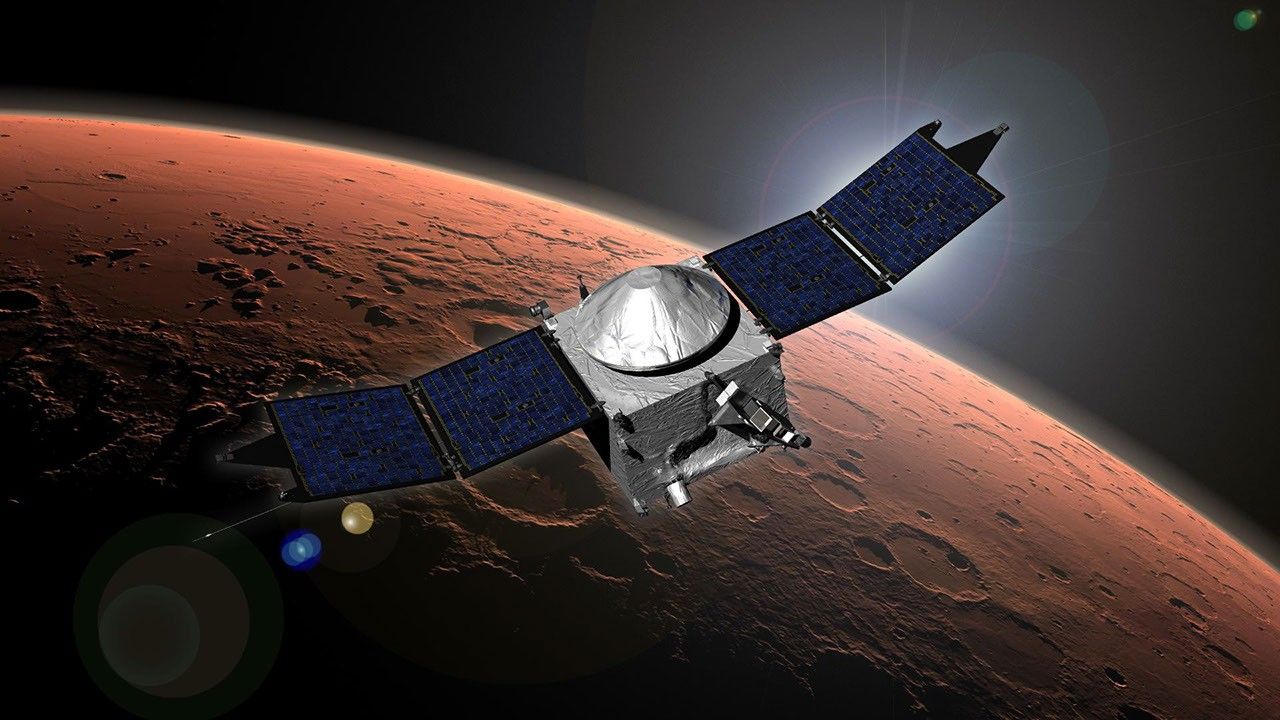
 science.nasa.gov
The spacecraft and operations teams are investigating the anomaly to address the situation. More information will be shared once it becomes available.
The MAVEN spacecraft launched in November 2013 and entered Mars’ orbit in September 2014. The mission’s goal is to explore the planet’s upper atmosphere, ionosphere, and interactions with the Sun and solar wind to explore the loss of the Martian atmosphere to space. Understanding atmospheric loss gives scientists insight into the history of the Red Planet’s atmosphere and climate, liquid water, and planetary habitability. The spacecraft also serves as a communications relay station for rovers on the Martian surface. Last year, MAVEN celebrated its 10th anniversary in orbit at Mars.
NASA Teams Work MAVEN Spacecraft Signal Loss - NASA Science
NASA’s MAVEN (Mars Atmosphere and Volatile EvolutioN) spacecraft, in orbit around Mars, experienced a loss of signal with ground stations on Earth on Dec. 6.
science.nasa.gov
NASA Teams Work MAVEN Spacecraft Signal Loss
NASA’s MAVEN (Mars Atmosphere and Volatile EvolutioN) spacecraft, in orbit around Mars, experienced a loss of signal with ground stations on Earth on Dec. 6. Telemetry from MAVEN had showed all subsystems working normally before it orbited behind the Red Planet. After the spacecraft emerged from behind Mars, NASA’s Deep Space Network did not observe a signal.The spacecraft and operations teams are investigating the anomaly to address the situation. More information will be shared once it becomes available.
The MAVEN spacecraft launched in November 2013 and entered Mars’ orbit in September 2014. The mission’s goal is to explore the planet’s upper atmosphere, ionosphere, and interactions with the Sun and solar wind to explore the loss of the Martian atmosphere to space. Understanding atmospheric loss gives scientists insight into the history of the Red Planet’s atmosphere and climate, liquid water, and planetary habitability. The spacecraft also serves as a communications relay station for rovers on the Martian surface. Last year, MAVEN celebrated its 10th anniversary in orbit at Mars.
Similar threads


- Replies
- 29
- Views
- 12K


- Replies
- 26
- Views
- 12K