- Joined
- Oct 11, 2009
- Messages
- 3,488
- Reaction score
- 407
- Points
- 123
- Location
- Utrecht
- Website
- www.spaceflightnewsapi.net
The light-weight of Arianespace/ESA's launch vehicles, Vega, is gearing up for its second flight that is planned to occur on April 20, 2013. Vega made its first mission in February 2012 delivering the LARES Satellite and multiple secondary payloads to orbit. Its second flight, VV02, will also deliver multiple satellites to orbit, ESA's Proba V satellite, VNREDSat for Vietnam and EstCube 1, a Cubesat from Estonia.
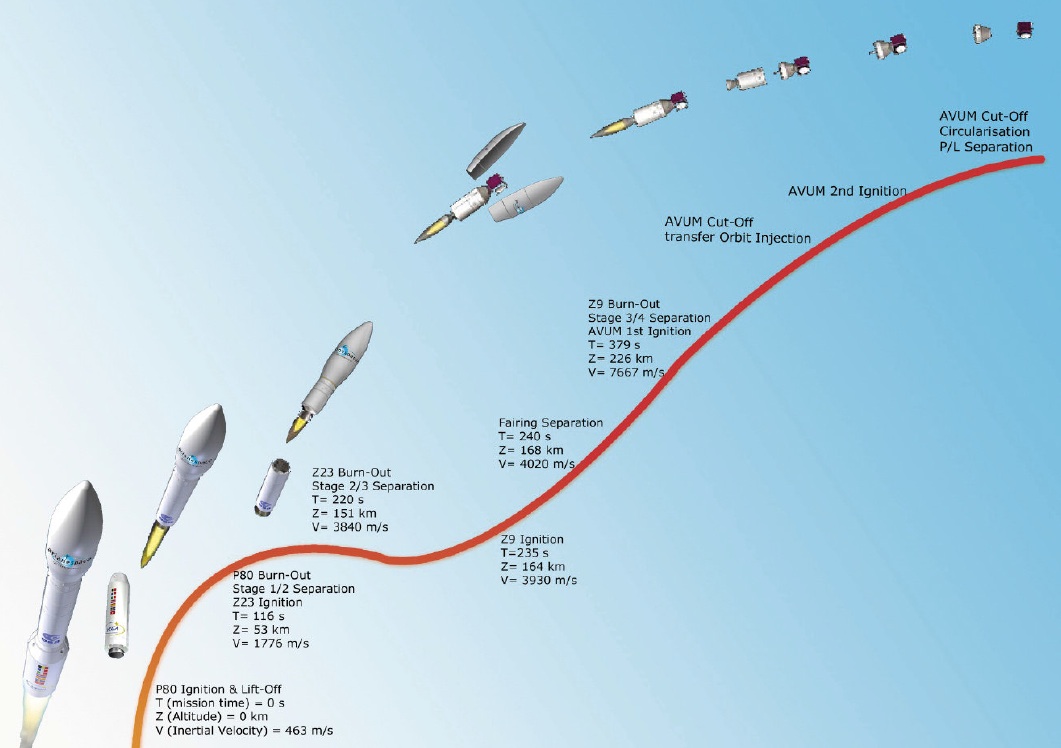
Preparations for the mission started at the ZLV Launch Site at the Guiana Space Center, Kourou, French Guiana, in February when the first stage of the Vega launcher was installed on its launch table inside the Vehicle Integration Facility. The P80 solid-fueled first stage was processed inside the Regulus facilities of the spaceport where it received its 88,400 Kilograms of HTBP bound propellant. Later, it was integrated with its nozzle and pyrotechnic initiators and the electrical harness and thrust vector control system was added. P80 delivers a total thrust of 2,261 Kilonewtons during its 107-second burn.
Once the first stage was in place atop the launch table and checkouts were complete, the 25,800 Kilogram second stage was installed on the vehicle after being processed itself. The second stage features a Zefiro 23 solid rocket motor that provides 1,196 Kilonewtons of thrust when making its 72-second burn.
The second stage was installed in late February to set the stage for the arrival of the third stage which was lifted atop the launcher early in March. The 11,000-Kilogram third stage is also solid-fueled featuring a Zefiro 9 motor that provides 225 Kilonewtons of thrust over the course of a 110-second burn.
A few days later, the fourth stage of the vehicle, called AVUM - Altitude and Vernier Upper Module, was attached to the launch vehicle. AVUM is a 1,000kg bi-propellant upper stage that can perform multiple engine burns using its RD-869 engine that provides 2.45 Kilonewtons of thrust. AVUM also contains the flight control system that sends commands to the lower stages.
With Vega fully integrated and waiting for its payloads, teams began final launch vehicle tests while the payloads were delivered to the Spaceport. Proba-V and VNREDSat-1A were delivered via a Boeing 747 aircraft touching down at the Félix Eboué Airport near the space center. The satellites will undergo final processing before being installed atop the Vega launcher.


Source: http://www.spaceflight101.com/vega-vv02-launch-updates.html
Preparations for the mission started at the ZLV Launch Site at the Guiana Space Center, Kourou, French Guiana, in February when the first stage of the Vega launcher was installed on its launch table inside the Vehicle Integration Facility. The P80 solid-fueled first stage was processed inside the Regulus facilities of the spaceport where it received its 88,400 Kilograms of HTBP bound propellant. Later, it was integrated with its nozzle and pyrotechnic initiators and the electrical harness and thrust vector control system was added. P80 delivers a total thrust of 2,261 Kilonewtons during its 107-second burn.
Once the first stage was in place atop the launch table and checkouts were complete, the 25,800 Kilogram second stage was installed on the vehicle after being processed itself. The second stage features a Zefiro 23 solid rocket motor that provides 1,196 Kilonewtons of thrust when making its 72-second burn.
The second stage was installed in late February to set the stage for the arrival of the third stage which was lifted atop the launcher early in March. The 11,000-Kilogram third stage is also solid-fueled featuring a Zefiro 9 motor that provides 225 Kilonewtons of thrust over the course of a 110-second burn.
A few days later, the fourth stage of the vehicle, called AVUM - Altitude and Vernier Upper Module, was attached to the launch vehicle. AVUM is a 1,000kg bi-propellant upper stage that can perform multiple engine burns using its RD-869 engine that provides 2.45 Kilonewtons of thrust. AVUM also contains the flight control system that sends commands to the lower stages.
With Vega fully integrated and waiting for its payloads, teams began final launch vehicle tests while the payloads were delivered to the Spaceport. Proba-V and VNREDSat-1A were delivered via a Boeing 747 aircraft touching down at the Félix Eboué Airport near the space center. The satellites will undergo final processing before being installed atop the Vega launcher.
Source: http://www.spaceflight101.com/vega-vv02-launch-updates.html


 Launch kit