Updates Artemis II

ok, just one thing I have to say, I was complaining about lack of interior action
but after couple of these tv interviews I have to say... there's nothing more to complain about!
thank you NASA
thank you crew of Artemis II
(y)
 
HFEy5njWsAArPaK

HFEy56IXwAAnG2M
 
@Astro_Christina is fun
I mean they all are but she's one notch up 🤗

and, maybe it's my english, but at first I understood that they had some issue with food warmer?:unsure: then it turns out it was toilet (again)

glad it's all ok now, but definitely something to improve for the next mission. we just got these great deep space toilets, we can let them keep being a nuisance at this rate
 
be careful what you wish for :ROFLMAO:

just kidding, love those guys, and I watch every interview and plan to see them all 🤟
 
Incredible.

Listened to the NASA daily press briefing a bit ago this evening, and Dr. Kelsey Young (lead of the Science Mission Directorate and lunar science lead for AII) embodies all of the enthusiasm for both the scientific objectives and a broader perspective on this mission's historical significance that I could have hoped. Hearing that enthusiasm (and her ability to articulate it) has me ever more hyped for the approach. I am greatly enjoying the clear enthusiasm of the crew themselves describing things as they approach (the features around Tycho, Copernicus, etc.) as well. Really a clearly articulated justification for human exploration, in all - that only human eyes, for instance, can detect subtle topographical differences in three dimensions or slight differences of color or albedo. Looking forward to what we see and learn.

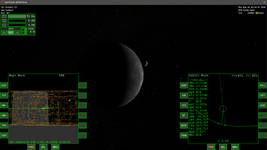
A reporter asked about the interesting UI for the Lunar Targeting Package screenshotted above. Dr. Young indicated that there will be an effort to archive this in some way for public access after the mission. Would be interesting if they could somehow integrate observational video and photographs from the mission, after splashdown, into that UI. Would be a great resource (and hours of fun).

We have a timeline for the approach more broadly, and can reasonably guesstimate based on that, but do we have a timestamp as yet for LOS?

 
We have a timeline for the approach more broadly, and can reasonably guesstimate based on that, but do we have a timestamp as yet for LOS?
If you go back a couple of pages, there is a scenario for Orbiter that can answer that question and more.
 
Here is a rough order of activities, from NASA, all times U.S. ET:

  • Live coverage begins at 1 p.m. on Monday, April 6, and continues through 9:45 p.m.
  • 1:30 p.m.: NASA hosts a conversation between the crew and the science officer in NASA’s Mission Control Center at the agency’s Johnson Space Center in Houston, to go over the objectives and timeline for the flyby.
    • Because the Sun’s angle on the Moon shifts by about one degree every two hours, the crew could not know the exact lighting conditions to expect on the lunar surface until after launch. This briefing provides one final opportunity to review details before the flyby begins.
  • 1:56 p.m.: The Artemis II crew is expected surpass the record previously set by the Apollo 13 crew in 1970 for the farthest humans have ever traveled from Earth.
    • The Apollo 13 crew traveled 248,655 miles from Earth; Artemis II will reach a maximum distance of 252,757 miles from Earth, surpassing the record by about 4,102 miles. The crew is expected to make remarks on the milestone around 2:10 p.m.
  • 2:45 p.m.: The seven-hour lunar observation period begins. Crew will see both the near and far sides of the Moon as the observation period begins.
    • Because room at Orion’s windows is limited, the crew will divide into pairs, with two crew members observing for 55 to 85 minutes, while the other pair exercises or works on other tasks.
  • 6:47 p.m.: Mission control expects to temporarily lose communication with the crew as Orion passes behind the Moon.
  • 7:02 p.m.: Astronauts will make their closest approach to the Moon, the reach its farthest point from Earth at 7:07 p.m.
    • At this distance, the Moon will appear to the astronauts about the size of a basketball held at arm’s length. They also may be the first humans to see some parts of the Moon’s far side with the unaided eye.
  • 7:27 p.m.: NASA’s Mission Control Center should re-acquire communication with the astronauts.
  • 8:35 p.m.: Orion enters period with Moon eclipsing the Sun and continues until 9:32 p.m.
  • 9:20 p.m.: The flyby observation period wraps, and crew will begin transferring some of the imagery to the ground. NASA’s science team will review the images and observations overnight, and then discuss with crew the following day, while the experience is still fresh.
 
Was curious to see what speed they will be doing around the dark side.
Moon is 2159 miles in diameter, they are covering that in 40 mins,
So 2159/40 miles per minute. Times 60 gives 3238 miles per hour, not bad. Probably faster than I will ever go.

Not accurate of course as they are doing an ellipse path some 4000 miles from the surface of the moon.
I'd need a bigger abacus for that.

Sorry about the Imperial units, old habits die hard...
 
Was curious to see what speed they will be doing around the dark side.
~1380 m/s:
ArtemisII.png

Updated from Horizons System trajectory:
Code:
BEGIN_URLDESC
CurrentState
END_URLDESC

BEGIN_ENVIRONMENT
  System Sol
  Date MJD 61136.458333
END_ENVIRONMENT

BEGIN_FOCUS
  Ship Artemis II
END_FOCUS

BEGIN_SHIPS
Artemis II:DeltaGlider
  STATUS Orbiting Earth
  RPOS -1.234639192836895E+08 -3.432658577515095E+07 -3.722144521530022E+08
  RVEL -7.748068663616708E+01 -4.928992009279007E+01 -5.416964091479981E+02
  PRPLEVEL 0:1.000000 1:1.000000
END
END_SHIPS
 
HFOwsL1WwAAzach

HFNELk_XQAAGS8G


NASA live streams, one with commentary and the other with just the view of the Moon:
Main broadcast:


Live views:
As bandwidth allows, this stream will feature live views from Artemis II's Orion spacecraft, without commentary, as it makes its journey around the Moon. This stream will begin as Artemis II begins its ascent into space and will conclude shortly before Orion splashes down into the Pacific Ocean.Viewers will see a blue screen if there is a loss of signal, or if the bandwidth is needed for mission activities. Viewers may see what appears to be a black screen when the vehicle is in darkness.
Everyday Astronaut live stream
 
The crew of Artemis II are now further from Earth than any humans before. They just passed a distance of 400,171 kilometers from subearth point. That was the highest altitude reached by the crew of Apollo 13 fiftysix years ago in April 1970.


Back
Top