Cycling / Running - Logs, Stories, & Pictures (any fellow cyclists or runners here?)

You said "passing on your left" without them getting confused and moving to their left and almost killing both of you. I have never been so fortunate.

Wow! There's some real idiots there. I've never had anyone move toward the direction I told them I'm passing...well people on bicycles anyway. I've nearly collided with some peds that way. They are the worst! They use up as much space as possible, often walking in the middle of the :censored:ing road.

I was in the hospital once again this morning. There is one bad news and one good news. The latest radiographs of my collarbone fracture don't yet show any bone callus. But it seems that the two fragments did approach each other and now even have contact. The doctor was quite surprised because of that.

My feeling is that there must be bone callus since I can move my shoulder without any pain while the collarbone moves normally again. The fragments don't move anymore. Not even during night. Yesterday I tried to lift my bike only with my right hand. It worked without any pain.

Anyway, end of the story is that I should wear the bandage for another two weeks. So no biking until December.

I only wonder what my shoulder joint will tell me after 8 weeks of inactivity...

Sorry to hear you have more time off the bike, but glad things at least seem to be improving. Hang in there!
 
Sorry to hear you have more time off the bike, but glad things at least seem to be improving. Hang in there!

I will :)

I met a sportswoman in a bike forum (I found it because they have a rather long thread regarding collarbone fractures :lol:). Although she has a clean fracture of her collarbone and the fragments are in a perfect position, there is also no sign of any bone callus after 5 weeks. And she is ten years younger than I am. So I think it's just a usual radiograph-thing. One has to be rather patient with a collarbone fracture obviously.

I started to do a little sports again by the way. I use a handgrip for my right hand/underarm three times a day @3x30 exercises. Plus I contract my biceps slowly but as strong as I can three times a day @3x30 exercises as well. Works without any pain which I consider a good sign. And I use my hand/underarm a lot now. The next step will be to hold my barbell with my right hand for some minutes. I will start with 4.5Kg. I can already lift/hold it without pain.

I'm also able to do knee bends again which is a good preparation for cycling again.
 
Last edited:

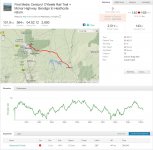
This was a group ride the day before Thanksgiving out of the Champions Bike Barn. Eight of us rode ~112 miles and averaged 21 mph. The route also included somewhere in the area of 2,300-2,900 feet of climbing. Great people and great weather made for an awesome day on the bike!

http://connect.garmin.com/activity/246024635
 
Then, the next day, I took my carbon fiber road bike...OFF road, lol!

 
My turn to work on the front.

[ame="http://www.youtube.com/watch?v=FmnejgCS-KI"]Pulling down FM 1375 (Champions Bike Barn Century) - YouTube[/ame]
 
Nice videos Tex, as always :thumbup:

I wish I had a carbon fiber road bike.
 
Hypothetically, if you had 2K to spend on a bike, would it be better to get a carbon bike with a lower spec groupset, or an alloy bike with a higher spec groupset?

By the way, I rode my first 100 kilometer ride this week, and on my clunky hybrid too:
 

Attachments

  • metric-century.jpg
    metric-century.jpg
    226.7 KB · Views: 9
Last edited:
Hypothetically, if you had 2K to spend on a bike, would it be better to get a carbon bike with a lower spec groupset, or an alloy bike with a higher spec groupset?

THE most important part is the frame. Components are also important, but they can be replaced, the frame can not. If it was me, I would save a little more so you can get the frame you really want, but hopefully with decent components. You don't need the very top level to reach race worthy stuff. My bike came with Sram Apex shifters, chain ring, and rear derailleur. I'm very happy with Sram.

I know it will be hard, but patience is key for bargain bike shopping. Test ride both frame types as well to help you decide. Really ride the bike before you buy, make sure you're happy with it.


By the way, I rode my first 100 kilometer ride this week, and on my clunky hybrid too:

Congrats on your ride, it's a good accomplishment! :thumbup:
 
Thanks for the advice. I'm beginning to feel like I've developed about as much as I can with the bike I've got, and the kind of rides I'm doing. I really need to do more long road rides, and start group riding, but of course this necessitates a decent road bike. Really, even a $900 road bike would feel out of sight compared to what I've got, but I'm willing to entertain the idea of paying above 2K. I'll keep thinking about it, and maybe start doing some test rides soon.

Without having tried anything yet, I can say I like the idea of relaxed geometry bikes like the Specialized Secteur and Roubaix, and the Cannondale Synapse. Those bikes would probably be suited to long rides over the elevation profiles here (compare our respective ratios of elevation gain to number of rides on strava!). It'd be less of a radical posture shift for me too.

Speaking of posture, an Australian cycling show recently interviewed Andy Pruitt, who invented the Specialized fitting method (interesting interview):

http://www.sbs.com.au/cyclingcentral/video/2286229496/bike-fit-with-specialized
 
Anyone have tips for training and warming-up to prevent leg (especially calf and thigh) cramping? I just ran in a half-marathon charity race (in support of UNICEF's effort against children AIDS) on Sunday through rainy weather, and for some reason (perhaps my lack of training for the past weeks due to tight schedule in college, or maybe because I did not sleep well the night before and had to wake up at 3:30 am for the race) I wasn't performing as expected (the non-stop raining didn't help either.... ), and had to pull out at the 13 km mark after having severe cramping on both legs, requiring quite a bit of medical assistance. Damn, my next half-marathon is 90 days away..... :uhh:
 
80mileshigh said:
Thanks for the advice. I'm beginning to feel like I've developed about as much as I can with the bike I've got, and the kind of rides I'm doing. I really need to do more long road rides, and start group riding, but of course this necessitates a decent road bike. Really, even a $900 road bike would feel out of sight compared to what I've got, but I'm willing to entertain the idea of paying above 2K. I'll keep thinking about it, and maybe start doing some test rides soon.

You don't need a road bike for group rides, but it's advisable. There's some crazy dudes in our club that show up on their mountain bikes on occasion. They're hard core...keeping up with us doing 25-30 mph! Crazy guys, LOL!

80mileshigh said:
Without having tried anything yet, I can say I like the idea of relaxed geometry bikes like the Specialized Secteur and Roubaix, and the Cannondale Synapse. Those bikes would probably be suited to long rides over the elevation profiles here (compare our respective ratios of elevation gain to number of rides on strava!). It'd be less of a radical posture shift for me too.

Hmm, I guess it depends on your ultimate goal. Do you intend to race or do you just want to go faster? It really doesn't take long to adjust to the different position of a road bike, unless you have back problems. If you plan to race or take performance seriously on the bike, you will want something that offers you the ability to set it up aggressively. With my current bike, I have it setup fairly aggressive, but I could make it even more aggressive by removing spacers under the stem so I am more flat. On the other hand, I could just as easily flip the stem around so it's angled upward, which would give me a more upright position for comfort. I never do this though. If I want to situp, I just place my hands on the top bar. If I want to get super flat and aggressive, I lay my arms on the top bar (like a time trial position) or just move my hands to the drop bar, which is the most comfortable aggressive position for me.

Anyone have tips for training and warming-up to prevent leg (especially calf and thigh) cramping? I just ran in a half-marathon charity race (in support of UNICEF's effort against children AIDS) on Sunday through rainy weather, and for some reason (perhaps my lack of training for the past weeks due to tight schedule in college, or maybe because I did not sleep well the night before and had to wake up at 3:30 am for the race) I wasn't performing as expected (the non-stop raining didn't help either.... ), and had to pull out at the 13 km mark after having severe cramping on both legs, requiring quite a bit of medical assistance. Damn, my next half-marathon is 90 days away..... :uhh:

Generally cramping is the result of dehydration and/or low electrolytes. Lack of sleep and the weather conditions certainly don't help matters. The last time I ran long distance in the rain, my legs started cramping toward the end from the extra weight of my completely soaked shoes. Don't discount the effect that will have. Lack of training for such conditions will make it worse. The best bet is dehydration though. If you're sweating a lot, you need electrolytes as well, so try drinking a sports drink. If you like only water, then carry a salt pill you can take with the water.

You should be drinking 80 -100 oz of water a day.
 
This one hurt just a touch...

 
Yesterday I took off my bandage for 3 hours to wash it and to see how it feels like. I feel a little more safe without the bandage now. But the situation nevertheless is worse than I expected. Even if I would be allowed to move my arm up to 90°, I could not even do 45°. It's only about 20° sideways and backwards and not even 10° forward.

There will be weeks of rehab required to regain at least a usable flexibility for everyday life. And I think it will take several month until I can ride again.

That's the max possible movements:

1n5vqoeh27g.jpg


2yxe608haqz.jpg


365qdf0py3t.jpg


Game over.

But at least muscle building gives positive results quickly:

469ors82fmk.jpg
 
Last edited:
FADEC said:
There will be weeks of rehab required to regain at least a usable flexibility for everyday life. And I think it will take several month until I can ride again.

Grim news, but I wish you a speedy recovery. At least you'll only be missing cold months.
 
I don't wear the bandage anymore for three days now. I decided to take it off and begin the rehab on my own on tuesday, since I felt that it's time to do so before not only the collarbone but also the joints literally start growing together.

And it seems that it was the right decision. The maximum movements of my arm now is beyond 45° forward, backwards and sideways.

Comparison Tuesday -> Friday:

1n5vqoeh27g.jpg
251r7jpv3is.jpg


365qdf0py3t.jpg
18u7l9pfijw.jpg
 
You couldn't know it, but it's my favourite time of the year :lol:

As far as I am concerned there could be winter 10/12 month.

We had the hottest November night on record last night. A few more like that and I may come around to your way of thinking. :) Good to see you're continuing to recover too.


Today I achieved something I've been aiming for - I completed 1000km on Strava, including 732km this month. This is important to me as I felt if I could achieve this it would evidence enough dedication to justify buying a better bike.

Tex already knows this from my Strava reports, but one big change I've already made is switching to a clipless pedal set-up. I'm using the Shimano R087 shoe and 105 SPD-SL pedal. The difference is quite amazing! The evenness of power, all the way around the pedal stroke, is immediately noticeable. As a corollary, my average cadence has also improved. I would strongly recommend going clipless to anyone wanting to make an affordable improvement to their bike - it will pay big dividends.
 
I don't wear the bandage anymore for three days now. I decided to take it off and begin the rehab on my own on tuesday, since I felt that it's time to do so before not only the collarbone but also the joints literally start growing together.

Good to see your recovery is progressing, although slower than you had hoped I'm sure. I did some reading online about collar bone breaks because one of the guys in our cycing club also took a spill and broke his CB. Doctors avoid surgery if possible because as I understand it can be risky. Everyone is different though in the time it takes for the bone to refuse, so on average one can expect between 6-12 weeks for healing. This would be devistating for me as I would be unable to work. My job is quite physically demanding, especially with my arms. I'm not sure what I would do and it leaves me with some serious considerations before I start racing next year...

Tex already knows this from my Strava reports, but one big change I've already made is switching to a clipless pedal set-up. I'm using the Shimano R087 shoe and 105 SPD-SL pedal. The difference is quite amazing! The evenness of power, all the way around the pedal stroke, is immediately noticeable. As a corollary, my average cadence has also improved. I would strongly recommend going clipless to anyone wanting to make an affordable improvement to their bike - it will pay big dividends.

Indeed I noticed a huge improvement after switching to clipless with my first bike. I rode around with normal pedals and shoes with a strap over the shoe for a long time before going clipless. At first I didn't like the idea of being clipped to the bike (makes me wonder why the hell they call it clipless anyway?), but it doesn't take long at all to get used to them. It really makes you feel one with the bike. You take advantage of the full range of motion throughout the pedal stroke. When you start climbing, you notice the difference especially because you can push and pull at the same time to really attack the climb. Here is a helpful video to demonstrate the effectiveness of the entire pedal stroke:


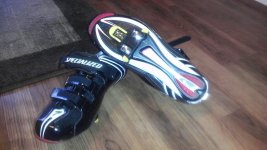
I started out with the Shimano shoes and pedals, but after I began riding hard, it didn't take long before I was getting hot spots on the bottom of my feet. They were basically the cheapest pair of shoes I could get at the time for around $100. I saw other pairs for $300+ and wondered who would ever pay that much for a pair of shoes. Several months later, I was the one in the bike shop buying a pair of $300+ shoes... :lol: What a difference though! It is amazing how much more comfortable the pricy shoes were. I went with the Specialized Pro Road shoe (picture below), which ironically has dropped just below $300 now - go figure. :facepalm:

It's got the FACT carbon sole, very light weight, and most importantly, SUPER comfortable. A comfortable shoe is so important because they're the intimate point of contact between rider and machine. It's where the transfer of power occurs and where rider and bicycle join together as a single system. If it doesn't "feel right", then the performance of the system will suffer. The right shoes are well worth the cost, whatever that may be. For that matter, I have learned the 3 most important things to not go cheap on are; saddle, shorts, and shoes. :)
 

Attachments

  • Specialized Shoes.jpg
    Specialized Shoes.jpg
    153.8 KB · Views: 3
Also, concerning the right ways to crash, the same people who made the video above made this one:


Hopefully none of us have to practice crashing, but I found it helpful nonetheless. There are more informative videos in other areas such as group riding, cornering, climbing, etc. I'll post some below along with a link to their You Tube channel.


http://www.youtube.com/user/CyclingSecrets
 
Back
Top