

- Joined
- Feb 13, 2008
- Messages
- 5,398
- Reaction score
- 8
- Points
- 0
- Location
- Khimki
- Website
- tigerofsiberia.livejournal.com



Launch site:
Baikonur Launch pad no. 200/39 46° 2'23.85"N, 63° 1'54.98"E
Launch date: December 29, 2009
The launch time is:
06:22:00 Baikonur 29.12.2009
03:22:00 Moscow Local 29.12.2009
00:22:00 UTC Dec 29, 2009
7:22:00 p.m. EST Dec 28, 2009
[eventTimer]2009-12-29 00:22:00?before|after;%dd% Days %hh% Hours %mm% Minutes %ss% Seconds %c%[/eventTimer] DirecTV 12 Launch
Payload: DirecTV 12 broadcasting satellite
Target orbit: GTO
Orbital slot: 102.8° W Longitude GEO
Contract Life: 15 years
Coverage: CONUS, Alaska, Hawaii
This will be a final, 32nd Russian and 78th World's orbital launch in the year 2009.
Spacecraft: Direc TV 12
Platform: 702


(Stowed - left; In orbit - right)
Manufacturer: Boeing Satellite Systems

Description and Purpose:
Three Boeing 702 satellites, called DIRECTV 10, DIRECTV 11 and DIRECTV 12, and six Ka-band uplink sites will enable DIRECTV to significantly expand broadcasting to its customers across the continental United States, Hawaii and Alaska. In addition to expanding national HDTV broadcasting, the three DIRECTV satellites will enable DIRECTV to broadcast local HDTV to millions of viewers that represent 91 percent of all U.S. households.
Customer:
Continuing a partnership that began in 1993, DIRECTV has again selected Boeing, the world's leading manufacturer of government and commercial communications satellites to grow its constellation of satellites. The new spacecraft will enable DIRECTV to provide consumers unprecedented local and national High Definition Television (HDTV).
General Characteristics:
The next-generation DIRECTV satellites feature state-of-the-art antenna and payload subsystems that will provide DIRECTV customers with unparalleled national and local HDTV service. The powerful payload integrates 36 active and 8 spare National Service Ka-band Traveling Wave Tube Amplifiers (TWTA) in addition to 54 active and 16 spare spot beam TWTAs. The payload will be powered by a massive solar array that spans more than 48 meters - a length greater than the height of the Statue of Liberty - consisting of ultra triple-junction gallium arsenide solar cells.
DIRECTV 10 and 11 currently receive and transmit programming throughout the United States with two Ka-band reflectors that each measure 2.8 meters in diameter and nine other Ka-band reflectors. After DIRECTV 12 is launched and deployed into operation with DIRECTV 10 and DIRECTV 11, the three satellites will deliver 200 national HD channels and 1,500 local HD channels to millions of U.S. households.
DIRECTV 12 SPECIFICATIONS
PAYLOAD
Ku-band|8 spare TWTAs
National/Hawaii|4 active TWTAs
Ku-band|4 spare TWTAs
Spot|55 active TWTAs
Ka-band|15 spare TWTAs
POWER
Beginning of life|18 kw
End of life|16 kw
Panels|2 wings each w/6 panels of Ultra Triple-Junction (UTJ) gallium arsenide solar cells
Batteries|59 cell NiH, 328 Ahr
PROPULSION
XIPS thrusters|Four 25 cm
DIMENSIONS
|W, antennas: 7.3 m (24 ft)
|L, solar arrays: 48.1 m (158 ft)
Stowed|H: 8 m (26 ft)
|W: 3.7 m x 3.3 m (12 ft x 11 ft)
Mass|
Launch|6,060 kg (13,360 lbs)
In orbit (beginning of life)|3,700 kg (8,157 lbs)
ANTENNAS
Nadir: two Ka-band sub-reflectors
Four 69" transmit reflectors (Ka-band)
One 64" receive reflectors (Ka-band)
Two 20" track reflectors (Ka-band)
Beam footprint information
Can be found here
Launcher: Proton-M with Briz-M upper stage

Rocket Family|Proton
Designation|8K82M
Class|Heavy
Type|Expendable
Designer|Salut Design Bureau
Manufacturer|Khrunichev State Research and Production Space Center
Stages|4
Height, mm|42340
Diameter, mm|7400
Launch Mass, kg|700000
---------- Post added at 00:46 ---------- Previous post was at 00:44 ----------
DirecTV 12 Ascent Profile
The Proton M launch vehicle, utilizing a 5-burn Breeze M mission design, will lift off from Pad 39 at Baikonur Cosmodrome, Kazakhstan, with the DIRECTV 12 satellite on board.
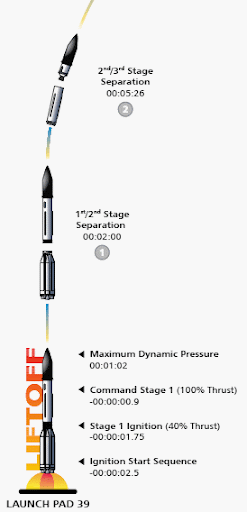
The first three stages of the Proton will use a standard ascent profile to place the Ascent Unit (payload fairing, Breeze M upper stage and the DIRECTV 12 satellite) into a sub-orbital trajectory.
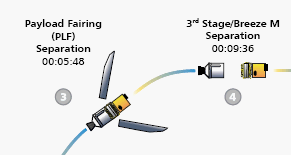
From this point in the mission, the Breeze M will perform planned mission maneuvers to advance the Orbital Unit first to a circular parking orbit, then to an intermediate orbit,
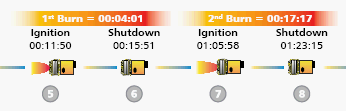
followed by a transfer orbit, and finally to a geo-transfer orbit. Separation of the DIRECTV 12 satellite is scheduled to occur approximately 9 hours, 10 minutes after liftoff.
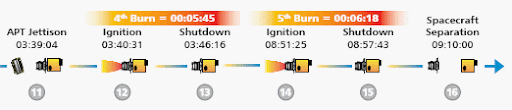
See the events marked up on the charts:
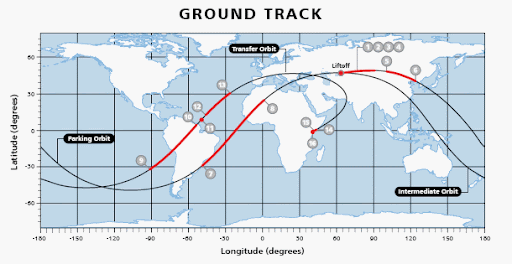
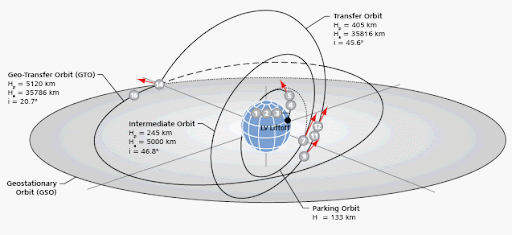
The vehicle's reliability statistics according to http://www.spacelaunchreport.com/reliability2009.txt:
Code:
================================================================
Vehicle     Successes/Tries Realzd Pred  Consc. Last     Dates
                             Rate  Rate* Succes Fail
================================================================
Proton-M/Briz-M  30    33    .91  .89     11    03/14/08 2001-
Weather forecast for Baikonur, Kazakhstan on December 29, 2009

Hi: -3°C
Lo: -9°C
Cloudy (more details are pending)
Sunrise/Sunset and associated twilight times for Baikonur on Tuesday, December 29, 2009
Times are local.
Astronomical twilight begins|07 : 39
Nautical twilight begins|08 : 15
Civil twilight begins|08 : 53
Sunrise|09 : 26
Transit (sun is at its highest)|13 : 48
Sunset|18 : 11
Civil twilight ends|18 : 44
Nautical twilight ends|19 : 22
Astronomical twilight ends|19 : 58
Watching the launch live
ILS broadcasts will begin
at 7 : 00 PM EST US Dec 28th / 12 : 00 AM GMT Dec 29th / 03 : 00 Moscow
- ILS Launch Services, HQ: http://www.ccistream.com/ils122809/300kwm.html
- ILS Launch Services, HQ: http://www.ccistream.com/ils122809/56kwm.html
- Khrunichev COOPI (requires free of charge registration): http://coopi.khrunichev.ru/main.php?id=200
- Space Center Website Video: mms://www.space-center.ru/video
- TSENKI Video Streams: http://www.tv-tsenki.com/livechoose.php
References
http://www.federalspace.ru
http://tvroscosmos.ru
http://www.ilslaunch.com
http://www.khrunichev.ru
http://coopi.khrunichev.ru
http://www.directv.com
http://www.boeing.com
http://www.satbeams.com
http://forum.nasaspaceflight.com
http://www.novosti-kosmonavtiki.ru
http://www.spacelaunchreport.com
http://weatherbug.com
http://www.good-stuff.co.uk/suntimes/sunmap.php


