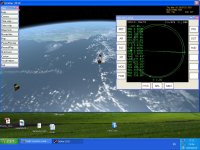
Flight Question Landing the Module on the moon's surface?

I think it's [ame="http://orbithangar.com/searchid.php?ID=5846"]this Spider[/ame] he's talking about, but I think the problem here is the word module- it's too cool to not use, and yet it fails to be descriptive on it's own. Either avoid it in the future, or be prepared to spend a moment providing some context. Come to think of it, context is usually and good thing in general.
 
On the bare bones of Orbiter, I can launch the shuttle with having excessive fuel in the ET. I may not understand APA or PEA or what ever concrete enough to just do anything, but by trial and error, I find Orbiter more interesting that way. I read back on the shuttle topic I made, the S curve came to mind, a little of that was necessary during my flight, not much it was that significant. I went high enough for the roll usually above 13KM, was at 90 degrees tilt.

apa is the highest point of the orbit, which I've only been recently observing with the shuttle launch. So my highest point was 454.4KM I did the OMS 2 burn to increase my height on the other side of the Earth, and did another OMS burn there to lower my height on the dark side a touch. As I passed at 84KM on the day light should I of really done a OMS 1 burn there to lower the altitude on the dark side creating the orbit higher while passing by on the day side.

The speed of the shuttle is almost 7,500 M/S.

I honestly don't like the science fiction crafts. I used the Delta one around Mars a few times, when I tried to land the constellation module on Mars.

The Module was the exception.

As for the Lunar Module Spider, was what I've been trying to land. I have taken off once only to run out of fuel, I was low on the other side of the moon and higher on the day light side. It wasn't bad. Realistically it was an obvious failure.

 
Last edited:
Learning your own way is fine, but when you're looking for help, I doubt the advice you receive will make much sense without understanding of at least the most very basic terminology and principles.

With that in mind the best advice I can give you is to remember that when you point the ship flatly in the go direction on the night side, pushing the "+" key will make you go high and slow on the day side, but pushing the "-" sign will make you go low and fast on the day side.
 
As I passed at 84KM on the day light should I of really done a OMS 1 burn there to lower the altitude on the dark side creating the orbit higher while passing by on the day side.

:huh: What are you talking about?

OMS-1 is a maneuver that STS used to correct the apoapsis of the initial orbit once the main engines were shut down. OMS-2 was the maneuver that put the orbiter in a safe orbit. The lighting conditions of the burns depend only on the local time of the launch.

I may not understand APA or PEA or what ever concrete enough to just do anything, but by trial and error, I find Orbiter more interesting that way.

Then can you explain the point of asking these questions?
 
As much as I know a little, I'm finding it difficult to the land the lunar module.

As for OMS 1 the orbiter passes that or it has done on my last launch, isn't a retrograde burn a necessary at that point? Or am I confusing those two procedures with just an engine burn at the OMS 1 and 2 points.

I'm sure I'm correct, if I wasn't, than the the craft wouldn't of maintained a stable orbit which it has. I launched the custom satellite which i managed to put together in blender 3D.

My problem is getting to grips with the whole world of this. I have read the orbiter manual, and watched some tutorial videos.

From the most frequent posters here, is maths and science quite a passion? I only see a few of you.

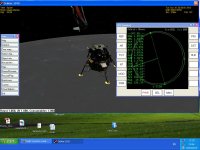
As you can see the Module is horizontal, the engine must fire half way with the engine facing the way it is moving, the moon, that is moving towards the sun well not literally, but you get the idea.

By keeping it at 90 degrees, and with time ahead, move the craft so that the engine is firing towards the surface to keep an altitude.

I had hoped for a video tutorial on this, but nobody has done such.
 

Attachments

  • STS.JPG
    STS.JPG
    120.4 KB · Views: 7
  • module.JPG
    module.JPG
    111 KB · Views: 9
Last edited:
Even if you like realistic space craft, as you do not have much experience, you should try with the unrealistic craft first. I think most people on OF did.

There is only the decommissioned orbiter, a soyuz, or the dated Module for landing. Or the WIP MPCV. There is that dreamchaser, but that doesn't interest me.

There is nothing for Mars, blah blah.

I was thinking to myself, the only way to appreciate space travel or more orbital travel with the exception of the moon going to there and back, which I haven't a clue on how to do, is to try and keep the craft usage realistic. So landing is my objective, taking off if I can succeed is another objective. I did once from Brighton with that rust bucket, but certainly would need a rescue, I did enjoy looking at the stars and Mercury, venus while orbiting the moon.:thumbup:

I tried reading the book I have, which goes into science and maths, and concepts for space probe flight to another star system, which is so hard for reading!!
 
As you can see the Module is horizontal, the engine must fire half way with the engine facing the way it is moving, the moon, that is moving towards the sun well not literally, but you get the idea.

By keeping it at 90 degrees, and with time ahead, move the craft so that the engine is firing towards the surface to keep an altitude.

You need to slow down facing the engine ONLY in the direction of travel BEFORE you point the engine towards the surface even a little bit, otherwise you are trying to land at orbital speed!! :facepalm: If you go back to the first few posts, you will see that you need to start slowing down hundreds of kilometers before you get the the crash site landing site. :lol:
 
You are correct, travelling at a velocity of 500KM isn't going to work, but the fuel is only 8.00, so the engine must be half powered on otherwise the speed builds up.

But to some extent it is a balancing act, of having to slow down to 1 or 2KM while maintaining a suitable altitude.
 
Which is why you need to watch LOLA and see what the program does to bring you down. Yes you are correct in saying it is a balancing act. But you want to accomplish something manually that not even the astronauts did. They flew the program. Armstrong took over manually after they were (more or less) nearly in a hover and saw that they were going to land in a bad place (thing Bad with a capital B).

Watch and learn from LOLA, then apply that to manual flight.

edit - I think all the other Mission Commanders landed manually also, just not to be outdone by Neil?
 
The default measurement for velocity in Orbiter is meters/second.
 
You are correct, travelling at a velocity of 500KM isn't going to work, but the fuel is only 8.00, so the engine must be half powered on otherwise the speed builds up.

But to some extent it is a balancing act, of having to slow down to 1 or 2KM while maintaining a suitable altitude.

No, the engine must not be only half powered otherwise speed builds up.

The engine must be full powered and pointed in the correct direction to slow down from orbital speed: "RETROGRADE" and speed will not build up, the spacecraft will slow down from orbital speed allowing you to accomplish a hover landing. 8.00 fuel is MORE than enough to slow down and land. If you mean altitude dropping speed is building up, then you only need to manage that by angling down not halfway, but probably one or two degrees AT MOST. Until you are going quite slow, then point the engine at the ground and power it down for descending.

However, if you use the built-in retrograde autopilot with a hovering lander, it will point the engine at the surface, so you have to point the engine retrograde manually, most easily accomplished by facing your cockpit reticule at +-90 on the surface HUD while making sure the engine is pointing exactly in the direction of travel, otherwise you will change your course and miss the base laterally:cheers:
 
who knows :shrug:

but if its not zero he's probably not hovering in place above a fixed landing site.
 
I'm going to try this Module landing business again, perhaps a few screens may help to get what I mean.

If I keep failing with no ounce of progress, perhaps I'll try this auto pilot addon that Phantom has mentioned.

As for Vel, it states 600KM in total it is more than one thousand on the orbit prior to having the engine on half way, so as I have read it should be full throttle.
 
full throttle AND pointing directly in the retrograde direction. Just remember that the hover engine is on the bottom of the spacecraft, under your feet, not the in the "back" like it would be in the space shuttle.
 
Retrograde would be going opposite the way the moon is moving or well the object above the moon is moving. It that isn't then I must be doing it right, as state below.

An update, I was at 1,000 something altitude, and velocity was 73K, the program froze. And it isn't the first time this happened, when the module crashed and went spinning, the program always froze. That annoyed me!
 
Back
Top