Vector Calculus with respect to AI

littleplatonian

New member
Joined
Dec 4, 2011
Messages
32
Reaction score
0
Points
0
Location
Sacramento
I am not that sophisticated mathematically but I still try to push the limits of my understanding as a mental exercise. Artificial intelligence intrigues me through my exposure to it through popular science fiction. My exposure to the vector as a direction and magnitude stems directly from my exposure to trigonometry. The idea of a 'thought' vector occurred to me recently. A vector consisting of a direction of logic and a numerical magnitude of emotion. Attempts have been made in the past to assign numerical values to emotional states such as the PAD emotional state model. I'm curious if this notion has any mathematical value and if it can be applied to computer science for game theory or development of artificial intelligence.

Thanks for looking.
 
I'm curious if this notion has any mathematical value and if it can be applied to computer science for game theory or development of artificial intelligence.

No. The thing to remember when working on what you consider to be an AI is to remove all anthropomorphism. If you change the name of a variable from "hapiness" to "*3008EF00", is it still meaningful to the program?

If you want to learn about AI, I propose reading into Bayes networks, probabilistic inference, neural nets, machine learning, etc...
 
Last edited:
If you change the name of a variable from "hapiness" to "*3008EF00", is it still meaningful to the program?

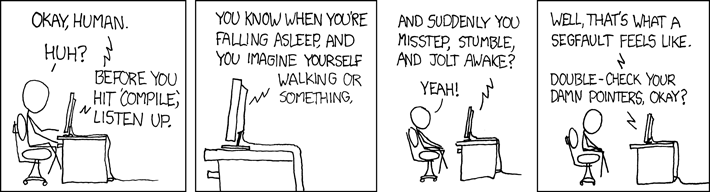
compiler_complaint.png


Couldn't help it... One of my favourite XKCD strips ever!

If you want to learn about AI, I propose reading into Bayes networks, probabilistic inference, neural nets, machine learning, etc...

"The emperors new mind" by Penrose is also a good read on the topic, especially for laymen.
 
Last edited:
Prior work on 'thought vectors' with respect to computer science.

I googled the term 'thought vector' and only found one relevant source of information pertaining to the matter and computer science. If I'm interpreting it correctly the equations found within utilize linear algebra and vector calculus to interpret behavior and for computer systems to act creatively via computer modeling of human thought processes.

Any future comments would be greatly appreciated. I will explore the ones offered so far to their fullest. Thanks.
 

Attachments

A thought vector is an interesting concept, but I think in the end it's just another way to implement a fuzzy-logic AI system.

Vectors would represent truth values, as 0-1 floats would in a 'standard' fuzzy logig AI model, and the algorithm would then change code paths (i.e., make decisions) whenever a set of values (or vectors) tripped a threshold.

It might be interesting as an experiment. You can potentially model a 'sphere' of soft states using thought vectors, or at least a 'circle' of states with 2D thought vectors.

Or, you can have, say, 6 main 'states', one for each cardinal direction, and lerp across to any neighboring state. If the state-sphere is well designed (which I presume would be a real challenge), you could have a very flexible and interesting way to model fuzzy AI.

You can, for instance, model 'polar opposite' states quite literally by placing them opposite one another (like angry-charge/panic-flee), and have other, less immediate opposites placed perpendicular to one another, and use dot products to get half-states from it.

You see, none of this would be impossible to model using other, more conventional techniques, like 0-1 truth values, but it is a pretty interesting way to do it.

Cheers
 
Last edited:
Emulating neurobiology mathematically...

Consider utilizing what we know about group theory with respect to 'thought vectors' when designing specific data structures to emulate specific structures in mammalian brains (chimps and other primates.) Primate brain structures 'compete' to arrive at a complex decision. Could this be yet another application of a Nash equilibrium in computer science between competing data structures in a system more complex than IBM's Watson? Such an approach might result in introducing a kind of psychology to the machine. "If droids could think..."
http://en.wikipedia.org/wiki/Watson_(computer)
 
Back
Top