

-
ORBITER-FORUM will be temporarily closed at 2026-07-23 18:00 UTC while we complete some OF maintenance tasks. The amount of downtime is expected to take up to one hour, but probably less.
You are using an out of date browser. It may not display this or other websites correctly.
You should upgrade or use an alternative browser.
You should upgrade or use an alternative browser.
Internet Video Thread
- Thread starter Tex
- Start date


Piorun
Well-known member
The most numerous armed forces within the EU, and the third in NATO, have today their celebration - the Polish Armed Forces Day  , on the occasion of which the traditional annual land and air defilade was held.
The defilade commemorates the victorious Battle of Warsaw, that took place on August 14-15, 1920, between the Armed Forces of the reborn Second Republic of Poland and the Russian bolshevik invaders on the outskirts of the capital city of Warsaw. The battle turned out to be a turning point of not only the 1919-1921 Polish-Soviet War, but also of European history: the defeat suffered by the Soviet Russia forced the invaders from the East to panically retreat, and prompted the Russian communist dictator Lenin to abandon his vile plans of all-European communist revolution. The Russian totalitarians Lenin, Stalin and Trotsky had intended to direct their barbaric, revolutionary Red Army toward Germany, Austria, Czechoslovakia, Hungary, Italy, Hungary, and many other European countries, that still were painfully remembering the recently finished First World War, in order to come with military help for local revolutionary communist parties.
Thereby, after the repulsion of Batu Khan’s (Genghis Khan’s grandson’s) Mongols in the battle of Legnica in 1241, and after the defeat of the Ottoman Empire in the battle of Vienna in 1683, the Polish Soldier saved Europe from foreign barbarians for one more time. The defilade is de facto Poland’s ideological counterweight to the Putinist Russia’s faked 9th May Day, when the Putinist Russia, leaving aside in silence the Lend-Lease program, celebrates its soviet predecessor’s posed victory over the Soviet Union’s former (1939-1941) ally, thanks to which the totalitarian USSR could enslave half of Europe behind the Iron Curtain for nearly half of century.
Preparations and rehearsals for the parade, including at night, are carefully covered every year in the Polish media many days prior to the defilade. In the today’s defilade we could see, inter alia, the Leopard 2PLM1, K2 Black Panther and M1A1 FEP Abrams tanks, the Krab and K9A1 Thunder howitzers, and the WR-40 Langusta rocket artillery launchers, the Poprad and Pilica anti-aircraft guns, the powerful HIMARS-es (in Poland known also as the Homar-A) and Chunmoo (in Poland known also as the Homar-K), the Gladius self-propelled drone launchers and the Waran multirole vehicles. We could also see the combat-proof Rosomak IFVs and Rak self-propelled mortars. The prototypes of upcoming vehicles being currently developed by the Polish military industry - the Baobab-K, Borsuk and Kleszcz - were also present. And many, many more.
The ground vehicles were accompanied from the air by the F-16 fighters and the PZL-130 Orlik trainers of the Polish Air Force, as well as by the Mi-24 and Blackhawk helicopters. The Czech Mi-17 and the U.S. Army’s Apache helicopters, and the USAF’s F-35 fighters were present too - the latter ones remember us the participation of the American volunteer aerial corps
  during the War over one hundred years ago. However, the aerial component of the defilade had been more numerous and varied one year ago.
In the defilade also honorable representatives of Poland’s friends from the Polish-Soviet War — the Great Britain , the United States , and Romania
  — participated actively as guests both during the infantry part and during the vehicle part, and of whose presence we are very honored. Happy victory day to everyone!
, on the occasion of which the traditional annual land and air defilade was held.The defilade commemorates the victorious Battle of Warsaw, that took place on August 14-15, 1920, between the Armed Forces of the reborn Second Republic of Poland and the Russian bolshevik invaders on the outskirts of the capital city of Warsaw. The battle turned out to be a turning point of not only the 1919-1921 Polish-Soviet War, but also of European history: the defeat suffered by the Soviet Russia forced the invaders from the East to panically retreat, and prompted the Russian communist dictator Lenin to abandon his vile plans of all-European communist revolution. The Russian totalitarians Lenin, Stalin and Trotsky had intended to direct their barbaric, revolutionary Red Army toward Germany, Austria, Czechoslovakia, Hungary, Italy, Hungary, and many other European countries, that still were painfully remembering the recently finished First World War, in order to come with military help for local revolutionary communist parties.
Thereby, after the repulsion of Batu Khan’s (Genghis Khan’s grandson’s) Mongols in the battle of Legnica in 1241, and after the defeat of the Ottoman Empire in the battle of Vienna in 1683, the Polish Soldier saved Europe from foreign barbarians for one more time. The defilade is de facto Poland’s ideological counterweight to the Putinist Russia’s faked 9th May Day, when the Putinist Russia, leaving aside in silence the Lend-Lease program, celebrates its soviet predecessor’s posed victory over the Soviet Union’s former (1939-1941) ally, thanks to which the totalitarian USSR could enslave half of Europe behind the Iron Curtain for nearly half of century.
Preparations and rehearsals for the parade, including at night, are carefully covered every year in the Polish media many days prior to the defilade. In the today’s defilade we could see, inter alia, the Leopard 2PLM1, K2 Black Panther and M1A1 FEP Abrams tanks, the Krab and K9A1 Thunder howitzers, and the WR-40 Langusta rocket artillery launchers, the Poprad and Pilica anti-aircraft guns, the powerful HIMARS-es (in Poland known also as the Homar-A) and Chunmoo (in Poland known also as the Homar-K), the Gladius self-propelled drone launchers and the Waran multirole vehicles. We could also see the combat-proof Rosomak IFVs and Rak self-propelled mortars. The prototypes of upcoming vehicles being currently developed by the Polish military industry - the Baobab-K, Borsuk and Kleszcz - were also present. And many, many more.
The ground vehicles were accompanied from the air by the F-16 fighters and the PZL-130 Orlik trainers of the Polish Air Force, as well as by the Mi-24 and Blackhawk helicopters. The Czech
Mi-17 and the U.S. Army’s Apache helicopters, and the USAF’s F-35 fighters were present too - the latter ones remember us the participation of the American volunteer aerial corps during the War over one hundred years ago. However, the aerial component of the defilade had been more numerous and varied one year ago.In the defilade also honorable representatives of Poland’s friends from the Polish-Soviet War — the Great Britain
, the United States , and Romania — participated actively as guests both during the infantry part and during the vehicle part, and of whose presence we are very honored. Happy victory day to everyone!
Video released of the wreckage of the OceanGate sub that imploded last year:
TheShuttleExperience
Well-known member
TheShuttleExperience
Well-known member
So, not really "completely" destroyed (disappeared to dust) unlike some dramatic animations showed.Video released of the wreckage of the OceanGate sub that imploded last year:

- Joined
- Feb 6, 2008
- Messages
- 38,938
- Reaction score
- 3,937
- Points
- 203
- Location
- Wolfsburg
- Preferred Pronouns
- Sire
So, not really "completely" destroyed (disappeared to dust) unlike some dramatic animations showed.
That would have been a very dubious interpretation anyway, the scientific expectation would have been many shards of carbon fiber and resin breaking of the individual layers of the cylinder and larger debris being produced when the metal parts are rammed through the weakened carbon fiber.
But the expectation, that the collapse began at the center of the cylinder seems to be wrong, the collapse started closer to the front and the origin is possibly the contact surface to the front titanium cap.
The production process was so "unconventional", its impossible to tell how contaminated contact surfaces are or how many air bubbles were inside the carbon-fiber cylinder. A part that was cutoff from the cylinder during manufacturing, was actually so bad, that light shines through it. Looks like the resin was distributed very uneven towards the ends.
It was discussed at the hearing that the compression of the cylinder caused a bending stress at the glue interface of the cylinder to the end cap. After several dives the glue joint separated enough that the cylinder end was only supported by a metal registration on the end cap. That sheared off instantaneously, allowing the cylinder to collapse.That would have been a very dubious interpretation anyway, the scientific expectation would have been many shards of carbon fiber and resin breaking of the individual layers of the cylinder and larger debris being produced when the metal parts are rammed through the weakened carbon fiber.
But the expectation, that the collapse began at the center of the cylinder seems to be wrong, the collapse started closer to the front and the origin is possibly the contact surface to the front titanium cap.
The production process was so "unconventional", its impossible to tell how contaminated contact surfaces are or how many air bubbles were inside the carbon-fiber cylinder. A part that was cutoff from the cylinder during manufacturing, was actually so bad, that light shines through it. Looks like the resin was distributed very uneven towards the ends.
- Joined
- Feb 6, 2008
- Messages
- 38,938
- Reaction score
- 3,937
- Points
- 203
- Location
- Wolfsburg
- Preferred Pronouns
- Sire
It was discussed at the hearing that the compression of the cylinder caused a bending stress at the glue interface of the cylinder to the end cap. After several dives the glue joint separated enough that the cylinder end was only supported by a metal registration on the end cap. That sheared off instantaneously, allowing the cylinder to collapse.
Let me guess: That glue joint wasn't properly monitored for damages between the dives.
Inspections cost money, so no.Let me guess: That glue joint wasn't properly monitored for damages between the dives.
It was rumored that the damage detection system indicated failure was occurring and that descent weights were dropped, but I don't know if that was confirmed in these hearings. I rather hope they never knew the crush was imminent.
TheShuttleExperience
Well-known member
Yeah. Luckily it was a very sudden death, even without visible remains. No chance to notice/realize anything. You are just gone in the next second. That was the only good news here. No pain, except for the bereaved.I rather hope they never knew the crush was imminent.
I'm not an engineer. I would take a trip with Dragon/Soyuz to visit the ISS by blind trust. But there is no chance you would get me into a tube which is made of composite materials, to dive nearly 4 km into the Oceans. That already sounds like a very strange idea without doing any math/material science. No way.
- Joined
- Feb 6, 2008
- Messages
- 38,938
- Reaction score
- 3,937
- Points
- 203
- Location
- Wolfsburg
- Preferred Pronouns
- Sire
Inspections cost money, so no.
It was rumored that the damage detection system indicated failure was occurring and that descent weights were dropped, but I don't know if that was confirmed in these hearings. I rather hope they never knew the crush was imminent.
The last call to the ship was, that only two weights were dropped, that sounds rather like they were slowing their descent.
TheShuttleExperience
Well-known member
The center of the cylinder didn't collapse first, but its distortion under the pressure load is what caused the combined tensile/shear failure of the glue joint. The carbon fibers would not support much compressive load before buckling. Essentially the only part of the composite that could support compression was the plastic resin binder which distorts easily.But the expectation, that the collapse began at the center of the cylinder seems to be wrong, the collapse started closer to the front and the origin is possibly the contact surface to the front titanium cap.
The diameter of the cylinder was the same as that of the two caps on the ends, but the diameter of the cylinder in the middle was smaller due to the pressure forces.
Several simulations show the failure of the glue joints, causing the cylinder to collapse violently and allowing the two end caps to be pushed together. The window was probably blown out when the pressure equalized and the explosive inrush of water caused a waterhammer. The rear end cap was blown some distance away by that same effect.
- Joined
- Feb 6, 2008
- Messages
- 38,938
- Reaction score
- 3,937
- Points
- 203
- Location
- Wolfsburg
- Preferred Pronouns
- Sire
The window was probably blown out when the pressure equalized and the explosive inrush of water caused a waterhammer. The rear end cap was blown some distance away by that same effect.
I wonder if it was already recovered. It may be hard to see, but should be easy to find with sonar. Especially since the Titan wreck site is far enough away from the Titanic debris field.

Arvil
Well-known member
- Joined
- Apr 20, 2008
- Messages
- 520
- Reaction score
- 457
- Points
- 78
- Location
- Pennsylvania, USA
- Preferred Pronouns
- he/him
The only good pressure vessel for this type of work is a sphere, and probably not carbon fiber, its best strength is in tension, not compression.
They recovered much of this vessel last summer, but, I don’t know if they got all the important stuff.
They recovered much of this vessel last summer, but, I don’t know if they got all the important stuff.
- Joined
- Feb 6, 2008
- Messages
- 38,938
- Reaction score
- 3,937
- Points
- 203
- Location
- Wolfsburg
- Preferred Pronouns
- Sire
The only good pressure vessel for this type of work is a sphere, and probably not carbon fiber, its best strength is in tension, not compression.
They recovered much of this vessel last summer, but, I don’t know if they got all the important stuff.
Yes, but Scott Manley mentioned a US submersible, that actually had a carbon fiber hull and really worked from the 1970s, but I can't find information about it.
BUT: There are some leads to the research project:
And...
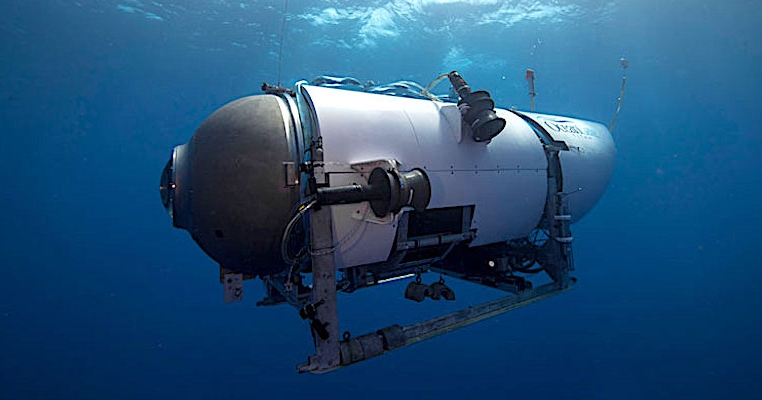
Carbon Fiber Is Safe for Submersibles When Properly Applied
Composite Energy Technologies has built dozens of carbon fiber deep-sea pressure vessels without failure.
Hemispherical bulkheads are actually one of the better applications for submarine composites as the fibers are largely in tension countering pop-through buckling, depending on how the base is supported. In spherical and cylindrical composite vessels under external pressure the fibers tend to see compressive loads, which eliminates the advantages of the reinforcing fibers and causes them to buckle and delaminate. The Titan might have been better off with composite end domes and a titanium cylindrical hull, though the window in one dome would complicate the loading.The only good pressure vessel for this type of work is a sphere, and probably not carbon fiber, its best strength is in tension, not compression.
They recovered much of this vessel last summer, but, I don’t know if they got all the important stuff.
Last edited:

MaxBuzz
Well-known member
The successor to the "Mir" bathyscaphe, the "Vityaz-D" unmanned deep-sea vehicle, is made of plastic  (of spheroplastics)
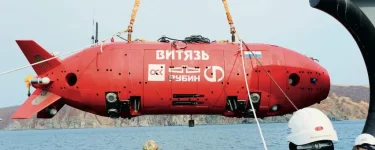
(of spheroplastics)
Graham2001
Well-known member
- Joined
- Mar 20, 2008
- Messages
- 1,601
- Reaction score
- 139
- Points
- 63
Procedural Generation (aka 'AI'.) strikes again...
Similar threads

- Replies
- 21
- Views
- 19K


- Replies
- 1
- Views
- 9K


- Replies
- 2
- Views
- 4K

- Replies
- 37
- Views
- 13K