Delta-V for "direct descent" to the lunar surface?

RGClark

Mathematician
Joined
Jan 27, 2010
Messages
1,635
Reaction score
1
Points
36
Location
Philadelphia
Website
exoscientist.blogspot.com
I was trying to get a lower roundtrip delta-V for lunar missions by flying directly to the lunar surface rather than going first into lunar orbit then descending, the "direct descent" mode. Here's a list of delta-V's of the Earth/Moon system:

Delta-V budget.
Earth–Moon space.
2ef1b28.jpg

http://en.wikipedia.org/wiki/Delta-v_budget#Earth.E2.80.93Moon_space

If you add up the delta-V's from LEO to LLO, 4,040 m/s, then to the lunar surface, 1,870 m/s, then back to LEO, 2,740 m/s, you get 8,650 m/s, with aerobraking on the return.
I wanted to reduce the 4,040 m/s + 1,870 m/s = 5,910 m/s for the trip to the Moon. The idea was to do a trans lunar injection at 3,150 m/s towards the Moon then cancel out the speed the vehicle picks up by the Moons gravity. This would be the escape velocity for the Moon at 2,400 m/s. Then the total would be 5,550 m/s. This is a saving of 360 m/s. This brings the roundtrip delta-V down to 8,290 m/s.
I had a question though if the relative velocity of the Moon around the Earth might add to this amount. But the book The Rocket Company, a fictional account of the private development of a reusable launch vehicle written by actual rocket engineers, gives the same amount for the "direct descent" delta-V to the Moon 18,200 feet/sec, 5,550 m/s:

The Rocket Company.
http://books.google.com/books?id=ku...epage&q="direct descent" Moon delta-V&f=false

Another approach would be to find the Hohmann transfer burn to take it from LEO to the distance of the Moon's orbit but don't add on the burn to circularize the orbit. Then add on the value of the Moon's escape velocity. I'm looking at that now.

Here's another clue. This NASA report from 1970 gives the delta-V for direct descent but it gives it dependent on the specific orbital energy, called the vis viva energy, of the craft when it begins the descent burn:

SITE ACCESSIBILITY AND CHARACTERISTIC VELOCITY
REQUIREMENTS FOR DIRECT-DESCENT LUNAR LANDINGS.
http://ntrs.nasa.gov/archive/nasa/casi.ntrs.nasa.gov/19700023906_1970023906.pdf

The problem is I couldn't connect the specific orbital energy it was citing to a delta-V you would apply at LEO to get to that point. How do you get that?

Bob Clark
 
C3? It is a standard measure of transfer orbits. It is in all launch vehicle user manuals. Do you know the vis-viva integral?

[math] C_3=\frac{\mu}{-a}[/math] (typing a latex formula on Android screen keyboard is a challenge)

PS:Remember that the eccentricity and inclination of the moons orbit means changing DV requirements
 
Last edited:
I wanted to reduce the 4,040 m/s + 1,870 m/s = 5,910 m/s for the trip to the Moon. The idea was to do a trans lunar injection at 3,150 m/s towards the Moon then cancel out the speed the vehicle picks up by the Moons gravity. This would be the escape velocity for the Moon at 2,400 m/s. Then the total would be 5,550 m/s. This is a saving of 360 m/s. This brings the roundtrip delta-V down to 8,290 m/s.

I think that you are not taking into account the encounter velocity in that calculation.

Having done quite a few Earth-Moon trips in Orbiter, I know from experience that a direct descent (without orbital insertion) wouldn't save Δv. When you begin the descent burn you are lowering your eccentricity from a hyperbolic trajectory >1 to an elliptical one <1. The most efficient place/time to do that would be the periapsis of the initial orbit. But since that's going to be under the lunar surface, you'll have to begin the burn before reaching periapsis, making the burn inefficient and end up using more Δv.

Interestingly -if you take into account the Δv for reaching Earth orbit- what could save Δv is a direct ascent from Earth, instead of going to LEO first.

In any case I think an Earth-Moon round trip would make a great challenge. I'll try to set up a scenario with a lua script and post it in the tutorials and challenges thread.

:cheers:
 
Last edited:
I think that you are not taking into account the encounter velocity in that calculation.

Having done quite a few Earth-Moon trips in Orbiter, I know from experience that a direct descent (without orbital insertion) wouldn't save Δv. When you begin the descent burn you are lowering your eccentricity from a hyperbolic trajectory >1 to an elliptical one <1. The most efficient place/time to do that would be the periapsis of the initial orbit. But since that's going to be under the lunar surface, you'll have to begin the burn before reaching periapsis...

this is exactly what I was about to point out.

Specific orbital energy in this case is actually your rVel to surface of the body in question. In essance it defines an absolute minimum of dv needed to make a soft landing as no matter what you do you'll have to finish with a rVel of 0 (or close enough that your landing system can absorb the shock) otherwise you're crashing not landing.
 
I think that you are not taking into account the encounter velocity in that calculation.
Having done quite a few Earth-Moon trips in Orbiter, I know from experience that a direct descent (without orbital insertion) wouldn't save Δv. When you begin the descent burn you are lowering your eccentricity from a hyperbolic trajectory >1 to an elliptical one <1. The most efficient place/time to do that would be the periapsis of the initial orbit. But since that's going to be under the lunar surface, you'll have to begin the burn before reaching periapsis, making the burn inefficient and end up using more Δv.

Does the Orbiter simulation allow you to set up the encounter velocity? I'm assuming the simulation is using a patched conic approximation. In this approximation once you get sufficiently close to the Moon, at a distance of some 10's of thousands of km, you assume the Moon's gravity is operating only, called the Moon's radius of the sphere of influence, RSOI.
Then could you arrange the flight trajectory from the Earth so that the tangential velocity component, relative to the Earth, matches the Moon's by the time the spacecraft reaches RSOI?


Bob Clark
 
Then could you arrange the flight trajectory from the Earth so that the tangential velocity component, relative to the Earth, matches the Moon's by the time the spacecraft reaches RSOI?

I don't see how that can be done. The moon has an orbital speed of about 1km/s (relative to Earth). Assuming a transfer orbit of 200km x 320000km (Moon's semi major axis minus the Rsoi), the vessel would have a speed of ~ 200 m/s at apoapsis, giving a difference of 800 m/s (roughly). That would be the encounter velocity (for a coplanar transfer).
 
Last edited:
Does the Orbiter simulation allow you to set up the encounter velocity? I'm assuming the simulation is using a patched conic approximation.

Wrong. Orbiter uses a multi-body solution including solar radiation pressure, non-spherical gravity and exosphere drag. You should really start to use it, not that it is mandatory for posting in Orbiter-Forum, but especially at this point helpful.

And yes, you can have encounter velocity set... simply be on the right Earth-relative trajectory before lunar encounter. All a matter of trajectory design.
 
I don't see how that can be done. The moon has an orbital speed of about 1km/s (relative to Earth). Assuming a transfer orbit of 200km x 320000km (Moon's semi major axis minus the Rsoi), the vessel would have a speed of ~ 200 m/s at apoapsis, giving a difference of 800 m/s (roughly). That would be the encounter velocity (for a coplanar transfer).

The transfer trajectory does not necessarily have to be an ellipse that ends at the Rsoi. It could even be hyperbolic or parabolic as long as aimed to impact the Moon. The spacecraft would have both radial and tangential component to the velocity in that case though.


Bob Clark
 
Do you have an estimate of the delta V you could save by taking the direct ascent approach?


Bob Clark

I only have empirical data from Orbiter. I am not on an Orbiter computer right now but IIRC there was a small save ~20 m/s.

The things that save the most fuel -in my experience- are these:

1. The transfer orbit has to be exactly coplanar to the Moon.
2. Reach the Moon at the Apoapsis of its orbit. Eventhough this requires ~30 m/s more Δv -for the transfer- than reaching the moon at its periapsis, it allows a less expensive (~80 m/s) orbital insertion.

These are numbers out of memory, I'll check them when I get home.
:cheers:
 
20 m/s is on the magnitude of guidance errors, you should do some more simulations to get better results.
 
I don't see how that can be done. The moon has an orbital speed of about 1km/s (relative to Earth). Assuming a transfer orbit of 200km x 320000km (Moon's semi major axis minus the Rsoi), the vessel would have a speed of ~ 200 m/s at apoapsis, giving a difference of 800 m/s (roughly). That would be the encounter velocity (for a coplanar transfer).

Here's a try at it using an elliptical orbit which extends beyond the Moon, but for which the spacecraft will enter the Moon's Rsoi to be captured by the Moon's gravity, instead of passing beyond the Moon's orbit.
First use this formula to calculate how large the semi-major axis has to be, the vis viva equation:

982a639029dacf417be67d9640454e21.png


The small m is the mass of the spacecraft, and capitol M is the mass of the Earth; so M + m is essentially just M. But what's needed here is the standard gravitational parameter G*M. For the Earth, it's 398,600.4418 km3s−2, with the distance measured in units of kilometers. The spacecraft speed is given as v, the radial distance of the spacecraft from the Earth is given as r, and the semi-major axis is a.
For this scenario I want v to be the orbital speed of the Moon, which I'll round off to 1,000 m/s. In units of km, this is 1 km/s. We also said we want r to be about 320,000 km. Then plugging these values into the formula we get: a = 267,000 km.
Now the Earth is well off-set from the center so that the perigee is only 400 km. The apogee is nearly then twice the semi-major axis, which I'll round off to 534,000 km.
If we let e be the eccentricity then the perigee distance is rp = a(1 - e) and the apogee distance is ra = a(1 + e). Since rp is 400 km, and a is 267,000 km, we calculate e to be .998502. A highly eccentric ellipse.
Another factor I need to check though is if direction of the velocity vector for the spacecraft at this point is at least close to the direction of the velocity vector of the Moon when the spacecraft reaches the Rsoi.


Bob Clark
 
Last edited:
So, if I got this correctly, you are going for a transfer orbit that will have a ~1km/s velocity at altitude X, and altitude X will be inside (or at the edge) of the moon's SOI. Correct?
 
Here is a pic of the characteristics of a 400km x 534000km orbit:
(the Moon is in yellow)

Moontransf1_zps4a86ef7c.jpg


LeftMFD distances are measured from the Earth's center.
RightMFD distances are measured from the Earth's surface.

I'll do the simulation and let you know at which altitude the velocity is 1km/s.

But there is no way that the direction of the velocity vector is going to be anything than close to perpendicular to that of the moon.

EDIT: As expected, that kind of transfer orbit ends up with a high velocity Moon encounter.

After transfer burn:
Untitled-2_zpsf863d9f2.jpg


At ALT 320000 km the velocity was 1022m/s. Relative to the Moon the velocity was already 1200m/s at that point.
Untitled-5_zps4fb84611.jpg


1000km above the moon's surface the velocity was already at 2200 m/s
Untitled-6_zps3407d432.jpg


---------- Post added at 11:19 PM ---------- Previous post was at 10:13 PM ----------

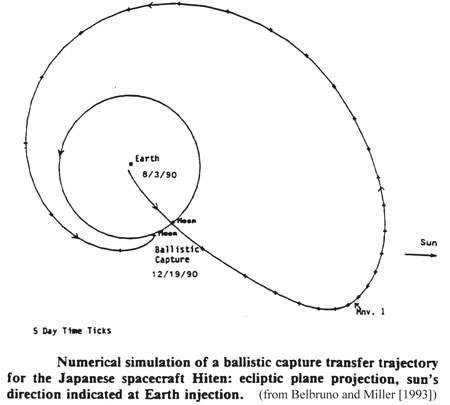
I remembered something about a japanese sattelitte that was on a course to the moon but failed and I found these:

previous_hiten.jpg


http://adsabs.harvard.edu/abs/1993JGCD...16..770B

[ame="http://en.wikipedia.org/wiki/Low_energy_transfer"]Low energy transfer - Wikipedia, the free encyclopedia[/ame]

http://www.marspapers.org/papers/MAR98076.pdf

The last one is for Mars, but it also mentions the Belbruno-Miller transfer, which seems very interesting.

I'll try to find more information and see if this can be simulated in Orbiter. The downside is that it takes 5 months instead of 3 days to get to the Moon, but it saves up to 18% of Δv relative to a Hohmann transfer (according to the abstract of the paper).

I have flown similar missions in Orbiter, using the Moon to get from a polar LEO to a GEO with minimum Δv, so this should be similar to that, just the PeA is going to be much higher.

---------- Post added 09-21-12 at 01:45 AM ---------- Previous post was 09-20-12 at 11:19 PM ----------

The initial setup of the B-M transfer looks very promising. :cool:

BMtransfer_zps2f07318c.jpg


Unfortunately, it's getting too late here to try the flight now. I'll give it a go sometime tomorrow.
 
Last edited:
Thanks for that. What was the impact speed?


Bob Clark

2700 m/s , due to the accelaration from the Moon.

I made a first attempt with the Belbruno-Miller transfer and already, I matched the Δv of a typical Hohmann transfer + lunar capture.

The main idea is that you transfer to the moon and the lunar gravity slings you off to a trajectory with a high apoapsis altitude and a periapsis at the moon's orbital altitude. Timing it correctly results in a low Δv encounter.

I'll do some more testing to see how much Δv this saves.
 
...I remembered something about a japanese sattelitte that was on a course to the moon but failed and I found these:

previous_hiten.jpg


http://adsabs.harvard.edu/abs/1993JGCD...16..770B

Low energy transfer - Wikipedia, the free encyclopedia

http://www.marspapers.org/papers/MAR98076.pdf

The last one is for Mars, but it also mentions the Belbruno-Miller transfer, which seems very interesting.

I'll try to find more information and see if this can be simulated in Orbiter. The downside is that it takes 5 months instead of 3 days to get to the Moon, but it saves up to 18% of Δv relative to a Hohmann transfer (according to the abstract of the paper)...

If their method could just get 4% savings in delta-V while increasing the transit time to say 5 days, that would be useful for manned flights.

Getting back to that case you mentioned with the spacecraft at a 320,000 km distance from Earth and a 800 m/s relative speed to the Moon, using a 2,400 m/s escape velocity for the Moon, estimate the impact speed as sqrt(2400^2 + 800^2) = 2,530 m/s. This is about 230 m/s less than the delta-V for the lunar orbit then landing method.
What do you get for the impact speed using the Orbiter simulation?

Bob Clark

---------- Post added at 10:58 AM ---------- Previous post was at 04:42 AM ----------

Here is a pic of the characteristics of a 400km x 534000km orbit:
(the Moon is in yellow)

Moontransf1_zps4a86ef7c.jpg


After transfer burn:
Untitled-2_zpsf863d9f2.jpg


At ALT 320000 km the velocity was 1022m/s. Relative to the Moon the velocity was already 1200m/s at that point.
Untitled-5_zps4fb84611.jpg


1000km above the moon's surface the velocity was already at 2200 m/s
Untitled-6_zps3407d432.jpg


---------- Post added at 11:19 PM ---------- Previous post was at 10:13 PM ----------


previous_hiten.jpg


---------- Post added 09-21-12 at 01:45 AM ---------- Previous post was 09-20-12 at 11:19 PM ----------


BMtransfer_zps2f07318c.jpg


Very nice graphs. How do you learn this part of Orbiter?

Bob Clark
 
Last edited:
If their method could just get 4% savings in delta-V while increasing the transit time to say 5 days, that would be useful for manned flights.

I don't think it is possible to get the flight time lower than two lunar orbits + Earth-Moon flyby. ~ 60 days.
In the first test flights I've made, I've had success in saving Δv (3800 m/s from a 300km x 300km LEO to a 50km x 50km LLO), but the transit time was +90 days.

It's a complicated transfer and the trajectory is not only affected by the Earth-Moon system but also from the Sun.
So far my Δv savings where ~150 m/s, which is impressive, but nowhere near the 18% (~700 m/s) that I read about in the info I found.

Getting back to that case you mentioned with the spacecraft at a 320,000 km distance from Earth and a 800 m/s relative speed to the Moon, using a 2,400 m/s escape velocity for the Moon, estimate the impact speed as sqrt(2400^2 + 800^2) = 2,530 m/s. This is about 230 m/s less than the delta-V for the lunar orbit then landing method.
What do you get for the impact speed using the Orbiter simulation?

2491 m/s for a best case scenario. Hitting the moon exactly at its apoapsis when it's moving the slowest. But that's not the Δv you need to land.
If my calculation is correct, in order to achieve a 0 m/s velocity at 0 altitude with a rocket that provides a decelaration of 20m/s² you need:

[math]\Delta V = V_{0}^{\frac{a+g}{a}} = 2491^{\frac{20+1.6}{20}} = 2491^{1.08} = 4656.76 m/s[/math]

Vo = impact velocity (2491 m/s)
a = Rocket deceleration (20 m/s²)
g = Lunar gravitational acceleration (1.6 m/s²)

Very nice graphs. How do you learn this part of Orbiter?

The Orbiter Manual and Go Play In Space are the best places to start. Also IMFD and all the tutorials and playbacks you can find on Orbiter Hangar. Then you can move on to TransX.

---------- Post added at 11:28 PM ---------- Previous post was at 07:25 PM ----------

I found were I had first read about the Belbruno-Miller transfer. It was on a Greek magazine about spaceflight back when I was in the army (1998). I traced the original article here.
 
Last edited:
...
2491 m/s for a best case scenario. Hitting the moon exactly at its apoapsis when it's moving the slowest. But that's not the Δv you need to land.
If my calculation is correct, in order to achieve a 0 m/s velocity at 0 altitude with a rocket that provides a decelaration of 20m/s² you need:

[math]\Delta V = V_{0}^{\frac{a+g}{a}} = 2491^{\frac{20+1.6}{20}} = 2491^{1.08} = 4656.76 m/s[/math]

Vo = impact velocity (2491 m/s)
a = Rocket deceleration (20 m/s²)
g = Lunar gravitational acceleration (1.6 m/s²)

...

Thanks for the info and links. I gather for that landing delta-V you are using the equation discussed in the thread Numbers in the appendix of Arthur C. Clarke's 1945 classic paper.
That result seems too high to me though. The delta-v for the ascent or descent to lunar orbit is about 1,870 m/s. This only about a gravity loss of 200 m/s. The gravity loss is given by the gravitational acceleration times the time of the burn. I don't think the burn time would be that much greater for this case compared to the orbital case.


Bob Clark
 
Back
Top