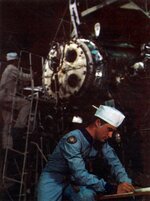
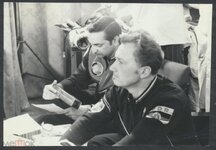
3игмунд Йен знакомится с устройством орбитальной станции 'Салют-6'. Zigmund Yen gets acquainted with the structure of the Salyut-6 orbital station. Zigmund Yen se familiariza con la estructura de la estación orbital Salyut-6.
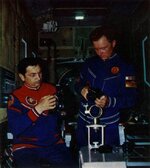
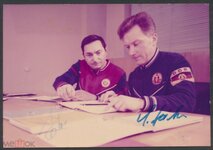
Валерий Быковский и 3игмунд Йен на занятиях фотоделу в Центре Подготовки Космонавтов. Valery Bykovsky and Sigmund Jähn during a photography class at the Cosmonaut Training Center. Valery Bykovsky y Sigmund Jähn durante una clase de fotografía en el Centro de Entrenamiento de Cosmonautas.
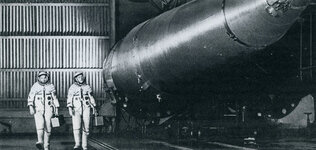
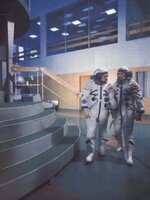
Экипаж космического корабля "Союз-31" в монтажно-испытательном корпусе космодрома Байконур. The crew of the Soyuz-31 spacecraft in the assembly and test facility at the Baikonur Cosmodrome. La tripulación de la nave espacial Soyuz-31 en las instalaciones de ensamblaje y pruebas del cosmódromo de Baikonur.
Валерий Быковский и Зигмунд Йен во время подготовки к полету. Valery Bykovsky and Sigmund Jähn during preparation for the flight. Valery Bykovsky y Sigmund Jähn durante los preparativos para el vuelo.
Валерий Быковский и Зигмунд Йен во время подготовки к полету. На фото автографы космонавтов. Valery Bykovsky and Sigmund Jähn preparing for the flight. The photo shows the cosmonauts' autographs. Valery Bykovsky y Sigmund Jähn preparándose para el vuelo. La foto muestra los autógrafos de los cosmonautas.
Валерий Быковский и Зигмунд Йен во время подготовки к полету. Valery Bykovsky and Sigmund Jähn during preparation for the flight. Valery Bykovsky y Sigmund Jähn durante los preparativos para el vuelo.
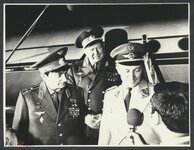
На фото слева направо: Валерий Быковский, Алексей Леонов (первый человек в истории человечества вышедший в открытый космос),Зигмунд Йен. In the photo from left to right: Valery Bykovsky, Alexei Leonov (the first person in human history to walk in outer space), Sigmund Jähn. En la foto, de izquierda a derecha: Valery Bykovsky, Alexei Leonov (la primera persona en la historia de la humanidad en caminar en el espacio exterior) y Sigmund Jähn.
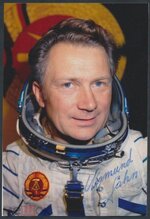
Зигмунд Йен. Первый немец побывавший в космосе. На фотографии автограф Зигмунда Йена. Sigmund Jahn. The first German in space.The photo shows Sigmund Jen's autograph. Sigmund Jahn. El primer alemán en el espacio.La foto muestra el autógrafo de Sigmund Jen.
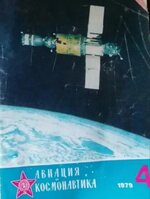
Космические обложки советских журналов. "Авиация и космонавтика", № 4, 1979 год. На обложке: - Пилотируемый орбитальный комплекс "Салют-6" - "Союз-31". Снимок сделан с космического корабля "Союз-29" В.Быковским и З.Йеном. Внизу цветная фотография Земли полученная с пилотируемой станции "Салют-3". Space-themed covers of Soviet magazines. "Aviation and Cosmonautics," No. 4, 1979. On the cover: - The Salyut-6 manned orbital complex - Soyuz-31. Photo taken from the Soyuz-29 spacecraft by V. Bykovsky and Z. Yen. Below is a color photograph of Earth taken from the Salyut-3 manned station. Portadas de revistas soviéticas con temática espacial. «Aviación y Cosmonáutica», n.º 4, 1979. En la portada: - El complejo orbital tripulado Salyut-6 - Soyuz-31. Fotografía tomada desde la nave Soyuz-29 por V. Bykovsky y Z. Yen. Debajo, una fotografía en color de la Tierra tomada desde la estación espacial tripulada Salyut-3.
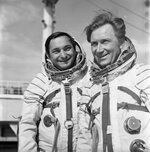
Экипаж космического корабля "Союз-31" - командир летчик-космонавт СССР Валерий Быковский и немецкий космонавт-исследователь Зигмунд Йен - в Центре подготовки космонавтов имени Ю.А. Гагарина. The crew of the Soyuz-31 spacecraft – commander, Soviet cosmonaut Valery Bykovsky and German cosmonaut-researcher Sigmund Jähn – at the Yury Gagarin Cosmonaut Training Center. La tripulación de la nave espacial Soyuz-31 —el comandante, el cosmonauta soviético Valery Bykovsky, y el cosmonauta e investigador alemán Sigmund Jähn— en el Centro de Entrenamiento de Cosmonautas Yuri Gagarin.
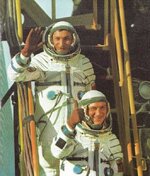
Космонавты В. Ф. Быковский и первый космонавт Германии З. Йен перед полетом. Cosmonauts V. F. Bykovsky and the first German cosmonaut Z. Jähn before the flight. Los cosmonautas V. F. Bykovsky y el primer cosmonauta alemán, Z. Jähn, antes del vuelo.
27 августа. Международный экипаж на станции Рабочий день экипажа "Союза-31" начался в 11 часов. В сеансе связи командир корабля доложил в Центр управления полетом, что все бортовые системы работают нормально и экипаж продолжает работы по программе. Готовился к стыковке и экипаж орбитального комплекса "Салют-6" - "Союз-29".
В 19 часов 37 минут 37 секунд корабль "Союз-31" состыковался с орбитальным комплексом. Открыт переходный люк, и в 22 часа 33 минуты на станцию "вплыл" 3. Йен, за ним - В. Быковский.
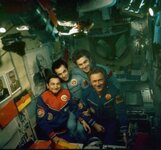
Хлебом-солью и сувенирами - олимпийским медвежонком и русской матрешкой - встретили их В. Коваленок и А. Иванченков. 3. Йен подарил своим товарищам кварцевые часы с надписью: "В память о совместном полете космонавтов СССР и ГДР", а также иллюстрированное сувенирное издание книги о ГДР. Экипаж "Союза-31" передал основному экипажу газеты, письма, посылки от родных и друзей. При встрече экипажи провели первый телевизионный репортаж. И сразу же началась их совместная работа. Космонавты перенесли грузы, доставленные кораблем "Союз-31", в помещение станции "Салют-6", выполнили консервацию бортовых систем "Союза-31".На фото слева направо: rосмонавты З. Йен, В.В. Коваленок, А.С. Иванченков и В.Ф. Быковский на борту орбитального научного комплекса «Салют-6» – «Союз-29» – «Союз-31». Август 1978 г. August 27. International Crew on the Station The working day of the Soyuz-31 crew began at 11:00. During a communication session, the commander of the spacecraft reported to Mission Control that all onboard systems were functioning normally and that the crew was continuing its work according to the flight program. The crew of the Salyut-6 – Soyuz-29 orbital complex was also preparing for the docking.
At 19:37:37, the Soyuz-31 spacecraft docked with the orbital complex. The transfer hatch was opened, and at 22:33 Sigmund Jähn floated into the station, followed by Valery Bykovsky.
Vladimir Kovalyonok and Aleksandr Ivanchenkov welcomed them with bread and salt and presented souvenirs — the Olympic bear mascot and a Russian matryoshka doll. Sigmund Jähn gave his crewmates quartz watches bearing the inscription: “In memory of the joint flight of the cosmonauts of the USSR and the GDR,” as well as an illustrated commemorative edition of a book about the German Democratic Republic. The Soyuz-31 crew delivered newspapers, letters, and parcels from relatives and friends to the station crew.
During the meeting, the crews conducted their first television broadcast. Immediately afterward, they began their joint work. The cosmonauts transferred the cargo delivered by Soyuz-31 into the Salyut-6 station and carried out the conservation procedures for the onboard systems of Soyuz-31.
In the photo, from left to right: cosmonauts Sigmund Jähn, Vladimir V. Kovalyonok, Aleksandr S. Ivanchenkov, and Valery F. Bykovsky aboard the Salyut-6 – Soyuz-29 – Soyuz-31 orbital scientific complex. August 1978. 27 de agosto. Tripulación internacional en la estación La jornada de trabajo de la tripulación de la Soyuz-31 comenzó a las 11:00. Durante una sesión de comunicaciones, el comandante de la nave informó al Centro de Control de Vuelo que todos los sistemas de a bordo funcionaban con normalidad y que la tripulación continuaba trabajando de acuerdo con el programa previsto. La tripulación del complejo orbital Salyut-6 – Soyuz-29 también se preparaba para el acoplamiento.
A las 19:37:37, la nave Soyuz-31 se acopló al complejo orbital. Se abrió la escotilla de transferencia y, a las 22:33, Sigmund Jähn entró flotando en la estación, seguido por Valeri Bykovski.
Vladímir Kovalyonok y Aleksandr Ivanchenkov los recibieron con pan y sal y les entregaron recuerdos: el osito olímpico y una matrioska rusa. Sigmund Jähn obsequió a sus compañeros relojes de cuarzo con la inscripción: «En memoria del vuelo conjunto de los cosmonautas de la URSS y de la RDA», así como una edición ilustrada conmemorativa de un libro sobre la República Democrática Alemana. La tripulación de la Soyuz-31 entregó a la tripulación principal periódicos, cartas y paquetes enviados por familiares y amigos.
Durante el encuentro, las tripulaciones realizaron su primer reportaje televisivo. Inmediatamente después comenzaron su trabajo conjunto. Los cosmonautas trasladaron a la estación Salyut-6 la carga transportada por la Soyuz-31 y llevaron a cabo la conservación de los sistemas de a bordo de la nave. En la fotografía, de izquierda a derecha: los cosmonautas Sigmund Jähn, Vladímir V. Kovalyonok, Aleksandr S. Ivanchenkov y Valeri F. Bykovski a bordo del complejo científico orbital Salyut-6 – Soyuz-29 – Soyuz-31. Agosto de 1978.
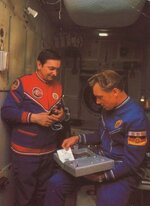
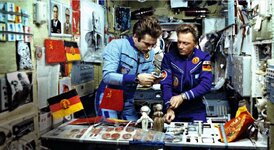
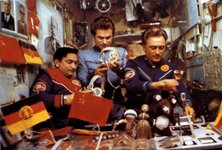
На фото: Виктор Коваленок и Зигмунд Йен рассматривают сувениры доставленные с Земли. In the photo: Viktor Kovalenok and Sigmund Jähn examine souvenirs brought from Earth. En la foto: Viktor Kovalenok y Sigmund Jähn examinan recuerdos traídos de la Tierra.
28 августа. Старт научной программы В первый день работы на орбитальной станции международный экипаж провел комплексное медицинское обследование с помощью аппаратуры "Полином-2М", "Реограф-2" и "Бета-3".
В этот день началось выполнение программы экспериментов совместной разработки. Первый из них-эксперимент в области космического материаловедения "Беролина" (старинное название г. Берлина). Он проводился в режиме гравитационной стабилизации орбитального комплекса. В 15 часов 30 минут космонавты приступили к подготовке эксперимента "Беролина-С1" на установке "Сплав-01". Он был начат в 16 часов 15 минут. Вечером был начат эксперимент и на установке " Кристалл " - " Беролина-К1". Программа этих работ состояла из шести опытов. Четыре из них выполнялись на советской установке "Кристалл", которая была доставлена на станцию автоматическим кораблем "Прогресс-2" и установлена основным экипажем в ее переходном отсеке. Она состоит из электронагревательной камеры, пульта управления и контейнера, в который помещаются ампулы с исследуемыми веществами. Масса установки-27 кг, потребляемая мощность-до 250 Вт.
На установке выполняются эксперименты в области космического материаловедения по направленной и объемной кристаллизации и получению пленочных структур. Максимальная температура в камере-до 1100° С. Здесь обеспечивается стационарный режим нагрева, выдержка и охлаждение, а также передвижение контейнера с ампулой по заданной программе в постоянном тепловом поле. Космонавт вставляет контейнер в камеру, "набирает" на пульте программу, задавая температуру, выдержку, скорость и режим движения контейнера. Управление процессом плавки осуществляется автоматически. Затвердевание расплава соединения происходит непосредственно в ампуле, при этом получается кристалл цилиндрической формы. Длина ампул - 175 мм, а диаметр-13 мм.
В этих четырех опытах производилась плавка и последующее выращивание полупроводниковых кристаллов. Исходными материалами здесь служили соединения свинец-теллур и висмут-сурьма (первое из них используется для изготовления полупроводниковых диодов для лазеров). Получение материалов с более равномерным составом смешиваемых веществ и более совершенной структурой монокристаллов (по сравнению с теми, которые получают в земных условиях), является одной из главных проблем космического материаловедения.
В пятом опыте (он проводился на установке "Сплав-01") выполнялась плавка с последующей кристаллизацией бериллиево-фторидного оптического стекла. Для некоторых оптических приборов требуются стекла, обладающие особыми свойствами. Часто эти свойства могут быть получены лишь при создании стекла со сложным составом, что в земных условиях связано с большими технологическими трудностями. Обычно в условиях гравитации не удается достичь требуемой однородности стекла. Чтобы понять, как влияет невесомость на технологический процесс, в полете производилось плавление и затвердевание стекла со сложным составом.
В шестом опыте, который проводился на установке "Сплав-01", изучались условия кристаллизации материалов выделением их из газовой среды. Здесь ставилась задача изучения физико-химических процессов в газообразном веществе. Исходным материалом в опыте служил германий. Под воздействием высоких температур он превращался в газ и переносился веществом-носителем (йод) в зону низких температур. В специальном контейнере располагались пять ампул с германием и йодом (в каждой- определенное давление газа), который и размещался в установке "Сплав-01". В этом опыте изучался процесс переноса массы в основном за счет диффузии, т. к. конвекция в условиях космического полета, когда на орбитальном комплексе сила тяжести практически отсутствует, очень мала.
Научная подготовка эксперимента "Беролина" в ГДР проведена Институтом электроники Академии наук, Берлинским Университетом имени А. Гумбольдта, Центральным институтом физики твердого тела в г. Дрезден и заводом "Шотт и Ген" предприятия "Карл Цейс Йена" в г. Йена. В постановке эксперимента участвовали специалисты Института космических исследований АН СССР.
В программе полета этого дня были эксперименты в области космической биологии. Они проводились с 16 часов. Один из них получил название "Культура ткани". В этом эксперименте определялись изменения, возникающие на клеточном и тканевом уровнях, и влияние условий космического полета на физиологию и структурную организацию клеток млекопитающих. Эксперимент подготовлен специалистами Института молекулярной биологии АН ГДР и Института медико-биологических проблем Министерства здравоохранения СССР.
В нескольких плоских чашечках из полимера была выращена стерильная культура клеток китайского хомячка. Чашечки были установлены в приборе "Вкладыш-КТ" (создан в ГДР), который имел пять экспериментальных камер. Его масса 0,47 кг. Прибор был "заправлен" в ГДР, после чего в специальном термостате при температуре +4° С доставлен на космодром (в этих условиях культура клеток находится в законсервированном состоянии). После перехода международного экипажа на орбитальную станцию прибор был вставлен в термостат (создан в СССР), находившийся на орбитальной станции, в котором поддерживалась температура +37° С. В течение семи суток клетки инкубировались здесь, а затем прибор перенесен в другой термостат, в котором обеспечивалась температура +4° С. После завершения полета прибор был доставлен на Землю.
Следующий эксперимент - "Рост микроорганизмов"- подготовлен в Институте технической химии АН ГДР и при участии специалистов Института медико-биологических проблем Минздрава СССР с использованием советского прибора "КМ" (культиватор микроорганизмов). Здесь были применены микроорганизмы, которые используют газ метан в качестве питательного вещества.
В этот же день В. Быковский и 3. Йен провели эксперимент "Репортер". И на Земле, и в условиях космического полета необходимо документировать происходящие события и явления, регистрировать деятельность человека, показания приборов, ход и результаты проведения экспериментов.
В качестве одного из средств документирования на орбитальном комплексе "Салют-6" проходила испытания малоформатная полуавтоматическая зеркальная камера "Практика-ЕЕ2", сконструированная Народным предприятием "Пентакон" (г. Дрезден, ГДР). В ней в зависимости от яркости снимаемых объектов, чувствительности пленки и установленной на объективе камеры диафрагмы автоматически определяется время выдержки при съемке. Во второй половине дня был проведен телевизионный репортаж о медико-биологических экспериментах, а затем у объединенного экипажа был совместный ужин, а с 23 часов космонавты отдыхали. August 28. Beginning of the Scientific Program On the first day of work aboard the orbital station, the international crew carried out a comprehensive medical examination using the Polinom-2M, Reograf-2, and Beta-3 instruments.
That day marked the beginning of the jointly developed scientific experiments. The first of these was the space materials science experiment "Berolina" (an old name for the city of Berlin). It was conducted while the orbital complex was operating in a gravity-stabilized mode. At 15:30, the cosmonauts began preparing the Berolina-S1 experiment on the Splav-01 furnace. The experiment started at 16:15. In the evening, another experiment, Berolina-K1, was initiated on the Kristall facility.
The program consisted of six experiments. Four of them were performed on the Soviet Kristall unit, which had been delivered to the station by the automatic Progress-2 spacecraft and installed by the resident crew in the transfer compartment. The unit consisted of an electrically heated chamber, a control panel, and a container holding ampoules with the materials under study. The apparatus weighed 27 kg and consumed up to 250 watts of power.
Kristall was designed for space materials science experiments involving directional and bulk crystallization, as well as the production of thin-film structures. The maximum chamber temperature reached 1100°C. The system provided controlled heating, holding, cooling, and movement of the ampoule container through a constant thermal field according to a programmed schedule.
The cosmonaut inserted the container into the chamber and programmed the temperature, holding time, speed, and movement mode through the control panel. The melting process was then carried out automatically. Solidification took place directly inside the ampoule, producing cylindrical crystals. The ampoules were 175 mm long and 13 mm in diameter.
In these four experiments, semiconductor crystals were melted and subsequently grown. The starting materials were lead telluride and bismuth antimony compounds. Lead telluride, in particular, is used in the production of semiconductor laser diodes. One of the main goals of space materials science is to obtain materials with a more uniform composition and more perfect single-crystal structures than can be achieved under Earth's gravity.
The fifth experiment, performed on the Splav-01 furnace, involved melting and crystallizing beryllium-fluoride optical glass. Certain optical instruments require glass with special properties that are often difficult to produce on Earth because of the complexity of its composition. Under normal gravity, it is difficult to achieve the required homogeneity. To study the influence of weightlessness on the process, glass with a complex composition was melted and solidified in orbit.
In the sixth experiment, also conducted on Splav-01, scientists studied crystallization through deposition from a gaseous medium. The objective was to investigate physical and chemical processes in gaseous substances. Germanium served as the starting material. Under high temperatures it turned into vapor and was transported by a carrier substance (iodine) into a low-temperature zone. A special container held five ampoules containing germanium and iodine at different gas pressures. The experiment focused on mass transfer mainly through diffusion, since convection is minimal under microgravity conditions.
The scientific preparation of the Berolina experiment in the GDR was carried out by the Institute of Electronics of the Academy of Sciences, Humboldt University of Berlin, the Central Institute for Solid State Physics in Dresden, and the Schott & Gen division of the Carl Zeiss Jena enterprise. Specialists from the Institute for Space Research of the USSR Academy of Sciences also participated.
The day's program also included experiments in space biology, which began at 16:00. One of them was called Tissue Culture. Its purpose was to determine changes occurring at the cellular and tissue levels and to study the effects of spaceflight conditions on the physiology and structural organization of mammalian cells.
The experiment was prepared by specialists from the Institute of Molecular Biology of the GDR Academy of Sciences and the Institute of Biomedical Problems of the USSR Ministry of Health.
Sterile cultures of Chinese hamster cells were grown in several flat polymer dishes. These dishes were placed inside the Vkladysh-KT device, developed in the GDR, which contained five experimental chambers and weighed 0.47 kg. The device was prepared in the GDR and transported to the cosmodrome in a special incubator at +4°C, where the cells remained preserved. After the international crew arrived at the station, the device was transferred into a Soviet-made incubator aboard the station maintained at +37°C. The cells were incubated there for seven days, after which the device was moved to another incubator maintained at +4°C. Following the mission, the apparatus was returned to Earth.
Another experiment, Growth of Microorganisms, was prepared by the Institute of Technical Chemistry of the GDR Academy of Sciences with participation from specialists of the Institute of Biomedical Problems using the Soviet KM (Microorganism Cultivator) apparatus. The microorganisms used in this experiment consumed methane gas as a nutrient source.
On the same day, V. Bykovsky and S. Jähn conducted the Reporter experiment. Both on Earth and in space, it is important to document events, record human activities, instrument readings, and the progress and results of experiments.
As part of this effort, the Praktica-EE2 small-format semi-automatic single-lens reflex camera, developed by the Pentacon enterprise in Dresden, GDR, underwent testing aboard the Salyut-6 orbital complex. Depending on the brightness of the subject, film sensitivity, and lens aperture settings, the camera automatically determined the appropriate exposure time. Later in the day, the crew conducted a television report on the biomedical experiments. Afterwards, the combined crew shared dinner, and beginning at 23:00 the cosmonauts rested. 28 de agosto. Comienzo del programa científico En el primer día de trabajo en la estación orbital, la tripulación internacional realizó un examen médico integral utilizando los equipos Polinom-2M, Reograf-2 y Beta-3.
Ese día comenzó la ejecución del programa de experimentos desarrollados conjuntamente. El primero de ellos fue el experimento de ciencia de materiales espaciales "Berolina" (antiguo nombre de la ciudad de Berlín). Se llevó a cabo mientras el complejo orbital operaba en modo de estabilización gravitacional. A las 15:30, los cosmonautas comenzaron la preparación del experimento Berolina-S1 en el horno Splav-01. El experimento se inició a las 16:15. Por la noche comenzó otro experimento en la instalación Kristall: Berolina-K1.
El programa comprendía seis experimentos. Cuatro de ellos se realizaron en la instalación soviética Kristall, que había sido transportada a la estación por la nave automática Progress-2 e instalada por la tripulación principal en el compartimento de transición. La instalación constaba de una cámara de calentamiento eléctrico, un panel de control y un contenedor para las ampollas con las sustancias estudiadas. Su masa era de 27 kg y su consumo eléctrico alcanzaba los 250 vatios.
Kristall estaba destinada a experimentos de ciencia de materiales espaciales relacionados con la cristalización dirigida y volumétrica, así como con la obtención de estructuras de película fina. La temperatura máxima de la cámara alcanzaba los 1100 °C. El sistema garantizaba calentamiento, mantenimiento, enfriamiento y desplazamiento programado del contenedor dentro de un campo térmico constante.
El cosmonauta introducía el contenedor en la cámara y programaba la temperatura, el tiempo de mantenimiento, la velocidad y el modo de desplazamiento. El proceso de fusión se realizaba automáticamente. La solidificación tenía lugar directamente dentro de la ampolla, obteniéndose cristales cilíndricos. Las ampollas medían 175 mm de longitud y 13 mm de diámetro.
En estos cuatro experimentos se efectuó la fusión y posterior crecimiento de cristales semiconductores. Los materiales utilizados fueron telururo de plomo y compuestos de bismuto-antimonio. El telururo de plomo se utiliza para fabricar diodos semiconductores para láseres. Uno de los principales objetivos de la ciencia de materiales espaciales es obtener materiales con una composición más homogénea y monocristales de estructura más perfecta que los producidos en condiciones terrestres.
El quinto experimento, realizado en Splav-01, consistió en la fusión y cristalización de vidrio óptico de fluoruro de berilio. Algunos instrumentos ópticos requieren vidrios con propiedades especiales que son difíciles de obtener en la Tierra debido a la complejidad de su composición. Bajo la influencia de la gravedad resulta complicado alcanzar la homogeneidad necesaria. Por ello, se estudió cómo afecta la ingravidez al proceso de fabricación mediante la fusión y solidificación de este vidrio en órbita.
En el sexto experimento, también realizado en Splav-01, se estudiaron las condiciones de cristalización mediante deposición desde un medio gaseoso. El objetivo era investigar los procesos físico-químicos que tienen lugar en sustancias gaseosas. El material inicial era el germanio. A altas temperaturas se transformaba en vapor y era transportado por una sustancia portadora (yodo) hacia una zona de menor temperatura. El experimento permitió estudiar la transferencia de masa principalmente por difusión, ya que la convección es mínima en condiciones de microgravedad.
La preparación científica del experimento Berolina en la RDA fue realizada por el Instituto de Electrónica de la Academia de Ciencias, la Universidad Humboldt de Berlín, el Instituto Central de Física del Estado Sólido de Dresde y la empresa Schott & Gen del complejo Carl Zeiss Jena. También participaron especialistas del Instituto de Investigaciones Espaciales de la Academia de Ciencias de la URSS.
El programa del día incluyó además experimentos de biología espacial. Uno de ellos recibió el nombre de Cultivo de Tejidos. Su objetivo era estudiar los cambios producidos a nivel celular y tisular y determinar la influencia del vuelo espacial sobre la fisiología y la organización estructural de las células de mamíferos.
El experimento fue preparado por especialistas del Instituto de Biología Molecular de la Academia de Ciencias de la RDA y del Instituto de Problemas Médico-Biológicos del Ministerio de Salud de la URSS.
Se cultivaron células estériles de hámster chino en pequeñas placas de polímero. Estas placas fueron colocadas en el dispositivo Vkladysh-KT, desarrollado en la RDA, que contenía cinco cámaras experimentales y tenía una masa de 0,47 kg. El aparato fue preparado en la RDA y transportado al cosmódromo en un termostato especial a +4 °C. Una vez que la tripulación internacional llegó a la estación, el dispositivo fue colocado en un termostato soviético mantenido a +37 °C. Las células permanecieron allí durante siete días y posteriormente fueron trasladadas a otro termostato a +4 °C. Tras finalizar la misión, el aparato regresó a la Tierra.
Otro experimento, Crecimiento de Microorganismos, fue preparado por el Instituto de Química Técnica de la Academia de Ciencias de la RDA, con participación de especialistas soviéticos. Para ello se utilizó el aparato soviético KM (Cultivador de Microorganismos). Los microorganismos empleados utilizaban el metano como fuente de nutrientes.
Ese mismo día, V. Bykovski y S. Jähn realizaron el experimento Reportero. Tanto en la Tierra como en el espacio es necesario documentar acontecimientos, registrar actividades humanas, lecturas de instrumentos y resultados experimentales.
Con este propósito se probó en el complejo orbital Salyut-6 la cámara réflex semiautomática de pequeño formato Praktica-EE2, desarrollada por la empresa Pentacon de Dresde. Dependiendo del brillo del objeto fotografiado, de la sensibilidad de la película y de la apertura seleccionada, la cámara determinaba automáticamente el tiempo de exposición. Durante la segunda mitad del día, la tripulación realizó un reportaje televisivo sobre los experimentos biomédicos. Más tarde, la tripulación conjunta compartió la cena y, a partir de las 23:00, los cosmonautas descansaron.
После завтрака В. Коваленок и А. Иванченков выполняли работы по обслуживанию станции, проводили тренировки на комплексном физическом тренажере и велоэргометре.
В. Быковский и 3. Йен продолжили выполнение программы исследований и экспериментов. Первым стал эксперимент "Метаболизм бактерий", подготовка к нему была начата в 9 часов 30 минут.
Согласно определению, метаболизм - это совокупность химических реакций, протекающих в живых клетках и обеспечивающих организм веществами и энергией для его жизнедеятельности, роста, размножения. Чем же вызвана постановка этого эксперимента? В настоящее время имеется гипотеза, что чем выше уровень организации живых организмов, тем больше требуется энергии для поддержания их структуры при наличии силы тяжести. Часть энергии, получаемой в результате обмена веществ, тратится организмами на сохранение своей структуры. А так как бактерии обладают простейшей структурой, то согласно этой гипотезе они как бы находятся в нулевой точке условной шкалы отсчета. Проверка этого и составляла цель эксперимента.
В пяти камерах прибора "Йена", в котором проводился эксперимент, размещались питательный раствор разной концентрации, споровая суспензия бактерий, а также консервант. Рост бактерий начинался после проведения космонавтами операций смешивания суспензии и раствора. Специалисты сравнивали так называемый коэффициент выхода (отношение образовавшейся биомассы к использованным питательным веществам), полученный в полете и в земных условиях, что дало возможность определить влияет ли гравитация на обмен веществ (метаболизм), необходимый для сохранения структуры организмов.
Эксперимент подготовлен Институтом микробиологии и экспериментальной терапии АН ГДР при участии советских специалистов, прибор "Йена" создан в ГДР.
Вслед за этим космонавты международного экипажа начали проведение одного из опытов эксперимента "Беролина" - "Беролина-К1" (он был завершен вечером).
В этот день международным экипажем были продолжены работы и в области космической медицины. До обеда был выполнен эксперимент "Время", цель которого-исследование динамики субъективного чувства времени у космонавтов в условиях полета. Известно, что человек в той или иной степени обладает способностью ориентироваться во времени без использования контрольных приборов. Это помогает ему в повседневной деятельности, а в некоторых профессиях, например, летчика, космонавта, является важным профессиональным качеством.
Чувство времени у человека зависит от его состояния, от условий, в которых проходит эта деятельность.
Получение данных о динамике чувства времени в период адаптации-важная научная и практическая задача.
Эксперимент "Время" выполнялся с использованием электронного кварцевого секундомера "Рула", созданного на Народном предприятии "Часовой завод Рула" (ГДР). В нем участвовали одновременно два космонавта, которые поочередно выступали в ролях экспериментатора и обследуемого. Исследования выполнялись по трем направлениям. Определялась скорость зрительно-моторных реакций. При этом обследуемый должен был как можно быстрее погасить световой индикатор на панели секундомера, включенного экспериментатором. Следующий опыт-определение точности психомоторного воспроизведения временных интервалов. Обследуемый должен погасить световой индикатор ровно через 10 секунд, ориентируясь на свое представление о времени. Проводилось также определение порогов различения временных интервалов. Обследуемый должен сравнить попарно "отрезки" времени и при этом отметить, как они соотносятся между собой (больше, меньше, равны). И здесь он должен ориентироваться только на свои представления о времени. В каждой паре предлагается эталонный интервал 9 секунд и один из ряда от 4 до 14 секунд. Прибор "Рула" имел питание от автономного источника и массу 0,9 кг.
В этот день был проведен эксперимент "Опрос", в котором наряду с использовавшимися ранее опросниками был применен дополнительный раздел (анкета БМС-11), созданный в Дрезденском техническом университете. Он предназначен для оценки состояния усталости, психического насыщения, стресса.
Помимо научных исследований в этот день космонавтами обоих экипажей выполнялись операции, связанные со сменой транспортных кораблей. Стартовав на "Союзе-31", В. Быковский и 3. Йен должны были возвратиться на Землю на "Союзе-29", на котором 15 июня начали космический полет В. Коваленок и A. Иванченков. Для подготовки кораблей к спуску космонавты провели замену индивидуальных ложементов кресел, установленных в спускаемых аппаратах, перенесли из корабля в корабль скафандры, индивидуальное снаряжение, личные вещи, произвели обмен бортовой документации.
Вечером в телевизионных сеансах состоялась пресс-конференция экипажа орбитального комплекса для советских журналистов и журналистов других социалистических стран, аккредитованных в Центре управления полетом.
На борт орбитального комплекса были доставлены медаль с изображением выдающегося деятеля коммунистического и рабочего движения Вильгельма Пика, миниатюрное печатное издание "Манифеста Коммунистической партии", изделие из мейссенского фарфора, изображающее совместный космический полет, памятные медали и значки. 3. Йен также взял в полет два красных галстука: один - своей младшей дочери, второй - дочери своего дублера Э. Кёллнера. А у B. Быковского были с собой два комсомольских значка. Один значок уже совершил космическое путешествие на "Востоке-5" и "Союзе-22" - он предназначен для старшего сына, а новый значок - для младшего.
В полетах международных экипажей сложилась традиция: брать с собой куклу - национальный персонаж. Так, с В. Ремеком в полете был кукольный Швейк, с М. Гермашевским в космос слетал пан Твардовский, который согласно польскому фольклору, сбежал на Луну от своей сварливой жены. 3. Йен захватил с собой непременного участника детских передач - "песочного человечка", который желает детям спокойной ночи.
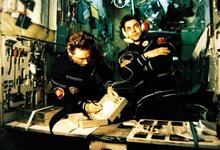
Рабочий день космонавтов завершился в 23 часа. На фото слева направо: Зигмунд Йен и Виктор Иванченков. August 29. The Experiments Continue After breakfast, V. Kovalyonok and A. Ivanchenkov carried out station maintenance work and trained on the integrated exercise machine and bicycle ergometer.
V. Bykovsky and S. Jähn continued the research and experimental program. The first activity was the "Bacterial Metabolism" experiment, preparations for which began at 09:30.
According to its definition, metabolism is the totality of chemical reactions occurring in living cells that provide an organism with the substances and energy necessary for life, growth, and reproduction. Why was this experiment conducted? At the time, there was a hypothesis that the higher the level of organization of living organisms, the more energy was required to maintain their structure in the presence of gravity. Part of the energy obtained through metabolism is used to preserve the organism’s structure. Since bacteria possess the simplest structure, they were considered to occupy the zero point on this hypothetical scale. Testing this hypothesis was the objective of the experiment.
The Jena instrument used in the experiment contained five chambers with nutrient solutions of different concentrations, bacterial spore suspensions, and a preservative. Bacterial growth began after the cosmonauts mixed the suspension with the nutrient solution. Scientists compared the so-called yield coefficient (the ratio of produced biomass to consumed nutrients) obtained in orbit with results obtained on Earth. This made it possible to determine whether gravity influences the metabolic processes required to maintain biological structure.
The experiment was prepared by the Institute of Microbiology and Experimental Therapy of the Academy of Sciences of the GDR with the participation of Soviet specialists. The Jena instrument was developed in the GDR.
Afterwards, the international crew continued one of the Berolina experiments — Berolina-K1 — which was completed later that evening.
The international crew also continued work in the field of space medicine. Before lunch, they carried out the experiment called "Time", whose objective was to study changes in the subjective perception of time under spaceflight conditions.
It is known that human beings possess, to varying degrees, the ability to orient themselves in time without the use of instruments. This ability helps in everyday activities and is particularly important in professions such as piloting and spaceflight.
The perception of time depends on a person’s condition and on the circumstances under which activities are performed.
Obtaining data on how time perception changes during the adaptation period in space is an important scientific and practical task.
The Time experiment used the Rula electronic quartz stopwatch, developed by the VEB Rula Watch Factory in the GDR. Two cosmonauts participated simultaneously, alternating between the roles of experimenter and subject.
The study included three components. First, the speed of visual-motor reactions was measured. The subject had to extinguish a light indicator on the stopwatch panel as quickly as possible after it was activated by the experimenter.
The second task involved reproducing time intervals. The subject had to switch off the light exactly ten seconds after it was activated, relying only on his internal sense of time.
The third task measured the threshold for distinguishing time intervals. The subject compared pairs of time intervals and determined whether one was longer, shorter, or equal to the other, again relying only on his own perception. Each pair included a standard interval of nine seconds and another interval ranging from four to fourteen seconds.
The Rula instrument was powered by an автономous source and had a mass of 0.9 kg.
That same day, the "Survey" experiment was conducted. In addition to questionnaires previously used, an additional section (BMS-11 questionnaire), developed at the Dresden University of Technology, was included. It was designed to assess fatigue, mental saturation, and stress.
Alongside scientific research, the crews carried out procedures related to the exchange of transport spacecraft. Having arrived aboard Soyuz-31, V. Bykovsky and S. Jähn were scheduled to return to Earth aboard Soyuz-29, the spacecraft that had launched V. Kovalyonok and A. Ivanchenkov on June 15.
To prepare the spacecraft for re-entry, the cosmonauts exchanged custom-fitted seat liners, transferred spacesuits, personal equipment, personal belongings, and exchanged onboard documentation.
In the evening, a press conference was held via television link with Soviet journalists and journalists from other socialist countries accredited at Mission Control.
The crew had brought aboard a medal depicting Wilhelm Pieck, a prominent figure in the communist and workers’ movement, a miniature printed edition of The Communist Manifesto, a Meissen porcelain artwork symbolizing the joint spaceflight, commemorative medals, and badges.
S. Jähn also carried two red Young Pioneer neckerchiefs: one belonging to his younger daughter and another belonging to the daughter of his backup crewmate, E. Köllner.
V. Bykovsky had brought two Komsomol badges. One of them had already traveled into space aboard Vostok-5 and Soyuz-22 and was intended for his eldest son. The second, a new badge, was intended for his younger son.
An established tradition in international space missions was to bring along a doll representing a national folk character. Thus, V. Remek flew with a doll of Švejk, while M. Hermaszewski brought Pan Twardowski, a legendary Polish figure who, according to folklore, escaped to the Moon from his quarrelsome wife.
S. Jähn brought with him the famous Sandman, the beloved character from children’s television programs who wished children a good night’s sleep.
The crew’s working day ended at 23:00. In the photograph, from left to right: Sigmund Jähn and Viktor Ivanchenkov. 29 de agosto. Los experimentos continúan Después del desayuno, V. Kovalyonok y A. Ivanchenkov realizaron tareas de mantenimiento de la estación y entrenaron en el complejo de ejercicios físicos y en el cicloergómetro.
V. Bykovski y S. Jähn continuaron con el programa de investigaciones y experimentos. El primero de ellos fue el experimento «Metabolismo de las bacterias», cuya preparación comenzó a las 09:30.
Según la definición científica, el metabolismo es el conjunto de reacciones químicas que tienen lugar en las células vivas y que proporcionan al organismo las sustancias y la energía necesarias para su vida, crecimiento y reproducción. ¿Por qué se realizó este experimento? En aquel momento existía la hipótesis de que cuanto mayor es el nivel de organización de los seres vivos, más energía se necesita para mantener su estructura en presencia de la gravedad. Parte de la energía obtenida mediante el metabolismo se emplea precisamente en conservar dicha estructura. Como las bacterias poseen la organización más simple, se consideraba que ocupaban el punto cero de esa escala hipotética. Comprobar esta hipótesis era el objetivo principal del experimento.
En las cinco cámaras del instrumento Jena se encontraban soluciones nutritivas de distintas concentraciones, suspensiones de esporas bacterianas y un conservante. El crecimiento de las bacterias comenzaba después de que los cosmonautas mezclaran las suspensiones con las soluciones nutritivas. Los científicos comparaban el llamado coeficiente de rendimiento (la relación entre la biomasa producida y los nutrientes consumidos) obtenido en órbita y en condiciones terrestres. Esto permitía determinar si la gravedad influía en los procesos metabólicos necesarios para mantener la estructura de los organismos.
El experimento fue preparado por el Instituto de Microbiología y Terapia Experimental de la Academia de Ciencias de la RDA, con participación de especialistas soviéticos. El instrumento Jena fue desarrollado en la RDA.
A continuación, la tripulación internacional continuó uno de los experimentos del programa Berolina, denominado Berolina-K1, que finalizó esa misma noche.
Ese día también prosiguieron los trabajos en el ámbito de la medicina espacial. Antes del almuerzo se realizó el experimento «Tiempo», cuyo objetivo era estudiar la dinámica de la percepción subjetiva del tiempo durante el vuelo espacial.
Se sabe que las personas poseen, en mayor o menor grado, la capacidad de orientarse en el tiempo sin utilizar instrumentos de medición. Esta capacidad resulta útil en la vida cotidiana y constituye una cualidad profesional importante para pilotos y cosmonautas.
La percepción del tiempo depende del estado físico y psicológico de la persona y de las condiciones en que desarrolla su actividad.
La obtención de datos sobre los cambios de esta percepción durante el período de adaptación al espacio constituye una importante tarea científica y práctica.
El experimento se llevó a cabo utilizando el cronómetro electrónico de cuarzo Rula, desarrollado por la fábrica de relojes Rula de la RDA. Participaban simultáneamente dos cosmonautas, alternándose en los papeles de experimentador y sujeto de estudio.
La investigación incluía tres pruebas. En la primera se medía la velocidad de reacción visomotora: el participante debía apagar una señal luminosa tan rápido como fuera posible después de que el experimentador la activara.
La segunda consistía en reproducir intervalos de tiempo: el sujeto debía apagar la luz exactamente diez segundos después de su activación, guiándose únicamente por su percepción interna del tiempo.
La tercera prueba medía la capacidad de distinguir intervalos temporales. El participante comparaba pares de intervalos y determinaba si uno era mayor, menor o igual que el otro. Cada par incluía un intervalo estándar de nueve segundos y otro que variaba entre cuatro y catorce segundos.
El cronómetro Rula funcionaba con una fuente de alimentación autónoma y tenía una masa de 0,9 kg.
Ese mismo día se realizó también el experimento «Encuesta». Además de los cuestionarios ya utilizados anteriormente, se incorporó una nueva sección denominada BMS-11, desarrollada por la Universidad Técnica de Dresde. Esta encuesta estaba destinada a evaluar el cansancio, la saturación psicológica y el estrés.
Además de las investigaciones científicas, ambas tripulaciones llevaron a cabo operaciones relacionadas con el intercambio de naves espaciales. Tras haber llegado a bordo de la Soyuz-31, Bykovski y Jähn debían regresar a la Tierra en la Soyuz-29, la misma nave en la que Kovalyonok e Ivanchenkov habían iniciado su misión el 15 de junio.
Para preparar las naves para el regreso, los cosmonautas intercambiaron los asientos moldeados individualmente, trasladaron trajes espaciales, equipo personal, objetos personales y documentación de a bordo.
Por la noche se celebró una conferencia de prensa transmitida por televisión con periodistas soviéticos y de otros países socialistas acreditados en el Centro de Control de Vuelo.
A bordo del complejo orbital se llevaron una medalla con la imagen de Wilhelm Pieck, destacado dirigente del movimiento comunista y obrero, una edición en miniatura del Manifiesto Comunista, una pieza de porcelana de Meissen dedicada al vuelo conjunto, además de medallas y distintivos conmemorativos.
S. Jähn llevó consigo dos pañuelos rojos de pionero: uno perteneciente a su hija menor y otro a la hija de su suplente, E. Köllner.
V. Bykovski llevó dos insignias del Komsomol. Una de ellas ya había viajado al espacio en las misiones Vostok-5 y Soyuz-22 y estaba destinada a su hijo mayor. La segunda, nueva, estaba destinada a su hijo menor.
En los vuelos internacionales se había establecido la tradición de llevar una muñeca o figura representativa del folclore nacional. Así, V. Remek voló con un muñeco de Švejk, mientras que M. Hermaszewski llevó a Pan Twardowski, personaje legendario polaco que, según la tradición, escapó a la Luna para huir de su esposa.
S. Jähn llevó consigo al famoso Hombrecito de Arena, personaje tradicional de los programas infantiles de televisión que deseaba a los niños una buena noche.
La jornada de trabajo de los cosmonautas concluyó a las 23:00. En la fotografía, de izquierda a derecha: Sigmund Jähn y Viktor Ivanchenkov.
This site uses cookies to help personalise content, tailor your experience and to keep you logged in if you register.
By continuing to use this site, you are consenting to our use of cookies.