• ORBITER-FORUM will be temporarily closed at 2026-07-23 18:00 UTC while we complete some OF maintenance tasks. The amount of downtime is expected to take up to one hour, but probably less.

News Horrific tornado strikes Oklahoma.

Simpler said: It is always better to fight on the terroritory of the enemy.
I started to agree with this, but in retrospect I think it's a slight misinterpretation. The British fought on our territory, and we spanked them because we were familiar with the area--we knew every tree, bush and hill, and used that knowledge to our advantage. Much the same thing happened to us in Vietnam (though it didn't help that we were also fighting the Russians and the Chinese).

You might better have said: it's better to get the initiative, and keep your enemy off balance. The fact that if you do that, you will end up on his territory is incidental;)
 
A lot has changed in warfare since the War of Independence. Back then the worst that could happen to you if the enemy was in your territory was some artillery action. If you look how the first World War looked like: trenches, hundreds of artillery rounds on the same place for months, entire regions destroyed. Or Stalingrad in the second World War, I think every Russian would have been more happy if that fight was not in Stalingrad but Dresden.
Or think of the burning oil fields in the Gulf Wars, with armies having such force to destroy entire countries it's vastly more important than ever before to fight in a territory you don't care if it's destroyed.
 
Well, of course, if you are trying to conquer another country, you want to fight on their turf and not your own. That not only saves your own people and property from destruction, but it's the whole purpose of your attack in the first place.

But still, like I said, fighting on foreign soil carries its own challenges. Now, if you are the US, and you have to study the battlefield for years before a single man sets foot in the sand, then yeah, things tend to be easier.

So, in conclusion, your point is taken--to a certain extent. In the words of the great Bill Whittle: "If we have to fight them, we'd rather fight them now than later, and we'd rather fight them over there than over here.":)
 
I'm not sure what the Gulf Wars have to do with a Tornado, so I'm assuming this thread has been derailed.
 
I'm not sure what the Gulf Wars have to do with a Tornado, so I'm assuming this thread has been derailed.

I second that. Sitha made a casual comment that was not really intended for analysis but is entirely correct, given a particular viewpoint and opinion. Let's get back to tornados.

You have to consider that Tornado Alley is also much further away from any ocean, as you can ever get in Europe. The rocky mountains funnel cold air to the mid west easily - cold air that only rarely exists in Europe. For us to get Tornados, we have to get a completely different situation in the European weather, than you need in the USA. For really big outbreaks in central Europe, we would need really cold air from Russia combined with dry hot Sahara winds from the south and warm and very moist air from the west. And Central Europe itself has to be heated already far enough for allowing the turbulent air to form. Something that exists like that only rarely.

Usually it is exactly the mild climate of Europe, that makes us such a pleasant place to live, that prevents big Tornado activity. The gulf stream heats us even in the deepest winter, storms from the Atlantic bring lots of rain, and such rainy weather also pushes the cold air away. It usually can't mix in the same way as in the USA.

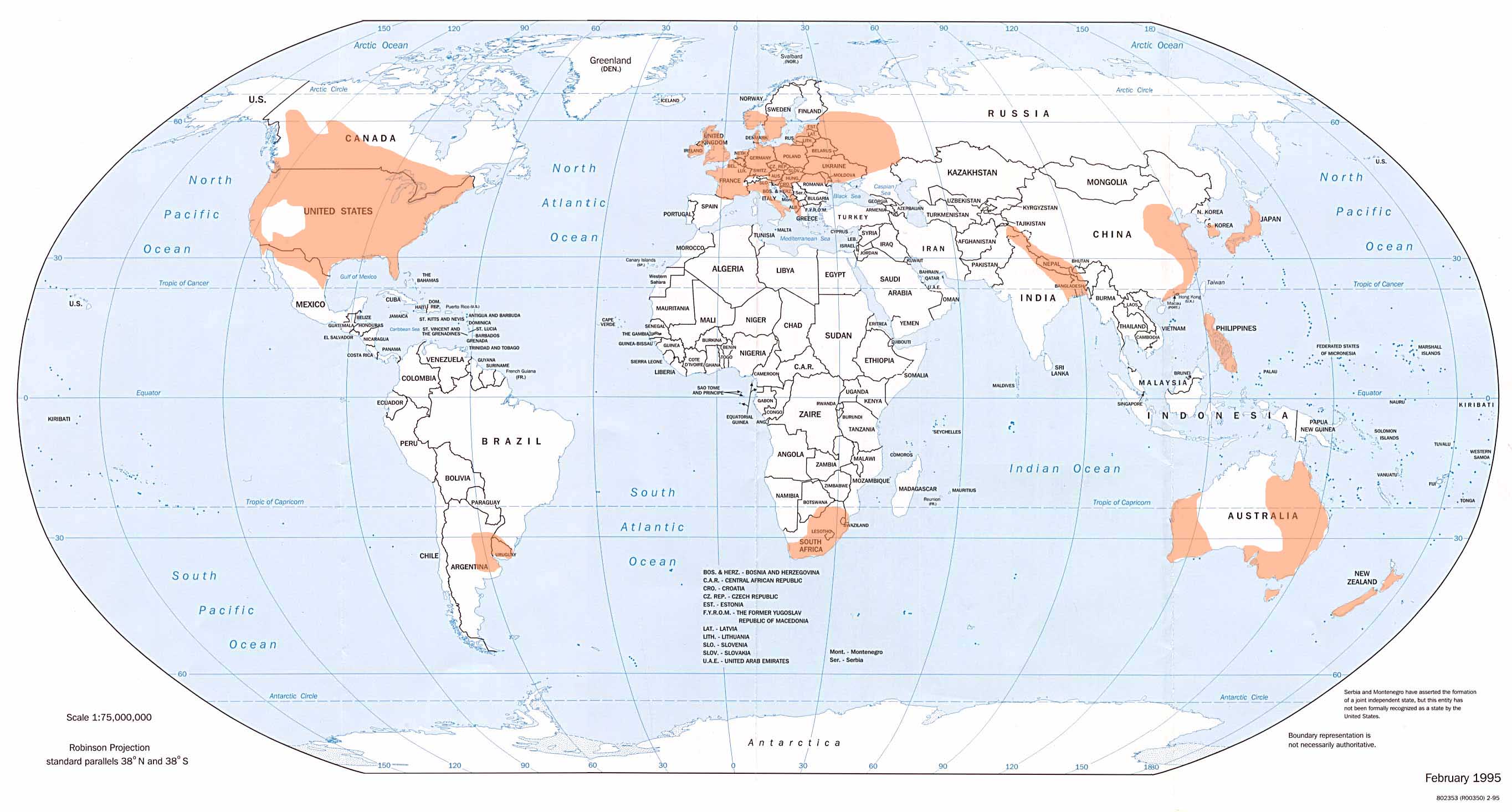
An area, that could see 25 tornadoes every year in the USA, would only see maybe 4 in Europe in the same time.


This map shows where tornadoes occur likely:
Globdisttornado.jpg


It is from that source, it also explains a lot of the right mixture for tornadoes:

http://www.ncdc.noaa.gov/oa/climate/severeweather/tornadoes.html

Thanks for the extra info Urwumpe; I've always wondered about the difference in frequency - though obviously not too much or I'd have actually looked it up. :)

Cheers!
 
I'm seeing reports that OKC has been hit again by multiple tornadoes right now, including one that has just plowed straight through the city center..... :blink:
 
Yes, I'm watching the weather myself from down here in Atlanta. The storm that might have gone through Oklahoma City was a huge one at one point, but may have literally skipped the densest areas. The reports coming from the region are still very conflicted and the truth won't be known for several hours.
 
Friends say no power or flickering lights at times. As well as tornados passing nearby and just missing their work/residence.
 
Travel in the Oklahoma City metro area is strongly discouraged. OK-DoT advises to avoid all interstate travel while emergency crews respond to tornado damage.
Various interstates are shut down anyways.
Weather predictions in the afternoon included hurricane-force winds and softball-size hail.
 
Last edited:
Friends say no power or flickering lights at times. As well as tornados passing nearby and just missing their work/residence.

Erm, didn't one of the tornadoes crossed your university campus a few hours ago? :shifty:

Stay safe! Heavy rainfall seems to be lingering as of right now....
 
Yea, it looks like another EF-4 or EF-5 tornado trucked through Oklahoma again-- this time south of El Reno into the Oklahoma City metro. 5 dead, 50 injured at this point. Doesn't look anywhere near as bad as the Moore tornado last week though, because the worst of the tornado lifted by the time it got to Moore and downtown Oklahoma City, however most of the deaths seem to be related to people being stuck in cars as the tornado went by El Reno. Gate-to-gate shear velocities were stronger than the Moore EF-5, they approached 275mph at one point (not ground winds however). The Weather Channel's storm chasers were nearly killed when their vehicle was flipped 200-400 yards. They also claim it was the most violent tornado they've ever witnessed.
http://www.youtube.com/watch?feature=player_embedded&v=kOh9Ptz4w28

---------- Post added at 03:22 PM ---------- Previous post was at 05:27 AM ----------

Death toll already up to 9 as first light sheds damage.
 
Oh no :(
I watched this team the last three seasons of the Storm Chasers TV series. By far, they were my favorite. They might not have had a fancy armored vehicle to drive into tornadoes, but they knew their stuff and gathered invaluable data. They always had an air of professionalism about them that the other featured teams just didn't have. Sure, they got excited, but it was never played up for the camera or anything like that. I'm not disparaging the other teams of course, I enjoyed watching all of them, but there was just something that Tim and his team offered that the others couldn't.
Rest In Peace :salute:
 
From the meteorologists I know and the ones in the articles, these guys were highly esteemed for their research. Consistently named as "some of the best" researchers and chasers, regardless of their fame.
Rest in peace Chasers, and thank goodness the Weather Channel guys survived the same erratic storms.
 
Here's a recent video he did with NASA to explain the "mystery" of Tornadoes.
http://www.youtube.com/watch?feature=player_embedded&v=GtOtDDPcNGE#!

Samaras wasn't your average screaming YouTube storm chaser, he was an actual professional of nearly 30 years who didn't ever take the kind of risks that you would by driving into a tornado. He was able to record the largest barometric pressure drop ever recorded in the planet with his instruments during an F-4 in 2004. He is considered a pioneer in the field of storm spotters. From what I gather is that Samaras's team couldn't escape because the tornado took an unexpected hook right towards them, and the traffic from people fleeing blocked their route of escape.
samaras_pressdrop.gif
 
Yea, I was watching the radar feed of that tornado live, and it was going East-Southeast frame by frame, then all of a sudden, the next frame (each frame is about 6 minutes apart) had "jumped" several miles to the Northeast. What also wasn't helping the traffic situation was one of the local news "meteorologists" (term used loosely here) decided it was time to coin a new catcphrase: "get underground or get out of town." So instead of simply heading for well-built shelter, everyone decided to flee which given the short amount of time was possibly the WORST thing to have done. Now given that tornadoes were expected, would it have been prudent for people in weaker structures (mobile homes) to gravitate toward stronger buildings like Hospitals or churches? Sure, but NOT RIGHT BEFORE THE STORM HITS! Until you get into EF-5 range where the soil can be torn away up to 18 inches down, the interior parts of most houses and buildings will stay intact enough to keep you alive. This storm is a textbook example of why you don't try to flee!
 
It's reported that one of the storm chasers was found in the vehicle and one of the two that were ejected was found a half mile from the vehicle.
s022671668.jpg
 
The tornado that hit El Reno might not have been an EF-3, several research teams briefly measured 100 m/s wind speeds around 400 feet in the air. Radar showed an insane 298kts (roughly 345mph) shear, all indicative of an EF-5 tornado. NWS Norman has noted this and is discussing an upgrade to at least EF-4. The distance and total destruction of the cars seems to be the only real damage to indicate anything beyond EF-3.
 
Back
Top