News Indian space program hit by another launch mishap

ISRO Press Release:
GSLV F06 Failure-Preliminary findings and Further steps

December 31, 2010
  1. The performance of the GSLV-F06 flight of December 25, 2010 (with GSAT-5P Satellite onboard) was normal up to 47.5 seconds from lift-off. The events leading to the failure got initiated at 47.8 seconds after lift-off. Soon, the vehicle started developing larger errors in its orientation leading to build-up of higher angle of attack and higher structural loads and consequently vehicle broke up at 53.8 seconds from lift-off (as seen visually as well as from the Radars).
     
  2. As per the Range safety norms, a destruct command was issued from the ground at 64 seconds after lift-off. The flight was hence terminated in the regime of the First Stage itself.
     
  3. Soon after this, Dr. Radhakrishnan, the Chairman ISRO constituted a Preliminary Failure Analysis Team under the chairmanship of former Chairman, ISRO Dr. G. Madhavan Nair, to conduct a preliminary analysis of the flight data, along with members of the Launch Authorisation Board, and Mission Readiness Review Committee as well as senior Project functionaries of GSLV Project and Experts.
     
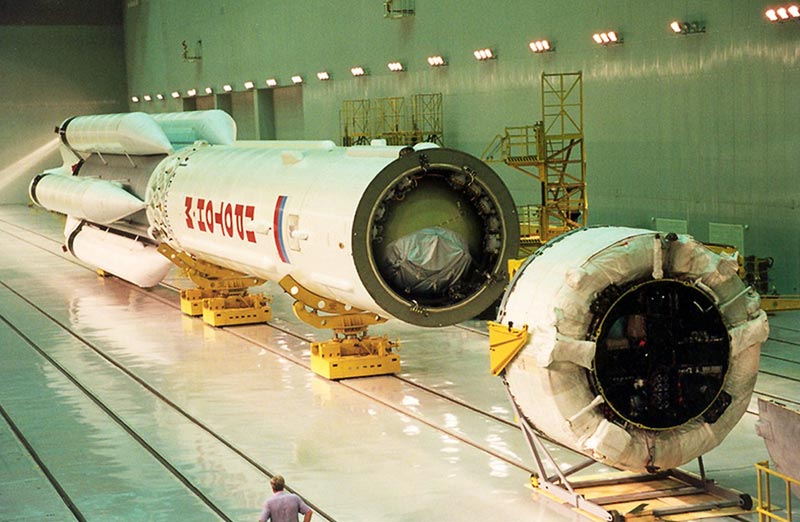
  4. The finding of the Preliminary Failure Analysis Team is that the primary cause of the failure is the untimely and inadvertent snapping of a group of 10 connectors located at the bottom portion of the Russian Cryogenic Stage. Some of these connectors carry command signals from the onboard computer residing in the Equipment Bay (located near the top of the vehicle) to the control electronics of the four L40 Strap-ons of the First Stage. These connectors are intended to be separated only on issue of a separation command at 292 seconds after lift-off. The premature snapping of these connectors has led to stoppage of continuous flow of control commands to the First Stage control electronics, consequently leading to loss of control and break-up of the vehicle. The exact cause of snapping of the set of connectors, whether due to external forces like vibration, dynamic pressure is to be analysed further and pin-pointed.
     
  5. Chairman ISRO has now constituted a Failure Analysis Committee to (i) carry out an in-depth analysis of the flight data of GSLV-F06 as well as the data from the previous six flights of GSLV; (ii) establish reasons for the failure of GSLV-F06 flight and; (iii) recommend corrective actions on the GSLV vehicle including the remaining one Russian Cryogenic Stage. The Failure Analysis Committee chaired by Former Chairman ISRO Dr. G. Madhavan Nair has 11 Experts drawn from within ISRO and outside.
     
  6. Chairman ISRO has also constituted a Programme Review and Strategy Committee to look into (i) the future of the GSLV Programme and assured launch for INSAT/GSAT Series, INSAT-3D as well as Chandrayaan-2 (ii) realization and operationalisation of indigenous Cryogenic Stage (iii) strategy for meeting the demands of communication transponders in the immediate future. Dr. K. Kasturirangan, former Chairman ISRO and presently Member of the Planning Commission will be chairing this seven member Committee.
     
  7. These two Committees have been requested to submit their Reports by the end of January 2011. Subsequently, the Reports of these Committees will be presented to Eminent National Experts including Dr A.P.J. Abdul Kalam, Prof. M.G.K. Menon, Prof. Yash Pal, Prof. U.R. Rao, Dr. K. Kasturirangan, Dr. G. Madhavan Nair, Dr. R. Chidambaram, and Prof. R. Narasimha.
     
  8. Further, a Panel chaired by Dr. S.C. Gupta, former member of Space Commission will be guiding and facilitating an internal exercise by Chairman, ISRO, eliciting views from the ISRO community at all levels to gear up for the complex and challenging space missions ahead.
     
  9. ISRO plans to complete these reviews and internal exercises by end of February, 2011.
________________________________________

Spaceflight Now: Snapped connectors led to Indian rocket failure.

Space News: ISRO Team Says Cable Rupture Caused Rocket Failure.
 
For reference:

a961df58f711.jpg
When did heatshields become fairings? :facepalm:

ISRO really needs to get their act together, especially since they plan manned lunar missions in 2020.
 
When did heatshields become fairings? :facepalm:

ISRO really needs to get their act together, especially since they plan manned lunar missions in 2020.

Well, practically, all payload fairings are heat shields. Though their function as aerodynamic protection is more important.
 
When did heatshields become fairings? :facepalm:


That is a commonplace and very valid engineering practice, the fairings are also designed to be heat shields. Especially in an unmanned booster, one that accelerates faster than a manned shuttle - for example.

The Apollo capsules also have a protective launch heat shield as well!

Once 'dem rokots get going, they really get going!

http://www.apollosaturn.com/asnr/escape.htm
 
So perhaps they are also designed for heat protection, but that is their secondary purpose their main purpose is as aerodynamic fairngs, so I stay with my original argument.
 
The one used in apollo was specifically designed to prevent charring of the command module during ascent. The command module didn't need aerodynamic shielding, just heat shielding.

Depending on the profile of launch, the fairings may serve more as a windshield or heatshield. Depends.
 
But in a case like this the aerodynamics are the main purpose, it was different for Apollo, but not in this case, this is for aerodynamics.
 
Still, you don't drop them when the dynamic pressure is low enough, but when the aerodynamic heat flux is low enough.
 
Still, you don't drop them when the dynamic pressure is low enough, but when the aerodynamic heat flux is low enough.


My friend how is cable/connector are set? outside the body of rocket or inside the rocket?
 
My friend how is cable/connector are set? outside the body of rocket or inside the rocket?

Inside special cable fairings. usually, they are also protected by small doors, that close after staging, so plasma does not mess with the circuits.
 
The cable runs outside the rocket or inside?

Most are outside, in the cable fairings. You have to think of a rocket like a egg, that is only a thin shell that encloses the rocket propellants. Inside the tanks, is usually a poor place for cables, since sparks can trigger explosions - see Apollo 13.


One is a cable trunk, the rest are pressurant lines, that transport warm gaseous hydrogen or oxygen back to the tanks for keeping tank pressure high enough.
 
Is there any link on that to educate me more on such drawing pls???

I mean connectors inside or outside?

Always inside. Look for example here:

Proton+and+Block+DM+upper+stage.jpg


The connectors for the fairing pyrotechnics are inside the small fairing on the top of the stage, the connectors to the Briz-M stage are on the inside of the ring.

---------- Post added at 06:23 PM ---------- Previous post was at 06:09 PM ----------

You can also see some details here:

GSLV-F04%20stacked%20upto%20Stage%202.JPG


The connection that failed would be right below the blue handling ring, on the inside of the interstage structure (with the structural ribs). One cable tunnel can be seen on the right edge of the stage in this photograph, it goes outside the tanks (white paint) and enters the interstage for letting the cables pass to the next stage on the inside of the interstage.
 
Always inside. Look for example here:

Proton+and+Block+DM+upper+stage.jpg


The connectors for the fairing pyrotechnics are inside the small fairing on the top of the stage, the connectors to the Briz-M stage are on the inside of the ring.

---------- Post added at 06:23 PM ---------- Previous post was at 06:09 PM ----------

You can also see some details here:

GSLV-F04%20stacked%20upto%20Stage%202.JPG


The connection that failed would be right below the blue handling ring, on the inside of the interstage structure (with the structural ribs). One cable tunnel can be seen on the right edge of the stage in this photograph, it goes outside the tanks (white paint) and enters the interstage for letting the cables pass to the next stage on the inside of the interstage.

You mean the cable touching (almost) red letters (Hindi) or the other thin one?
 
You mean the cable touching (almost) red letters (Hindi) or the other thin one?

No, that is a pressurization duct, that supplies warm gas from the engine to the oxidizer tank. The cable duct is at the right edge of the stage on this photograph.

Here you can see a bit more of the connection between second and third stage:
hoistthirdstage.jpg


The open access door in the gray interstage on top of the second stage (the lowest visible part of the rocket in the photograph), is used for making mechanical and electrical connections. All black parts in the photograph belong to the cryogen third stage.
 
So all said n done connectors are always inside? those that failed in GSLV??

I would love to see the connector picture if any - or more material - but u r under no obligation - u have done more than enough, and I am thankful 2 u
 
Last edited:
So all said n done connectors are always inside? those that failed in GSLV??

Yes, these had been between second (gray) and third stage(black). The only way to access them after the third stage was integrated in the stack, is by the access doors on top of the second stage.

There are many possible causes for such failures, most of them involved human failure. A rather technical failure happened on a Soyuz rocket in an accident called the April 5 anomaly. There, an early ignition of a set of separation pyrobolts (bolts that are split in half by a small explosive charge) also destroyed the electrical connections to the remaining sets of separation pyrobolts, leaving the second stage partially connected to the third stage and dragging it of course quickly by the additional mass and torques. A pretty complex failure, that easily visualizes how much can go wrong at once.

You could also have errors during assembly, like the cables not being properly secured to the connector, permitting them to shake loose.

Here is a free patent with a rather complex electrical connector:

http://www.freepatentsonline.com/4264115.html

or without pyro-option:

http://www.freepatentsonline.com/3905669.html

In reality, you often have simpler plugs that are pushed apart by the mechanism that push the stages apart.

Like these:

http://davewilsonphotography.com/2010/10/28/electrical-connector-saturn-v/
 
Last edited:
Yes, these had been between second (gray) and third stage(black). The only way to access them after the third stage was integrated in the stack, is by the access doors on top of the second stage.

There are many possible causes for such failures, most of them involved human failure. A rather technical failure happened on a Soyuz rocket in an accident called the April 5 anomaly. There, an early ignition of a set of separation pyrobolts (bolts that are split in half by a small explosive charge) also destroyed the electrical connections to the remaining sets of separation pyrobolts, leaving the second stage partially connected to the third stage and dragging it of course quickly by the additional mass and torques. A pretty complex failure, that easily visualizes how much can go wrong at once.

You could also have errors during assembly, like the cables not being properly secured to the connector, permitting them to shake loose.

Here is a free patent with a rather complex electrical connector:

http://www.freepatentsonline.com/4264115.html

or without pyro-option:

http://www.freepatentsonline.com/3905669.html

In reality, you often have simpler plugs that are pushed apart by the mechanism that push the stages apart.

Like these:

http://davewilsonphotography.com/2010/10/28/electrical-connector-saturn-v/

Good job - danke sher...

Also, see if this is right from Nasa:

Command signals and power from the Sciencecraft will be
delivered to the P/M through a zero insertion force connector in the separation system.
 
Back
Top