Meteoroid explosion in Russia

:blink:
Wait, whaaaaa?!?!?
OK, could it have been put through a couple of gravitational slingshots to redirect it to a retrograde orbit over the millions of years it's been kicking around? Statistically, that's a highly unlikely event, but there's enough rocks out there that it could have happened (and seems to have done so here)...
 
Unlikely, but still possible. Must not even be retrograde.

I just calculated, a periodic cometary object, that came from the limits of the solar system, would have arrived at 52 km/s on Earth.

And there are also non-periodic comets, which could reach 72 km/s and more, depending on their origin.
 
Well, we can't know what is happening deep in the Oort cloud, so collisions plus slingshots with the other bodies there can send us meteroids from a near-infinite variety of orbits.
 
What the videos with Chelyabinsk meteor blast reveal, that Russia is by far less Orthodox as some hope, no one shouts "God forbid!" or "Mercy on me!", but rather people are swearing like 10,000 devils! :rofl:

Dare I ask the meaning of "Охренеть" (Which I noticed in a video or two as well as your post)?
 
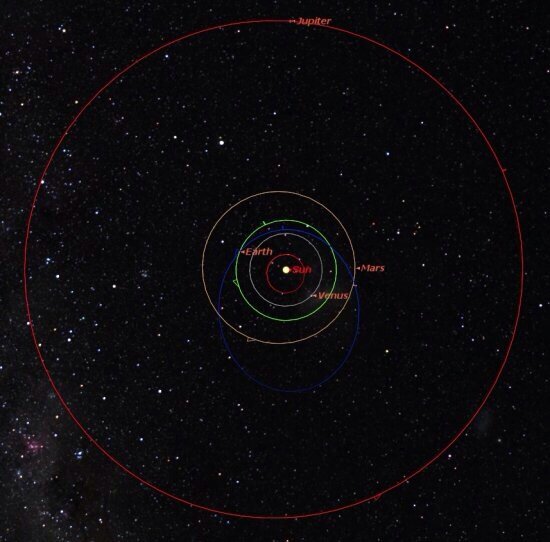
The latest reports are indicating the meteor hit at 64 km/s. If my math isn't off, that is approximately twice the orbital velocity of the earth relative to the sun. I'm not sure exactly what plane the meteor was in relative to the sun, but it suggests that the meteor was in a retrograde orbit relative to the sun.

I think that's 64,000 km per hour.

Bob Clark
russia-huge-meteorite-bolide-130216a-02.jpg
 
Last edited:
Approximate orbit of the meteoroid by NASA (blue line):

BDO960mCUAEpP4L.jpg
 
NASA statement on Russian meteor:

"According to NASA scientists, the trajectory of the Russian meteorite was significantly different than the trajectory of the asteroid 2012 DA14, making it a completely unrelated object. Information is still being collected about the Russian meteorite and analysis is preliminary at this point. In videos of the meteor, it is seen to pass from left to right in front of the rising sun, which means it was traveling from north to south. Asteroid DA14's trajectory is in the opposite direction, from south to north."

http://www.nasa.gov/topics/solarsystem/features/asteroidflyby.html

I really don't like coincidences in science. Reports are asteroids of this size getting this close occur about once in 30 years. And meteors the size of the Russian one enter our atmosphere about similar frequency. But the problem is their both occurring in the same 24 hour period. If you imagine the asteroid arriving on a particular day, the question to ask is what is the probability of the Russian meteor arriving on that same day? Once in 30 years, and then 365 days in a year, means the chance of this happening is like 1 in 10,000. That's disturbingly unlikely.
On the other hand if this really is just coincidence, then it should be kept in mind that chances this low have been quoted in regards to large asteroids impacting Earth in our lifetime.

Bob Clark
 
1 in 10,000 coincidences happen every few days.
Nothing special.

Besides, one data point does not make science - there would be a problem if each such event in the last century coincided with a close NEO pass, but they do not.
 
1 in 10,000 coincidences happen every few days.
Nothing special.

Besides, one data point does not make science - there would be a problem if each such event in the last century coincided with a close NEO pass, but they do not.

If you were playing cards, then there are 1/10,000 card combinations occurring every day. But in that case there are millions of different hands of cards being dealt everyday. There are not millions of different asteroids and meteors this size encountering Earth every day.


Bob Clark
 
Last edited:
If you were playing cards. Then there are 1/10,000 card combinations occurring every day. But in that case there are millions of different hands of cards being dealt everyday. There are not millions of different asteroids and meteors this size encountering Earth every day.


Bob Clark

and if you played the same game with the same deck everyday for 4billion years at some point you'd have the same hand twice in day.

Think about this as well, If no one was looking at the heavens 2012 DA14 would have swung by unnoticed. A few minutes difference in timing or speed at the Russian meteorite would have missed us.

How many close encounters with lumps of rock has the Earth had that we don't know about.

As has already been mentioned, this is one data point. As more data is generated we may find that scarily, it's not that unusual.
 
If data suggesting the airburst energy in 300 - 500 kt range is correct we are very lucky this rock came in at such shallow trajectory. Objects of this size can make it to the ground and produce direct impact or low altitude airburst. An asteorid that made [ame="http://en.wikipedia.org/wiki/Kaali_crater"]Kaali_crater[/ame] is thought to be much smaller only 20 - 80 tons and it made 110 m crater and set forests on fire in 6 km radius from impact site. Had Russian asteorid came in closer to vertical there would be much less atmosphere in its way making a low altitude airburst or direct hit much more likely.
 
Could it have been a dead comet nucleus fragment?

-- removed bad info --
 
Last edited:
Could it have been a dead comet nucleus fragment? That would explain the large vapour and debris cloud hanging in the sky, as well as the peculiar orbit... retrograde, high velocity, coming from the direction of the Sun...

It didn't go retrograde and there's nothing all that odd about the orbit. Not sure what you're getting at...
 
Just showed a friend of mine some videos of the meteor and the response was "Russia on fire, burning with desire" :rofl:
 
We all make mistakes :cheers:

(Hopefully, noone dealing with asteroid impact calculations will... :blink: )
 
Back
Top