Launch News Minotaur from Kodiak on September 27th 2011

IronRain

The One and Only (AFAIK)
Administrator
Moderator
Orbiter Contributor
News Reporter
Donator
Joined
Oct 11, 2009
Messages
3,488
Reaction score
407
Points
123
Location
Utrecht
Website
www.spaceflightnewsapi.net
Preparations to launch a U.S. Navy communications satellite have kicked off in Alaska three weeks before a souped-up Minotaur rocket will pilot the spacecraft to an orbit 7,500 miles above Earth.

Technicians began transferring the three lower stages of the Minotaur 4 rocket to Launch Pad No. 1 at Kodiak Launch Complex on Monday, kicking off assembly of the solid-fueled launcher ahead of its Sept. 27 blastoff.

The Minotaur's first stage, a decommissioned SR118 Peacekeeper missile motor, was placed atop the launch pad's pedestal Monday. The second and third stages of the Minotaur 4 will be stacked Tuesday, according to Alaska Aerospace Corp., which operates the oceanfront launch complex.

The launch site is positioned on the southern shore of Kodiak Island in southern Alaska.

Launch is scheduled for September 27th, 11:45 a.m. EDT, 15:45 UTC

processing.jpg


Spaceflight Now: Minotaur launch campaign begins at Alaska spaceport
 
Spaceflight Now: Mission Status Center:
FRIDAY, SEPTEMBER 16, 2011Technicians attached a 1,000-pound U.S. Navy communications satellite to its launch vehicle this week as preparations continue for liftoff Sept. 27 from the southern coast of Alaska.

The TacSat 4 satellite was moved from its processing facility to Kodiak Launch Complex's primary launch pad Thursday, then workers lifted the fully-fueled spacecraft in place on top of the fourth stage of the Minotaur 4 rocket.

The spacecraft was enclosed inside the rocket's 92-inch payload fairing earlier this month, then the entire nose apparatus was transported to the pad in one piece.

It was the last stop for the U.S. military payload before launching into orbit at approximately 1545 GMT (11:45 a.m. EDT; 7:45 a.m. Alaska time) on Sept. 27.

With the 78-foot-tall launcher now fully assembled, the attention of the launch team will now turn to testing and a series of readiness reviews leading toward the Sept. 27 blastoff from Kodiak Island, Alaska.

{...}
 
"Note: At the request of the U.S. Air Force, this broadcast is
time-delayed and will end in the event of an anomaly."

Never read something like this before, is the USAF now the Soviet Union or China?
 
Spaceflight Now: Mission Status Center:
1730 GMT (1:30 p.m. EDT; 9:30 a.m. Alaska time)The weather forecast continues to indicate a 40 percent chance of bad weather prohibiting launch Tuesday. The outlook calls for the same chance of violation Wednesday.

The primary concern is the proton flux from a solar flare unleashed a few days ago. Although the flare originated from a sunspot not directly aimed at Earth, radiation will deliver a glancing blow to the planet.

Officials are concerned charged particles will play havoc with the Minotaur's guidance system and computers during launch, so if proton levels rise above a certain threshold, launch will not go forward.

Plans call for the five-hour countdown to get underway at 2:49 a.m. local time (1049 GMT; 6:49 a.m. EDT) Tuesday.
 
"Note: At the request of the U.S. Air Force, this broadcast is
time-delayed and will end in the event of an anomaly."

Never read something like this before, is the USAF now the Soviet Union or China?

I've only seen it in fiction:

The panic button was not a button at all, but a bright red knife switch positioned at the top right corner of the communications console. no one remembered who had originally installed the first panic button in those primitive days of the space program when all communications originated from the first missile control center at Cape Canaveral, Florida. Although some gave the credit to Shorty Powers, he denied the honour, and there are no written records to prove or disprove the point.

...no one has ever uncovered the fact that as the world watched the U.S space shots, everything that happened on screen or over the radio had occurred seven seconds earlier in realtime

...

When Jakes pulled the red switch, he set several events into motion. First he disconnected all radio and video feeds from downrange. They could not be reconnected without a complicated rewiring procedure. Second he destroyed both the endless tape loop and the video disc inside the console, wiping out any information that might have been recorded on them before he hit the panic button.

Finally, he had activated monstrous jamming transmitters located on Merritt Island in Florida, which blanketed the microwave frequencies from downrange to prevent any unauthorized receivers from picking them up.

Sargasso: Edwin Corley, Sphere Books, 1978(Emphasis mine)
 
Spaceflight Now:
  • Minotaur launch timeline:
    [table="head;width=500"]
    T [MM:SS]
    |EVENT

    T-00:00​
    |Liftoff

    {colsp=2}
    The first stage's decommissioned Peacekeeper SR118 solid rocket motor ignites to begin the Minotaur 4 rocket's mission. Pitch and roll commands two seconds later will put the rocket on the proper trajectory.


    T+00:37​
    |Max Q

    {colsp=2}
    Aerodynamic pressure on the vehicle reaches its peak as the Minotaur 4 accelerates through the lower atmosphere.


    T+00:57​
    |Stage 1 Sep./Stage 2 Ignition

    {colsp=2}
    At an altitude of 15 miles, the rocket's ATK-built solid-fueled first stage exhausts its supply of propellant and is jettisoned. The second stage's SR119 motor ignites to continue the flight toward space.


    T+01:55​
    |Stage 2 Burnout

    {colsp=2}
    The second stage SR119 motor, built by Aerojet, burns out at an altitude of 58 miles.


    T+02:05​
    |Stage 2 Sep./Stage 3 Ignition

    {colsp=2}
    After a 10-second coast, the Hercules SR120 third stage motor fires for a 72-second burn.


    T+02:17​
    |Fairing Jettison

    {colsp=2}
    The 92-inch graphite-epoxy aluminum honeycomb payload fairing that protected the satellites during the ride through the lower atmosphere is jettisoned as the rocket ascends into space at an altitude of 78 miles.


    T+03:18​
    |Stage 3 Burnout

    {colsp=2}
    The Hercules SR120 motor completes its burn and the Minotaur 4 enters a coast period lasting almost 20 minutes, during which the vehicle's altitude will soar to more than 400 miles.


    T+22:55​
    |Stage 3 Separation

    {colsp=2}
    The Minotaur's third stage is released to re-enter Earth's atmosphere.


    T+23:06​
    |Stage 4 Ignition

    {colsp=2}
    The Star 48 solid rocket motor is ignited to complete the job of placing the payload into orbit. This is the first flight of a Minotaur 4 rocket with the Star 48 fourth stage motor. This version of the rocket is called the Minotaur 4+ configuration.


    T+24:28​
    |Stage 4 Burnout

    {colsp=2}
    The fourth stage uses up its propellant and burns out as it enters the targeted elliptical orbit with a perigee altitude of about 115 miles, an apogee altitude of 7,487 miles, and an orbital inclination of 63.435 degrees.


    T+27:48​
    |TacSat 4 Separation

    {colsp=2}
    The Navy's TacSat 4 satellite is deployed from the Minotaur 4 rocket's fourth stage.
    [/table]​


  • Minotaur 4 launch ground track:
    track.jpg


  • Photos: Minotaur on the pad (PHOTO GALLERY #1)
  • Photos: Minotaur on the pad (PHOTO GALLERY #2)
  • Photos: Minotaur on the pad (PHOTO GALLERY #3)


  • Video: U.S. Navy communications satellite set for launch:
 
Spaceflight Now status center:

On a crisp, clear morning in Alaska, the launch team has arrived at the control center two miles northwest of Launch Pad No. 1 at Kodiak Launch Complex. Voice and status checks are now underway.

Nearly 50 senior managers and engineers from the Air Force, the Navy, Orbital Sciences and Alaska Aerospace occupy the control room during countdown operations.

The countdown formally begins at 2:49 a.m. local time (1049 GMT; 6:49 a.m. EDT).

The launch pad crew is also completing final inspections of the Minotaur 4 rocket before the clamshell-like service structure retracts. The rotating launch service structure should move beginning around 3:19 a.m. local time (1119 GMT; 7:19 a.m. EDT).

The four-stage rocket is made of three rocket motors from the Peacekeeper missile program. A Star 48 fourth stage will place the mission's TacSat 4 payload into a 7,487-mile by 115-mile orbit inclined 63.4 degrees to the equator.

The first stage is a Peacekeeper SR118 motor manufactured by ATK. The second stage SR119 motor was originally built by Aerojet, and ATK was the contractor for the Peacekeeper's SR120 third stage.

ATK is also the builder of the Star 48 fourth stage, which is being used in place of the standard Orion 38 fourth stage motor to give TacSat 4 an extra boost into a higher orbit. This particular configuration is known as the Minotaur 4+ rocket.
 
According to Spaceflight Now the weather has improved to a 30% chance of unfavorable conditions at launch time. The main concern is solar radiation that could interfere with the Minotaur's flight computer and guidance system
 
Spaceflight Now said:
T-minus 41 minutes and counting. There is now a zero percent chance of weather prohibiting launch this morning, according to forecasters.

Weather is good, rocket too (until now)
 
Launch has occured at 15:49 UTC / 07:49 AKST. The three ex-Peacekeeper missile stages have all burned out. The third stage will keep attached to the fourth stage until T+23 minutes. The fourth stage will then burn for 88 seconds. S/C separation is expected at T+27:48.

---------- Post added 09-28-11 at 00:20 ---------- Previous post was 09-27-11 at 23:54 ----------

Spacecraft separation should have occurred. Confirmation of this should come within five minutes when a ground station in Chile would acquire the signal.
 
Magnificent plume of smoke !

Launching a military satellite with a modified ICBM makes sense. :thumbup:
 
Spaceflight Now: Low-cost UHF antenna deployed on Navy satellite:
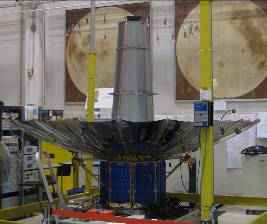
The umbrella-like antenna on the U.S. Navy's experimental TacSat 4 communications satellite has popped open and begun relaying voice messages a week after launching from southern Alaska, according to mission officials.

The 12-foot-diameter antenna opened three days after the craft's Sept. 27 launch aboard a Minotaur 4 rocket from Kodiak Launch Complex in Alaska.

{...}
 
Back
Top