Launch News MUOS-1 atop Atlas V, February 24th, 2012

IronRain

The One and Only (AFAIK)
Administrator
Moderator
Orbiter Contributor
News Reporter
Donator
Joined
Oct 11, 2009
Messages
3,486
Reaction score
407
Points
123
Location
Utrecht
Website
www.spaceflightnewsapi.net
The Mobile User Objective System (MUOS) is a next-generation narrow tactical satellite communications system designed to significantly improve ground communications for U.S. forces on the move.

MUOs will provide military users 10 times more communications capability over existing systems, including simultaneously voice, video and data, leveraging 3G mobile communications technology.

MUOS systems will fully support legacy UHF SATCOM terminals and Joint Tactical Radio System terminals, ensuring its users receive the technological advancements needed without a gap during necessary system upgrades. The MUOS constellation will also provide enhanced geolocation capabilities.

The Atals V will fly in the 551 configuration. This means it has a 5 diameter fairing, 5 solid rocket motors and a single engine Centaur upper stage.

Launch time: February 24th 2012, 5:15 P.M. EST (22:15 UTC)

Atlas_V%28551%29_New_Horizons.jpg

(Atlas V in the 551 configuration during the New Horizons launch)
 
Last edited by a moderator:
Spaceflight Now:

The United Launch Alliance Atlas 5 rocket that will propel the U.S. Navy's next-generation mobile communications spacecraft into orbit Feb. 16 was rolled to the Complex 41 pad at Cape Canaveral this morning for a practice countdown. The giant booster consisting of its bronze-colored first stage, Centaur upper stage and five strap-on solid-fuel rockets was recently assembled together atop the mobile launching platform at the Vertical Integration Facility.
This morning's rollout, which took place just after 10 a.m. EST, is part of the Wet Dress Rehearsal activities that each Atlas undergoes prior to launch. The rocket will be fully fueled tomorrow for a realistic countdown simulation.
The event is designed to iron out any problems with the hardware and exercise the launch team.
Once the simulated launch day is completed, the rocket will be rolled back to the assembly building for final pre-flight work. Attachment of the MUOS 1 satellite payload will occur next week.
Liftoff remains targeted for sunset Feb. 16 during a window opening at 5:46 p.m. EST (2246 GMT).


Mission patch


muos1logo.jpg
 
Spaceflight Now:

[FONT=VERDANA, ARIAL, HELVETICA, SANS-SERIF][SIZE=+2]Atlas 5 rocket topped with Navy's newest satellite

[/SIZE][/FONT]Looking towards launch next week to begin dramatically improving the capacity for U.S. military mobile communications, a new breed of satellite was hauled to the towering Atlas 5 rocket assembly building today for mounting atop the powerful booster.

The Navy's first Mobile User Objective System satellite, dubbed MUOS 1, is scheduled for blastoff next Thursday, Feb. 16, at sunset from Complex 41 at Cape Canaveral, Florida. The 44-minute launch window stretches from 5:46 to 6:30 p.m. EST (2246-2330 GMT). Given the sunset time of 6:13 p.m., a liftoff anytime in the window could be spectacular as the 206-foot-tall rocket rises on a pillar or fire and smoke, weather permitting, of course.
With just 10 days left until flight, MUOS 1 took a middle-of-the-night road trip from the commercially-run Astrotech satellite processing campus in Titusville to the launch site aboard a trailer-like transporter.

The slow-moving drive crossed the river, went northward through Kennedy Space Center, passed by the Vehicle Assembly Building and the old space shuttle launch pad before cruising down along the beach to the Atlas rocket's Vertical Integration Facility.

MUOS 1 was delivered to the Cape on Dec. 15 from Lockheed Martin's factory in Sunnyvale, California, arriving inside an Air Force transport aircraft. The shipping crate was taken to Astrotech where the craft was unboxed for final testing, loaded with maneuvering propellants and encapsulated in the rocket's nose cone.

1.jpg


2.jpg


3.jpg


5.jpg


1.jpg


2.jpg


4.jpg


5.jpg
 
Last edited:
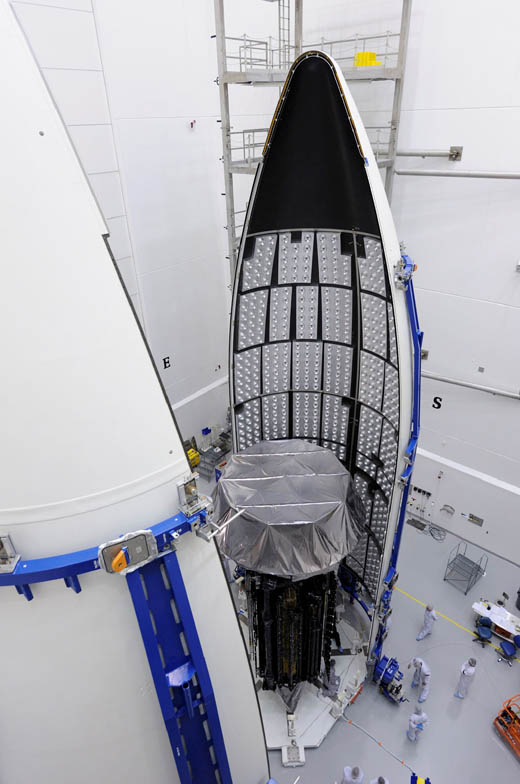
I never understood the purpose of all the little round things on the inside of the payload fairing. Could someone enlighten me?
 
I never understood the purpose of all the little round things on the inside of the payload fairing. Could someone enlighten me?
maybe something as the same usage as pyramid shaped pieces that is used in radio and antenna laboratories, called "Anechoic chamber". (but i'm not sure)
[ame="http://en.wikipedia.org/wiki/Anechoic_chamber"]Anechoic chamber - Wikipedia, the free encyclopedia[/ame]
http://www.wired.com/gadgetlab/2010/07/apple-antenna-lab/
 
I never understood the purpose of all the little round things on the inside of the payload fairing. Could someone enlighten me?
Insulation and vibration protection most likely. They kill any shock waves that are passed through the fairing.
 
Tomorrow is launch day!

The Atlas V was rolled out today and is now on Pad 41 of Cape Canaveral (the northernmost launch pad of the CCAFS).
Countdown begins tomorrow at T-06:20 (10:46 AM EST, 15:46 UTC).
Liftoff is scheduled for 5:46 PM EST (22:46 UTC).
Weather conditions are 80% favorable, only concern are some cumulus clouds. But on Friday is rainy weather with a cold front, so weather conditions drop to 40%.

Countdown Sequence (Eastern is UTC-5):
Spaceflight Now said:
HR:MM..Eastern...Event
T-6:20..10:46am...Countdown begins with rocket power up
T-5:30..11:36am...Weather briefing
T-4:55..12:11pm...Start clearing assembly building area
T-4:20..12:46pm...C-band tracking beacon testing
T-3:40...1:26pm...S-band telemetry link checks
T-2:55...2:11pm...Establish blast danger area roadblocks
T-2:20...2:46pm...Weather briefing
T-2:15...2:51pm...Clear the pad
T-2:00...3:06pm...T-120 minutes and holding (for 30min)
T-2:00...3:31pm...Launch conductor briefing to team
T-2:00...3:33pm...Readiness poll for fueling
T-2:00...3:36pm...Resume countdown
T-1:50...3:46pm...Centaur LOX transfer line chilldown
T-1:43...3:53pm...Begin Centaur liquid oxygen loading
T-1:30...4:06pm...Begin Atlas first stage LOX loading
T-1:25...4:11pm...Centaur LH2 transfer line chilldown
T-1:10...4:26pm...Centaur RL10 engine chilldown
T-1:02...4:34pm...Begin Centaur liquid hydrogen loading
T-0:40...4:56pm...FLight termination system final test
T-0:16...5:20pm...RD-180 engine fuel fill sequence
T-0:10...5:26pm...Weather briefing
T-0:04...5:32pm...T-4 minutes and holding (for 10min)
T-0:04...5:39pm...Readiness poll for launch
T-0:04...5:42pm...Resume countdown
T-0:00...5:46pm..LAUNCH

Edit: The 551-configuration of the Atlas V is actually the most powerful version ever launched. After New Horizons and Juno it's the third launch and the first time not launching an interplanetary probe but a military satellite.
 
Last edited:
5 SRM no less, another big military toy :P
 
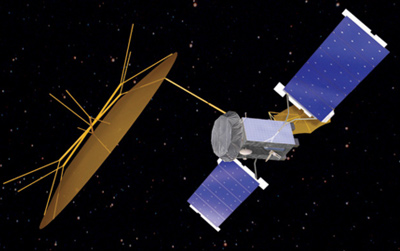
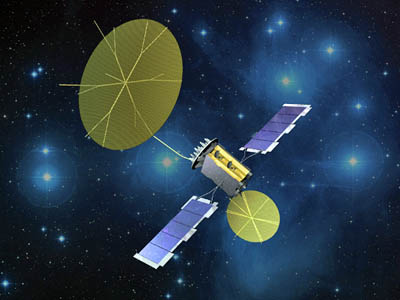
Here're two fact sheets about the 6.8 tonne big satellite that will be launched on this flight. Put it simply, it's the military version of the mobile communication service satellites used by us with satellite phones, satellite TV and satellite Internet access. From video signals of troops on the field to controlling UAVs in a battlefield arena, this and the follow on satellites will gradually replace the 11 UFO (UHF follow-on) satellites used by the DoD since the early 1990s. To achieve this, the satellite has a huge 14 meter diameter mesh reflector antenna to achieve fine-pointing of the signal beams, along with a 17.7-foot-diameter reflector on the bottom of the craft for supporting the original signals.

muos-1__1.jpg


muos_artwork.jpg


P.S. The Atlas V to be used tomorrow (AV-030) will feature the 200th Centaur upper stage built since the first one was launched way back in May 1962!
 
Calendar event for the launch. You can request a reminder for it.


Spaceflight Now:
  • Get to know MUOS' launcher: The Atlas 5 rocket

  • Mission Status Center:
    1545 GMT (10:45 a.m. EST)On the pad! Completing the first third-of-a-mile on the trek to geosynchronous transfer orbit orbit, the Atlas 5 rocket has arrived at the Complex 41 pad for tomorrow's ascent with the U.S. Navy's Mobile User Objective System 1 satellite to begin constructing a new space-based constellation for global mobile communications and replacing the military's aging Ultra High Frequency (UHF) spacecraft fleet.

    "Whether it's in vehicles, on ships, in submarines and aircraft, or simply carried by service members who are dismounted from vehicles and on the move, this system was designed to bring them voice and data communications," said Capt. Paul Ghyzel, program manager of the Navy's Communications Satellite Program Office.

    "As we bring MUOS online, we'll bring up a capability that allows (users) to move around the battlespace and be able to continue to communicate over the horizon. The top requirements for the MUOS system have to with capacity, coverage and link availabilities. So we'll be providing 24-hour-a-day, 7-day-a-week global coverage."

    The two mobile trailers connected to the launching platform, which were part of the convoy during this morning's rollout, soon will be hooked up to power and communications systems at the pad. These trailers provide conditioned air to the payload and communications with the rocket during the rollout and the countdown. They are protected from the blast of launch by a concrete structure on the north-side of the platform.

    Within the next hour, the auto couplers between the pad and platform will be engaged to route umbilical connections from the ground to the rocket for tomorrow's fueling of the booster with cryogenic propellants.

    Later today, the undercarriages used to move the mobile platform will be disconnected and the "trackmobiles" pulled free.

    Ground crews will secure the rocket for a quiet evening leading into tomorrow's launch opportunity. Countdown clocks will start ticking seven hours before liftoff time.

    The day's 44-minute launch window opens at 5:46 p.m. and closes at 6:30 p.m. EST.

  • Atlas/MUOS 1 launch timeline:
    [table="head;width=500"]
    T [HH:MM:SS]
    |Event

    -00:00:02.7​
    |Engine Start

    {colsp=2}
    The Russian-designed RD-180 main engine is ignited and undergoes checkout prior to launch.

    +00:00:01.1​
    |Liftoff

    {colsp=2}
    The five strap-on solid rocket boosters are lit as the Atlas 5 vehicle, designated AV-030 lifts off and begins a vertical rise away from Complex 41 at Cape Canaveral Air Force Station, Florida.

    +00:01:44.6​
    |Jettison SRBs

    {colsp=2}
    Having burned out of propellant approximately 15 seconds earlier, the spent solid rocket boosters are jettisoned to fall into the Atlantic Ocean. The separation event is staggered with two motors releasing first, then the others about 1.5 seconds later.

    +00:03:22.2​
    |Nose Cone Jettison

    {colsp=2}
    The payload fairing that protected the MUOS 1 spacecraft during launch is separated once heating levels drop to predetermined limits after passage through the atmosphere.

    +00:03:27.2​
    |Forward Load Reactor Jettison            

    {colsp=2}
    The Forward Load Reactor deck that supported the payload fairing's structure to Centaur upper stage is released five seconds after the shroud's jettison.

    +00:04:24.1​
    |Main Engine Cutoff

    {colsp=2}
    The RD-180 main engine completes its firing after consuming its kerosene and liquid oxygen fuel supply in the Atlas first stage.

    +00:04:30.1​
    |Stage Separation

    {colsp=2}
    The Common Core Booster first stage of the Atlas 5 rocket separates from the Centaur upper stage. Over the next few seconds, the Centaur engine liquid hydrogen and liquid oxygen systems are readied for ignition.

    +00:04:40.1​
    |Centaur Ignition 1

    {colsp=2}
    The Centaur RL10 engine ignites for the first of three upper stage firings. This burn will inject the Centaur stage and MUOS spacecraft into an initial parking orbit.

    +00:12:21.0​
    |Centaur Cutoff 1

    {colsp=2}
    The Centaur engine shuts down after arriving in a planned low-Earth parking orbit of 90 by 337 nautical miles at 28 degrees inclination. The vehicle enters an 8-minute coast period before arriving at the required location in space for the second burn.

    +00:20:48.9​
    |Centaur Ignition 2

    {colsp=2}
    The Centaur re-ignites to accelerate the payload into a highly elliptical transfer orbit from the parking altitude achieved earlier in the launch sequence.

    +00:26:50.1​
    |Centaur Cutoff 2

    {colsp=2}
    At the conclusion of its second firing, the Centaur will have ascending into a 104 by 18,600 nautical mile orbit inclined 26 degrees to begin a two-and-a-half-hour coast.

    +02:56:50.4​
    |Centaur Ignition 3

    {colsp=2}
    A final push by Centaur is ignited to raise the orbit's low point and reduce orbital inclination for the MUOS spacecraft.

    +02:57:44.2​
    |Centaur Cutoff 3

    {colsp=2}
    The powered phase of flight is concluded as the Centaur, making its 200th launch, reaches the planned geosynchronous transfer orbit of 1,870 by 19,323 nautical miles and 19 degrees inclination.

    +03:01:23.2​
    |Spacecraft Separation

    {colsp=2}
    The U.S. Navy's first Mobile User Objective System spacecraft, MUOS 1, is released into orbit from the Centaur upper stage to complete the AV-030 launch.
    [/table]​

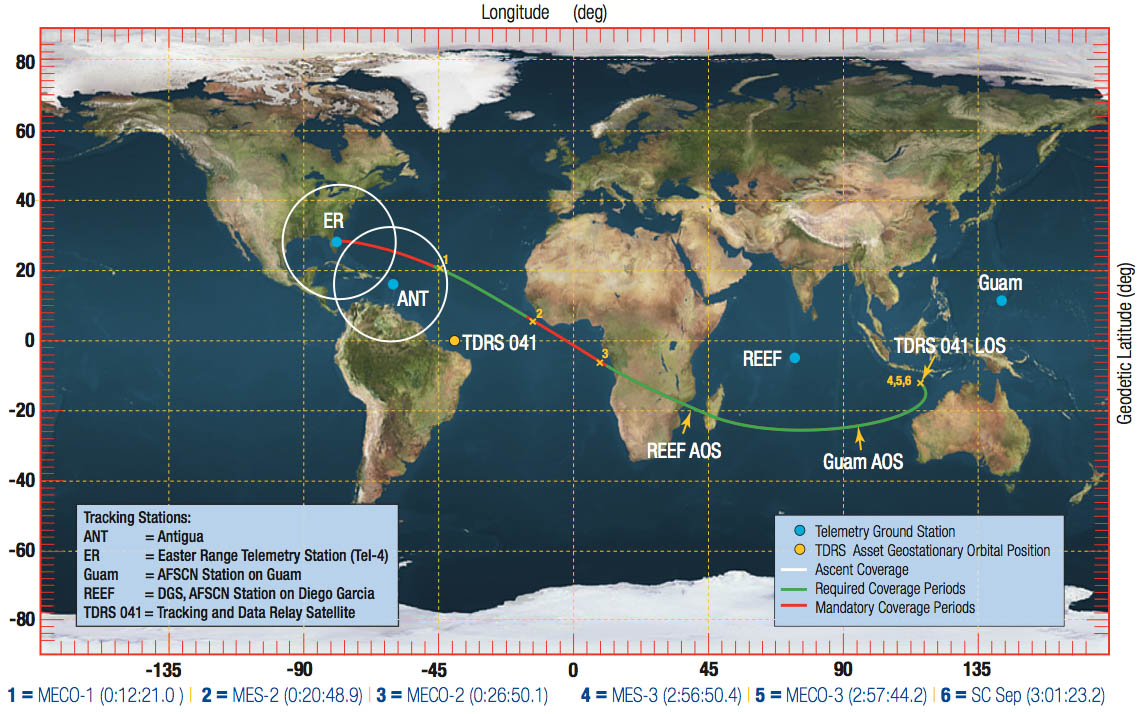
  • Atlas launch ground track:
    map_full.jpg

  • MUOS 1 encapsulated for launch (PHOTO GALLERY)
  • MUOS 1 hoisted atop its Atlas launcher (PHOTO GALLERY)
  • Atlas 5 rocket rolled out to launch pad (PHOTO GALLERY)

SPACE.com: US Navy to Launch Advanced New Military Satellite Thursday
 
T-1 hour and counting. Tanking is underway. There are no any technical issues being worked at this time. Weather remains at 80 percent chance of favorable conditions for launch at 22:46 UTC / 5:46 p.m. EST.

Currently live on Spaceflight Now's Livestream.

NASASpaceflight: Atlas V set to launch MUOS – Historic Centaur milestone


Some more rollout and at the pad photos -

Spaceflight Now:
Rollout timelapse video:
 
WOW, it was reported that John Glenn is at the Cape for this launch to celebrate his own flight on Friendship 7 on an Atlas nearly 50 years ago! :blink:

BTW it was reported that the team is aiming at ~23:10 UTC for launch to wait for the upper level winds to die down.
 
Last edited:
New T-0 at 23:29 UTC.
 
T-4 minutes and counting. The countdown has resumed for liftoff at 23:29 UTC / 6:29 p.m. EST.


Here's a look at some stats about today's mission. This will be:
  • The 611st launch for Atlas program since 1957
  • The 323rd Atlas to occur from Cape Canaveral
  • The 200th mission for Centaur upper stage
  • The 177th use of Centaur by an Atlas rocket
  • The 29th launch of an Atlas 5 since 2002
  • The 25th Atlas 5 to occur from the Cape
  • The 21st Atlas 5 under United Launch Alliance
  • The 8th Atlas 5 launch overseen by the Air Force
  • The 9th 500-series flight of the Atlas 5
  • The 3rd Atlas 5 to fly in the 551 configuration
  • The 1st Atlas launch of 2012
 
SCRUB. Hold at T-01:15 with no remaining time in window for recycle.

24-hour turnaround.


The outlook for tomorrow predicts only a 40 percent chance of acceptable weather due to thick clouds and disturbed conditions from a passing cold front.

The launch window outlook calls for a scattered clouds at 2000 feet, broken decks at 4500 and 9000 feet, overcast skies at 23000 feet, rain showers in the area, good visibility, easterly winds of 9 - 14 knots / 4.6 - 7.2 m/s, and a temperature of 21°C / 70°F.
 
SCRUB. Hold at T-01:15 with no remaining time in window for recycle.

24-hour turnaround.

Tomorrow's launch window starts at 22:42 UTC (5:42 pm EST). Weather may however be a concern here: weather forecast predicts that there's only a 40% chance of weather permitting launch.
 
:blink: Launch window?

Why a launch window for geostationary orbit? You're launching to a "target" that's defined by ground position. That should be the same an hour from now, or tomorrow. I assume it's some kind of sun/heating issue?
 
From my experience, I think it has something to do with how the USAF schedules the AMR tracking stations.
 
Back
Top