• ORBITER-FORUM will be temporarily closed at 2026-07-23 18:00 UTC while we complete some OF maintenance tasks. The amount of downtime is expected to take up to one hour, but probably less.

Orbiter Screenshot Thread

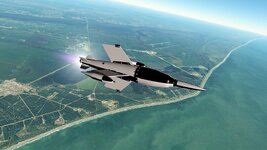
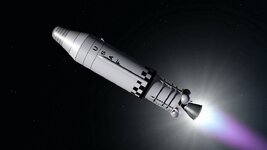
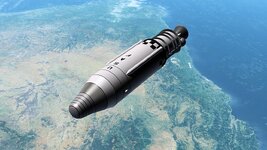
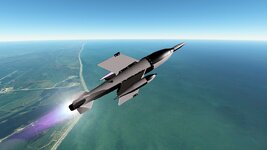
Ruhrstahl X-4: Not exactly 'orbital' in nature, the X-4 was an air-to-air wire-guided missile developed by Germany during WWII - but was never deployed during wartime. Another example of a missile precursor that inspired further work and later developments in the field of rocketry science.

SCREENSHOT 06.jpg

SCREENSHOT 07.jpg

I cheated a bit here; these images were captured after launching from the ground at Cape Canaveral (LC14). And, maybe I could use better exhaust textures. Anyway.

cs
 
Last edited:
Yeah, for Surface to Air use, there was the radio guided Wasserfall missile. :D
 
Great shots. I imagine all of those variables (metal textures, nomals, spec maps) are tricky on their own, and the possible combinations are endless. The ones you have here are very convincing.
 
The ones you have here are very convincing.
Thanks! Yes, it is tricky to find a good combination. The very basic material parameters like color and reflective color are always a bit different in the 3D-modelling program compared to Orbiter's rendering. My very first tries looked more like granite stone, not like metal.

I found a site online that creates normal maps from the textures, which is very helpful! The rest is trial and error. :giggle:
 
🧼

maxresdefault.jpg
 
Default Orbiter 2024 sun does not look good at all in most screenshots. "My" sun is better, I managed to change high frequency spikes (more blurred, so it's better).
 
Could you maybe post your sun texture? It may be interesting to compare the visuals. ☀️:cool:
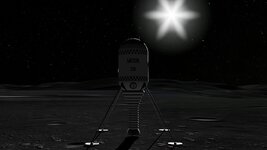
I edited part of glare.hlsl, (backup the file though) and replace these parts (file is in Modules\D3D9client folder):
I think I edited mostly rows with " // High frequency spikes "

// ====================================================================
// Creation of "glare" textures
// ====================================================================


// ======================================================================
// Render sun "Glare" (seen in space)
//
float4 CreateSunGlarePS(float u : TEXCOORD0, float v : TEXCOORD1) : COLOR
{
u = u * 2.0 - 1.0; v = v * 2.0 - 1.0;

float a = atan2(u, v);
float r = sqrt(u * u + v * v);

float q = 0.5f + 0.3f * pow(sin(3.0f * a), 4.0f);
float w = 0.5f + 0.2f * pow(sin(30.0f * a), 2.0f) * pow(sin(41.0f * a), 2.0f);

//float I = pow(max(0, 2.0f * (1 - r / q)), 12.0f);
//float K = pow(max(0, 2.0f * (1 - r / w)), 12.0f);
//float I = exp(max(0, 10.0f * (1 - r / q))) - 1.0f;
//float K = exp(max(0, 10.0f * (1 - r / w))) - 1.0f;

float L = pow(max(0, (1 - r / q)), 2.0f) * 3.0f; // Low frequency spikes
float H = pow(max(0, (1 - r / w)), 8.0f) * 5.0f; // High frequency spikes
float C = ilerp(0.03, 0.01, r) * 7.0f; // Core
float S = ilerp(1.7f, 0.35f, r); // Skirt

C *= C;
C += S * S * 0.40f;

return float4(max(L + C, H + C), 0, 0, 1);
}


// ======================================================================
// Render sun "Glare" (seen in atmosphere)
//
float4 CreateSunGlareAtmPS(float u : TEXCOORD0, float v : TEXCOORD1) : COLOR
{
u = u * 2.0 - 1.0; v = v * 2.0 - 1.0;

float a = atan2(u, v);
float r = sqrt(u * u + v * v);

float q = 0.5f + 1.0f * pow(sin(3.0f * a), 4.0f);
float w = 0.5f + 0.8f * pow(sin(10.0f * a), 2.0f) * pow(sin(6.0f * a), 2.0f);

float I = pow(max(0, (1 - r / q)), 3.0f) * 4;
float K = pow(max(0, (1 - r / w)), 8.0f) * 8;

float L = ilerp(0.05, 0.01, r) * 16.0f;
float T = max(0, max(I + L, K + L)) * 2.0f;

return float4(T, 0, 0, 1);
}
 
0164.jpg
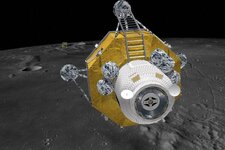
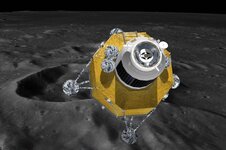
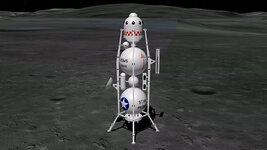
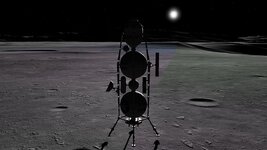
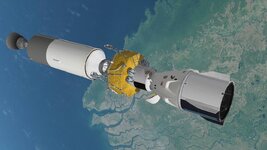
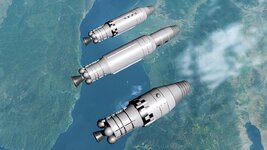
High over the Sundarbans a Dragon capsule is delivering the crew to the Lunar excursion vehicle (LEV). The three-day flight to the Moon will be a bit cramped in the small cabin of the LEV. Note the FalconHeavy upper stage has a grey stripe to prevent the fuel from freezing while it was waiting for the crew to arrive.
 
View attachment 42879
High over the Sundarbans a Dragon capsule is delivering the crew to the Lunar excursion vehicle (LEV). The three-day flight to the Moon will be a bit cramped in the small cabin of the LEV. Note the FalconHeavy upper stage has a grey stripe to prevent the fuel from freezing while it was waiting for the crew to arrive.
Question. How do they get home ?
 
Question. How do they get home ?
That's a bit longer story, described in full here: Moon Direct - A purpose-driven plan to open the lunar frontier.

Before the crewed mission, uncrewed mission(s) set up an automated base on the Lunar surface, with a refuelling depot.
Then: LEV to parking orbit on a FalconHeavy. Crew of 2 to LEV on a Falcon9 in a Dragon Capsule. TLI burn of LEV on the FalconHeavy 2nd stage.
LEV Moon orbit capture and landing at the pre-deployed base. One week stay. Refuelling. Direct launch back to Earth. Propulsive capture of the LEV into LEO. Re-docking with Dragon. Crew returns to Earth in the Dragon capsule.
 
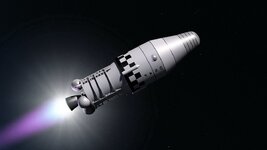
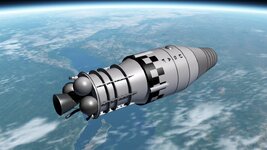
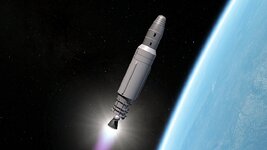
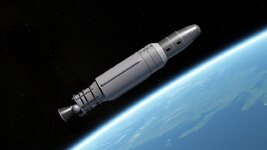
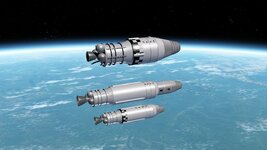
Agena upper stages. The CORONA program, active primarily during the 1960s, deployed a series of satellites for the purposes of photographic reconnaissance. Early satellites within the program ran under the name 'Discoverer' and later missions flew under the name 'Keyhole' (KH). Most of these were launched on top of Thor boosters (some of the later missions employed Titan). Here are a few representatives flying in Orbiter 2024.

KH-1 CORONA ("C" model - single panoramic camera); Agena-A module:

AGENA-A_01.jpg

AGENA-A_02.jpg

KH-2 CORONA ("C Prime" model - improved panoramic camera); Agena-B module:

AGENA-B_01.jpg

AGENA-B_02.jpg

KH-4 CORONA ("MURAL" model - 2 cameras for stereoscopic imaging); Agena-B module:

AGENA-C_01.jpg

AGENA-C_02.jpg

KH-1, KH-2, and KH-4 flying in tandem formation (a fantasy scenario):

AGENAs_01.jpg

AGENAs_02.jpg

Hi-Ho,

cs
 
Back
Top