Launch News Progress M-13M atop Soyuz-U on Oct 30, 2011

For those who missed it, here is the whole video for the Progress docking:

 
http://www.mcc.rsa.ru/English/cup.htm

“Progress M-13M”: undocking tomorrow
MCC PAO, the 23th of January, 2012

At the International Space station are prepared to undocking operation of “Progress M-13M”.

Earlier, Russian crew members of thirtieth long ISS expedition completed the packing of disposed goods to "Progress M-13M", installed in the spaceship the transportation and launch container with microsatellite "Chibis-M" and then close the passageways between the truck and the docking bay - "Pierce", in which the ship stays from November 2 last year.


According to the preliminary data of the ballistic service of TsNIImash Mission control centre, January 24, at 02:07 MSK (01/23/12 22:07 GMT) a command to “Progress M-13M” and ISS undocking will be send, after 3 minutes the cargo vehicle will be separated from the station. After that, by using of two primary engines, the spacecraft will be moved to the higher orbit with average high – 500 km. According to calculations, the first switch on is scheduled in 05:35:13 MSK (01:35:13 GMT), the second one in 06:22:00 MSK (02:22:00 GMT).


January 25, in 3:18:30 (01/24/12 23:18:30 GMT) “Chibis-M” will separate from the space transport and will start its own mission on the near-earth orbit.
 
Is there a diagram how the microsatellite is attached to the Progress?

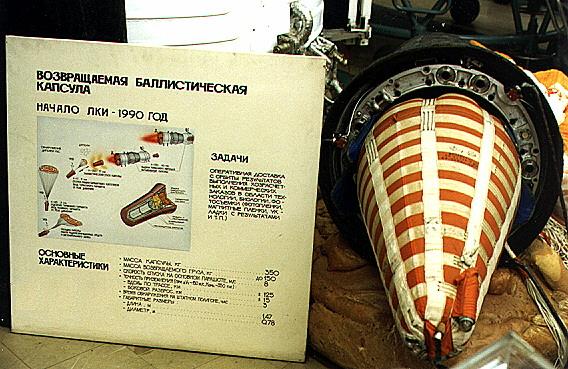
Good question. None, as far as I know. In my idea, the deployment should be similar to how Raduga reentry capsules were placed: put inside the docking port:

procapka.jpg


But I may be wrong.
 
Is there a diagram how the microsatellite is attached to the Progress?

I don't have a diagram, but ST is correct: The satellite and its deploy system is attached to the forward hatch, in place of the removable docking probe. I'll try and find a picture for you.
 
I have just been enlighted by Nicolas Pillet about it. The scheme of Chibis-M placement inside progress is similar to how "Inspector" spacecraft was packed a while ago.

imgp3110.jpg


Left side of the picture shows the launch position of the satellite container. At right is the deployment position: ISS crew have removed the docking probe and replaced it with the payload deployment collar with the satellite container in the middle. After the Progress boosts its orbit, spring will push the Chibis out. Like at 1:20 in this video:

 
ISS crew have removed the docking probe and replaced it with the payload deployment collar with the satellite container in the middle. After the Progress boosts its orbit, spring will push the Chibis out.

And because of this, Progress M-13M was depressurised to vacuum following hatch closure - an unusual procedure which meant that all trash in M-13M had to be "certified" for vacuum - don't want any "solid wastes" rapidly expanding inside the cargo compartment. :sick: :lol:
 
http://www.federalspace.ru/main.php?id=2&nid=18604

Microsatellite Chibis-M has been put into orbit
:: 25.01.2012

January 25, at 03:18:30 MSK (23:18:30 / Jan 24 UTC) a small spacecraft Chibis-M has separated from space freighter Progress M-13M and began its autonomous mission.

Accroding to ballistician service of MCC, the microsatellite has been put into an orbit with parameters:

  • Minimum altitude above Earth - 497.535 km
  • Maximum altitude above Earth - 513.607 km
  • Orbital period = 94.55 min
  • Inclination 51.62 degrees

Few minutes after the separation, first telemetry has been received from Chibis-M. It confirmed that all service systems went online.

[...]

Orbit raising has been done to shape a working orbit for Chibis-M spacecraft that is intended for performing of a new Geo-Physical experiment to study physical processes that correlate with atmospheric lightning discharges.

The spacecraft was created in Institute of Space Research of Russian Academy of Science in collaboration with other scientific institutions.

About 1/3 of the spacecraft's mass is an assembly of instruments called Groza (Russian: Thunderstorm). It's the 1st time when one satellite carries a range of observation instruments covering all bands of electromagnetic spectrum, from Gamma to Radio waves. This, as researches hope, will allow to register a large number of processes that happen during lightning discharges.

Groza assembly consists of detectors of X-Ray, Gamma, Ultra-violet and Radio bands 20-50 MHz, to register radiation emitted by electric discharges at altitudes between 13 and 20 km. Also it has instruments to study plasma fluctuations. To correlate these processes with lightning events, the assembly is also outfitted with a digital visible light camera.

[...]

The mass of microsatellite is about 40 kg.

The dimensions with antennae and solar arrays deployed are 1250x96 mm.

 
http://www.federalspace.ru/main.php?id=2&nid=18605

Flight of Progress M-13M is over.
:: 25.01.2012

January 25th, the flight of cargo spaceship Progress M-13M has been finished.

In agreement with the program, uploaded by the MCC into its onboard computer, the spaceship has burned its main engine for deceleration at 06:25:00 MSK (02:25:00 UTC). After 235.3 seconds long burn, it has decreased the orbital speed of the vehicle by 125.6 m/s. After that, Progress M-13M has deorbited and ceased its existence over the Southern Pacific.

Coordinates of the centre of deposit of the spaceship's remnants are 51,4°S 128,2°W.

The time of impact was 07:17:55 MSK (03:17:55 UTC).
 
Two things to add about Chibis-M is that:
1. Spacecraft separation process was likely recorded by the onboard camera and (if the video quality is found passable, might be released to public).
2. Expected lifetime in the orbit is about 2 years.
 
Back
Top