

Soheil_Esy
Fazanavard فضانورد
- Joined
- Apr 5, 2015
- Messages
- 744
- Reaction score
- 20
- Points
- 18
15 Sep 2015
The Defence & Security Equipment International (DSEI) opens its gates to the international defence community in London every two years.
At its exhibition stand S7-110, the high technology group specialising in Security and Mobility will also showcase its leading role in the field of High Energy Laser (HEL) effectors. An Air Defence HEL effector capable of engaging low, slow, small (LSS) threats will be presented at a European Defence show for the very first time. The German defence contractor will also be showing an HEL effector for maritime applications for the first time.
http://www.rheinmetall-defence.com/...c_relations/news/latest_news/details_8256.php
16 September 2015
Rheinmetall displayed its latest high energy laser (HEL) configuration at DSEI 2015, with five 20 kW-class laser beam forming units (BFU) fitted to an MLG27 light naval gun mount.
Dr Markus Jung, Rheinmetall's vice-president for directed energy, told IHS Jane's that the system is a Technology Readiness Level 7 demonstrator and confirmed that the company is conducting a programme of over-water firing trials. He said targets to date have mostly comprised small surface craft, but unmanned aerial vehicles were also anticipated to be within the target set.
The BFUs are essentially the same systems as seen previously fitted to a Skyshield 35 mm air defence gun mount, a Boxer armoured vehicle, an ISO container, and other platforms, albeit contained within marinised protective housings. The laser generators and power units were not on display as they would be installed below decks on a naval platform.
Rheinmetall's HEL project is largely being internally funded, but with some direct investment from the German government. Until recently, the company's demonstrations had mostly centred on land-based systems for air defence, counter-rockets, artillery and mortar, and some anti-materiel roles, but Dr Jung said that "the customer is looking more at naval applications, so we're focusing on that".
However, he added that Rheinmetall's concept envisioned a suite of HEL weapons for a range of land, naval, and potentially air applications, which would be comprised of 80-90% common components and could, therefore, be held in a central store and swapped between users as required.

Front view of Rheinmetall's MLG27-mounted laser weapon, showing the weather flaps in their open positions and BFUs just visible.

Rear view of Rheinmetall's MLG27-mounted laser weapon.
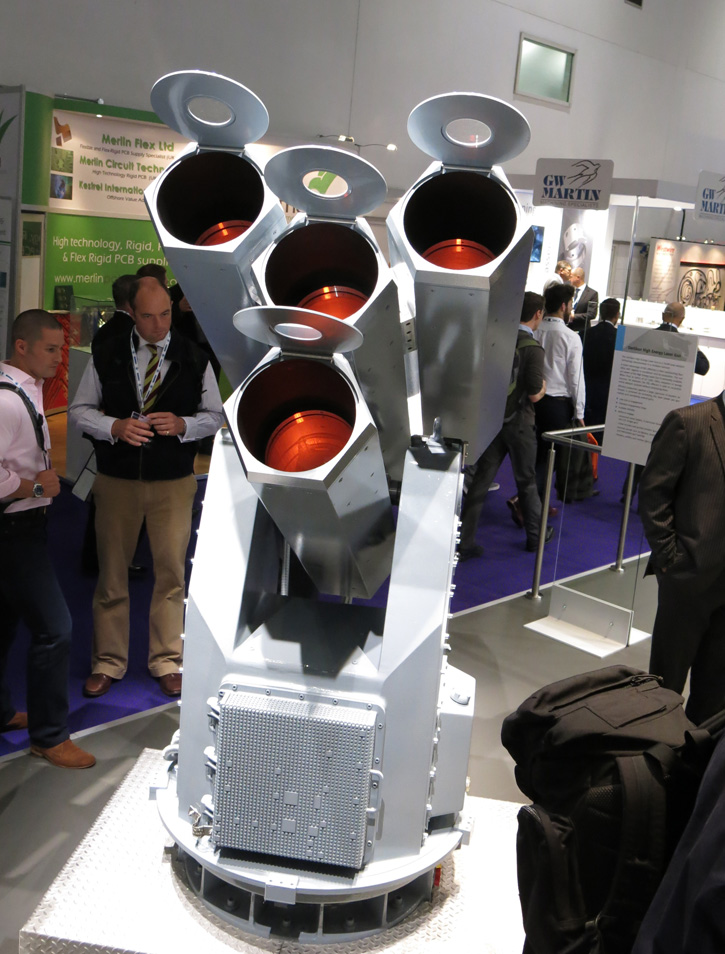
Another innovative weapon system approach from Rheinmetall Defense. These four 20kW lasers modules are coupled into a multi-effector system emitting 80 kW, where all lasers operate in synch, to yield the higher overall emission. More laser emitters can be stacked to create a hundred kW class laser effector, utilizing an effective and proven beam concentration. These lasers have already demonstrated the capability to defeat mortar rounds at a distance of few kilometers, in two seconds, and multiple unmanned aerial vehicles at distances of 500 meters.
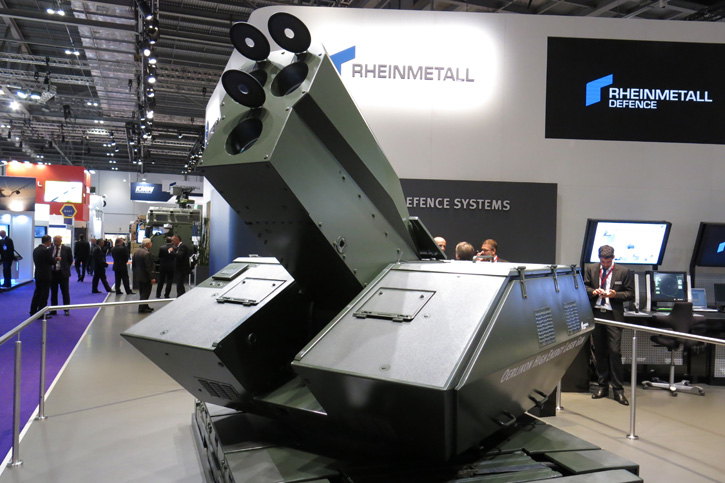
The laser interceptor from Rheinmetall could one day provide a central effector for Skyguard air defense systems. This specific interceptor packs three 20kW lasers enabling defeat of fast flying aerial target such as mini UAVs.
http://www.janes.com/article/54340/dsei-2015-rheinmetall-shows-off-navalised-laser-mount


