Cygnus gently fired its thrusters to move out of the vicinity of the Space Station before placing itself into an orbit about five Kilometers above that of ISS.
Safely in free flight, Cygnus powered up the SAFFIRE-II experiment payload five hours after departing the Space Station.
SAFFIRE-II – the second Spacecraft Fire Experiment – follows up on the first SAFFIRE run in June on the Cygnus OA-6 mission but is substantially different in its experimental setup and objectives. While SAFFIRE-I studied a large scale fire using a 1.0 by 0.4-meter piece of fabric, SAFFIRE-II set out to ignite nine smaller samples to examine the Zero-G flammability of different materials.
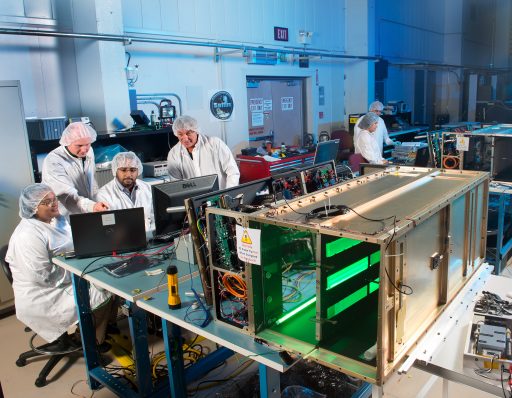
Saffire II hardware-Photo: NASA
The SAFFIRE experiments make use of the Cygnus spacecraft as a vessel to conduct experiments not possible within the strict safety regulations of ISS as a crewed spacecraft.
The uncrewed end-of-mission portion of Cygnus flights offer a safe testbed as no humans or expensive hardware is exposed to a potentially dangerous experiment. Nevertheless, SAFFIRE still is designed with safety in mind – igniting samples in a controlled environment and a closed sample container, also employing several safety barriers to prevent inadvertent ignition.
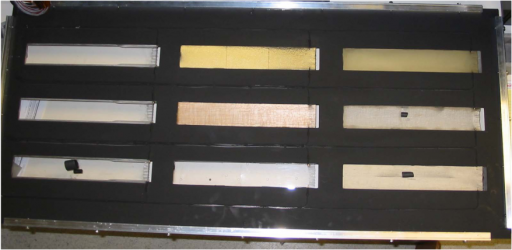
The first SAFFIRE Experiment ignited the largest intentional fire ever set in space and employed cameras and different sensors to document flame growth, temperatures and oxygen use to assess how microgravity and limited oxygen affect the properties of a fire. SAFFIRE-II hosted nine different sample cards, each 5 by 30 centimeters in size, ignited by a hot wire at the bottom and monitored by cameras and various temperature, airflow and oxygen sensors.
The SAFFIRE-II samples were selected from materials commonly found on spacecraft to assess the fire hazards they may pose in a microgravity environment. Four samples were a silicon material of different thickness, samples 5 & 6 were the same cotton-fiberglass blend ignited on SAFFIRE-I, and the others were Nomex and acrylic glass samples.
SAFFIRE II Sample Card – Photo: NASA
NASA’s Glenn Research Center is in charge of the experiment with representatives present at Orbital ATK’s Dulles Mission Control facility to send commands for the activation of the experiment for some checkouts before committing to igniting the first sample. Ignition of the first sample was confirmed at 0:14 UTC on Tuesday and it took around two and a quarter hours for all samples to burn.
According to the SAFFIRE Project, the experiment hardware functioned as intended and data & images were recorded for all samples plus air flow data to put the combustion dynamics into the required context of airflow and oxygen availability. Within 24 hours of the initiation of the experiment, NASA released the first videos of the Nomex and Plexiglas samples.
The overall goal of SAFFIRE-II is to assess the flammability of different spacecraft materials as well as their Maximum Oxygen Concentration (MOC) flammability limits. Scientists will now comb through a wealth of data delivered by SAFFIRE-II to come to firm conclusions on the flammability of the materials and to learn more about flame spread dynamic in space which has been a challenge in previous experimental setups.
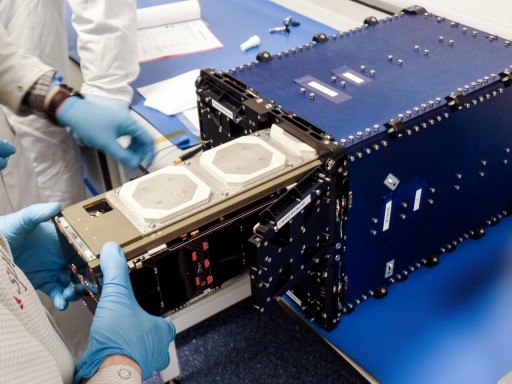
Photo: NASA Glenn
Despite decades of combustion experiments run in space, only few tests have studied spacecraft fire safety and none have studied environment sizes typical for a spacecraft fire due to obvious concerns of conducting this type of experiment in an inhabited spacecraft. Due to the lack of firm data, spacecraft manufacturers use models and standards for terrestrial fires when designing spacecraft fire safety systems.
Although this approach has been successful thus far, there is inherent risk given the level of uncertainty in modeling large-scale fires in space. SAFFIRE is the first experiment to address the need for firm data on material flammability and flame spread dynamics to make future spacecraft safer.