Updates Ares Updates and Discussion

Ares-IX is a test flight to gether data for validating models, which has an impact on future test flights and the final Ares1 design.

Flight data which will mean very little, since Ares-IX has nothing in common with Ares-I.

Ares-IX is a new launch vehicle. A single SRB never has been used as a first stage on such a configuration.

Uh, yeah. I said that Ares-IX was not new, not Ares-I itself.

Soyuz for example does not look less like a pencil at all after first stage separation.

Huh? I never said anything about Soyuz being an asthetically pleasing launch vehicle. I was only comparing Ares-I to the Saturn-IB

What I like on the Ares1 design is its clarity and simplicity.

Huh? It is neither clear nor simple- then again, most rockets are not.

And because it uses flight proven hardware in a new and safer configuration than STS does

"New" seems to be your buzzword, but "new" means nothing- NASA could be peddling an SRB launched by a billion firecrackers arranged in a fibonnachi sequence, which would also be "new". "New" does not mean "a good idea".

The only thing safer about Ares-I is that is has an escape option that STS does not. There are potentially a multitude of issues that could lead to a loss of crew.

The solid rocket first stage is that much of a good idea that NASA is seriously going to use it.

Oh really? NASA also seriously wanted the Shuttle, which has proven itself to not be that much of a good idea. Just because NASA says they're going to use does not mean that it's a good idea (or that they'll actually end up doing it).

For solids there is no need for elaborate fuel storage and fueling mechanisms at the launch pad. The fuel also does not need to be elaborately kept at a certain temperature. On the whole solids consist of less elaborate, sensitive and less high-maintenance propulsion technology.

Yes, but they have their own problems. For one, they cannot be fueled at the pad- they have to be fueled while the vehicle is mated together, which leads to long stays at the pad and potential safety issues.
 
Last edited:
What if NASA dropped the problematic 5-segment SRB, and used a 4-segment with lift-off boosters to make up the DV? Has this configuration been considered?
I don't know if the 4-segment SRB would be able to manage without the mass damper, but AFAIK it doesn't have the pogo resonance problems.
I wonder if Ares-1 is too far into the design to make such a big change.
 
Flight data which will mean very little, since Ares-IX has nothing in common with Ares-I.

Ares-IX does not have to be 100% similar to Ares1. Computer models and wind tunnel models are also not 100% similar to final airplanes and other final rockets (nor are heat shields used for tests 100% similar to the real ones in size and relation to atmospheric entry). It is about gathering data to improve modeling and predictions.

It would not be a smart idea to completely build a fully operational Ares1 launch vehicle to test it and discover that something of the design has to be changed.

Uh, yeah. I said that Ares-IX was not new, not Ares-I itself.

Ares-IX has never been build and launched before. It's a new launch vehicle, just like Ares1 is, which also never has been build and launched before.

Huh? It is neither clear nor simple- then again, most rockets are not.

Ares1 is not most rockets at all, already because of its unique first stage. The Space Shuttle stack already is way more complex and elaborate than Ares1. Especially the Orbiter. Like Ares1, Soyuz also is a simpler configurated launch vehicle than the Shuttle. It is a cheap and reliable design for decades. The Shuttle has caused roughly a decade of not flying into space manned. The most gap producing program for now.

"New" seems to be your buzzword, but "new" means nothing- NASA could be peddling an SRB launched by a billion firecrackers arranged in a fibonnachi sequence, which would also be "new". "New" does not mean "a good idea".

Ares1 is a completely new launch vehicle. But for those who don't like the word new and want to play with words and definitions, I agree to replace new by different. Anyway, never has a solid rocket been used as a single first stage. The second stage also did not already exist before, just like Orion as well. Ares1 is something new/different (or whatever people may want to call it) that NASA does. It is not related to good or bad, which is individual opinions like the Shuttle, Apollo and any program was and will be accompanied with.

The only thing safer about Ares-I is that is has an escape option that STS does not. There are potentially a multitude of issues that could lead to a loss of crew.

There are always a multitude of issues that could lead to a loss of crew of any system. Space flight is about flying on top of thousands of tons of explosives no matter if its liquid or solid, about traveling with high kinetic energy within an artifical "world" we call spacecraft, far away from our safe home. People should always keep that in mind. Safety and certainty is something that is more narrow in space flight than one might think and wish.

The launch escape system of Ares1 is not the only safer improvement in relation to the Shuttle. The thermal protection system of Orion is completely covered during early ascent and can not be potentially hit by foam during any phase of ascent. The less elaborate stack/launch vehicle also won't for sure cause that many delays and depending costs than the Shuttle does and did. It's already not that much high-maintenance -> no complex reusable delay causing SSME's and its depending systems and issues.

NASA also seriously wanted the Shuttle, which has proven itself to not be that much of a good idea. Just because NASA says they're going to use does not mean that it's a good idea (or that they'll actually end up doing it).

The Shuttle was an amazing gain of knowledge and experience beside those two losses. Its risky outcomes will increase future safety of Orion and how it gets into space.

Yes, but they have their own problems. For one, they cannot be fueled at the pad- they have to be fueled while the vehicle is mated together, which leads to long stays at the pad and potential safety issues.

Long stays of Ares at the pad won't be more risky than the Shuttle at the pad for month, which always includes two fully operational solid rocket boosters and had never been a serious safety issue at all.

Those solid rocket booster safety concerns are no longer vaild for decades. I also was concerned still a few years ago until I had to change my mind because of the facts that speak for itself. The only valid concern in relation to Ares1 is potential vibrations during first stage ascent. And that is something that can be ruled out. The word "impossible" does not exist in this case.

 
Ares-IX does not have to be 100% similar to Ares1. Computer models and wind tunnel models are also not 100% similar to final airplanes and other final rockets (nor are heat shields used for tests 100% similar to the real ones in size and relation to atmospheric entry). It is about gathering data to improve modeling and predictions.

Yes, but it does have to have an acceptable degree of similarity. Which it does not.

Ares-IX has never been build and launched before.

No, Ares-IX has not been built before, but the 4-seg booster has (and it is the only real working component in the vehicle).

Ares1 is not most rockets at all, already because of its unique first stage. The Space Shuttle stack already is way more complex and elaborate than Ares1. Especially the Orbiter. Like Ares1, Soyuz also is a simpler configurated launch vehicle than the Shuttle. It is a cheap and reliable design for decades. The Shuttle has caused roughly a decade of not flying into space manned. The most gap producing program for now.

Do you know the effort and money that goes into the design, construction and operation of a launch vehicle?

Simplicity is relative but I don't see Ares-I being any major advancement in that matter.

Ares1 is something new/different (or whatever people may want to call it) that NASA does. It is not related to good or bad, which is individual opinions like the Shuttle, Apollo and any program was and will be accompanied with.

Read my previous post- "new", "different" etc means nothing, just like appearances. Just because it is "different" does not mean that it will work.

The launch escape system of Ares1 is not the only safer improvement in relation to the Shuttle. The thermal protection system of Orion is completely covered during early ascent and can not be potentially hit by foam during any phase of ascent. The less elaborate stack/launch vehicle also won't for sure cause that many delays and depending costs than the Shuttle does and did. It's already not that much high-maintenance -> no complex reusable delay causing SSME's and its depending systems and issues.

Foam strikes are not an ascent danger. While the damage they cause occurs during ascent, their occurance does not affect the ability of the vehicle to reach orbit.

The lack of SSMEs and simpler stack as safety improvements are negated by the other issues presented by the design of Ares-I.

The Shuttle was an amazing gain of knowledge and experience beside those two losses. Its risky outcomes will increase future safety of Orion and how it gets into space.

STS is not a bad idea because it failed on two occasions. It is a bad idea because it is incredibly expensive and it does not perform in the manner that it was expected to.

If you think the sole purpose of STS was to pave the way for Orion, you're wrong. STS was intended to make spacecraft like Orion obsolete.

Long stays of Ares at the pad won't be more risky than the Shuttle at the pad for month, which always includes two fully operational solid rocket boosters and had never been a serious safety issue at all.

Those solid rocket booster safety concerns are no longer vaild for decades. I also was concerned still a few years ago until I had to change my mind because of the facts that speak for itself. The only valid concern in relation to Ares1 is potential vibrations during first stage ascent. And that is something that can be ruled out. The word "impossible" does not exist in this case.

Long stays at the pad are not a risk issue, but they do present engineering problems relating to the exposure of the vehicle to the elements.

While a Challenger-like failure with current SRB designs is impossible, there are other potential failiure routes, as no system is 100% reliable.

It isn't the fact that Ares-I uses an SRM, but the manner in which it uses it that creates safety issues.
 
The only valid concern in relation to Ares1 is potential vibrations during first stage ascent. And that is something that can be ruled out. The word "impossible" does not exist in this case.
TO can't be "ruled out" yet. Another valid concern is the published USAF claim that Max-Q introduces a zone in which the escape rocket can't pull Orion away fast enough.
 
Yes, but it does have to have an acceptable degree of similarity. Which it does not.

No, Ares-IX has not been built before, but the 4-seg booster has (and it is the only real working component in the vehicle).

Ares-1X does not need to be an entire real working vehicle. Stacking, launch and recovery is being tested by Ares-1X together with data measuring for future modeling. The 5-segment SRB test by ATK will also contribute to conclusions and modeling of Ares1 without even being launched.

Simplicity is relative but I don't see Ares-I being any major advancement in that matter.

In relation to the Shuttle it is that much a major advancement for the purposes of Constellation that NASA has chosen it.

Read my previous post- "new", "different" etc means nothing, just like appearances. Just because it is "different" does not mean that it will work.

That new/different means nothing, also does not mean that it won't work.

Beside those useless play of words, both, the 4-segment and the 5-segment SRBs do work perfectly. There is no doubt that the 5-segment SRB will be able to lift the second stage and Orion. Potential vibrations are reducible. The only real serious issue at the moment is budget.

Foam strikes are not an ascent danger. While the damage they cause occurs during ascent, their occurance does not affect the ability of the vehicle to reach orbit.

Well, we move in a circle with those play of words. I wrote that the TPS is covered during early ascent which makes damade to the TPS by foam strike quite impossible. I did not wrote anything about reaching orbit. That foam strike affects the vehicles (Shuttles) ability to bring the crew home alive should be self-explanatory. That the covered TPS of Orion makes any missions more safe and does not require time consuming OBSS and photography procedures is not arguable.

The lack of SSMEs and simpler stack as safety improvements are negated by the other issues presented by the design of Ares-I.

Which issues?

STS is not a bad idea because it failed on two occasions.

Right. I didn't say so by the way.

If you think the sole purpose of STS was to pave the way for Orion, you're wrong.

I didn't say so as well. I say that its risky outcomes will increase future safety of Orion.

STS was intended to make spacecraft like Orion obsolete.

More than that. It was intended to make manned space exploration beyond LEO obsolete on the whole. It followed a totally different vision than Apollo did and Constellation does. The latter is a valid reason to make the Shuttle obsolete to clear the way for Orion and the ability to do seomthing else beyond LEO in future.

Long stays at the pad are not a risk issue, but they do present engineering problems relating to the exposure of the vehicle to the elements.

Well, like new and different, you may call risk issue "safety issue". Because not me but you wrote that they have to be fueled while the vehicle is mated together, which leads to long stays at the pad and potential safety issues.

The Shuttle does perform long stays at the pad with two fully operational SRB's.

While a Challenger-like failure with current SRB designs is impossible, there are other potential failiure routes, as no system is 100% reliable.

It isn't the fact that Ares-I uses an SRM, but the manner in which it uses it that creates safety issues.

Any system has safety issues, or if you will risk issues, whatever description you prefer (I better be careful ;)). SRBs are quite reliable and safe. There is no serious reason yet not to use Ares1, beside potential low budget.

---------- Post added at 03:10 PM ---------- Previous post was at 02:59 PM ----------

TO can't be "ruled out" yet. Another valid concern is the published USAF claim that Max-Q introduces a zone in which the escape rocket can't pull Orion away fast enough.

TO can be ruled out by certain solutions. It is not impossible.

The USAF claim is that much of importance like the claim that Ares1 is going to shake its crew to death. Ares-1X did not even leave the pad, nor did Ares-1Y. And we are still waiting for the ATK test firing...
 
Ares-1X does not need to be an entire real working vehicle. Stacking, launch and recovery is being tested by Ares-1X together with data measuring for future modeling.

Yes, it does. The data given by Ares-IX will mean little to the development of Ares-I, due to the fundamental design differences.

In relation to the Shuttle it is that much a major advancement for the purposes of Constellation that NASA has chosen it.

Anything is an advancement compared to STS in the regard of simplicity, whether it be a man-rated EELV, Direct-style LV or side-mount.

Potential vibrations are reducible.

Yet they are still a problem. As is the max Q seperation problem. Add to that several unknown problems, which undoubtedly exist.

Well, we move in a circle with those play of words. I wrote that the TPS is covered during early ascent which makes damade to the TPS by foam strike quite impossible. I did not wrote anything about reaching orbit. That foam strike affects the vehicles (Shuttles) ability to bring the crew home alive should be self-explanatory. That the covered TPS of Orion makes any missions more safe and does not require time consuming OBSS and photography procedures is not arguable.

Yet you'll get a covered TPS on virtually any capsule configuration. Only the sidemount SDLV has the problem of foam strikes.

Which issues?

Vibratons, the earlier mentioned max Q abort problem, weight issues, etc.

More than that. It was intended to make manned space exploration beyond LEO obsolete on the whole. It followed a totally different vision than Apollo did and Constellation does. The latter is a valid reason to make the Shuttle obsolete to clear the way for Orion and the ability to do seomthing else beyond LEO in future.

No. The point of the shuttle was to create an LEO infrastructure that would create possibilities for eventual lunar interplanetary flight.

The Shuttle does perform long stays at the pad with two fully operational SRB's and potential safety issues as well.

Uh... yes. I never said STS is safer then Ares-I. STS isn't a very safe vehicle, anyway...

There is no serious reason yet not to use Ares1, beside potential low budget.

There are several alternatives that have several advantages over the Ares-I/Ares-V archetecture. To ignore them would be ignorant and foolish.
 
TO can be ruled out by certain solutions. It is not impossible.

The USAF claim is that much of importance like the claim that Ares1 is going to shake its crew to death. Ares-1X did not even leave the pad, nor did Ares-1Y. And we are still waiting for the ATK test firing...
Re: TO, that's what I thought you meant just wanted to be sure. :) But I forgot, yet another valid concern is that its mass margin has been exhausted, so hopefully these "certain solutions" will take no mass to implement.
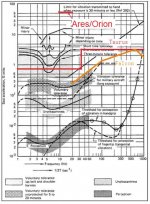
Re: USAF, it's their job to identify range safety problems. The math is straightforward. Did you read their report?
 
Re: TO, that's what I thought you meant just wanted to be sure. :) But I forgot, yet another valid concern is that its mass margin has been exhausted, so hopefully these "certain solutions" will take no mass to implement.

I think it will, which will lead to compromises elsewhere...

But we are talking about ~8 seconds of potential vibration issues as far as I know. That's for sure not the end of Ares1 ;) If at all, money might be...

USAF, it's their job to identify range safety problems. The math is straightforward. Did you read their report?

No, I did not read the report. I'm waiting for Ares1-X to see how Max Q and other stresses during ascent will look like.

People these days expect 100% reliability and safety and no challenges during development at all. That's simply impossible.
 
Ares was chosen cause mike griffin had his little pet project from before Bush's VSE, and he found a way to shoehorn it through.
One of the main problems is they've had to cut Orion's mass big time to compensate for the under-performing booster. Unless you're building a payload for a proven, already-flying design, you don't change the payload to fit a not-even-built-yet booster! It's one thing if Company A is building their satellite and learn that a Delta II doesn't have the lift capability for it. It's quite another when the payload for which the rocket is designed has to be chopped up to accommodate the rocket.
 
The baseline of carrying four astronauts to the Moon, which will be the basic task of Orion, is not affected. Only a crew of six members to the ISS is affected, in reconciliation with the ISS program. The ISS won't last for too long anyway once Orion is in operation. I don't see this as a dramatic change at all to be honest (just like NASA and its their thing). There is no need to carry 6 astronauts to the ISS by one spacecraft. Soyuz does its job very well with "only" three astronauts aboard. Everybody is so much focused on the ISS. But ISS is not the wide future.

Weight problems always were the biggest challanges during development. For the Apollo spacecraft as well as for the Space Shuttle, especially its payload (beside the main engines, which caused a significant delay). A gap and budget problems is not unusual as well. The Shuttle development also suffered from budget problems. In the late 70's congress members even told that NASA is in deep problems. Today it flies for nearly 3 decades.

The difference is that today anybody can watch and read about NASA and its progresses nearly real-time. Any issue immediately becomes as big as the universe in the public eye. Ares can't fly, Ares is going to shake its crew to deatch, NASA is out of the booster business, blah blah blah...

Ares1 is going to carry nearly as twice as much payload as the Saturn1b did and about as much as the Shuttle does (the Orbiter itself is a big waste of mass just to return the crew back to earth). A shrinking crew size from 6 to 4, which does not affect the baseline anyway, is anything but a dramatic change.
 
The ISS won't last for too long anyway once Orion is in operation.

AFAIK with new budget restrictions, ISS will be long gone once Orion flies.

The Shuttle development also suffered from budget problems. In the late 70's congress members even told that NASA is in deep problems. Today it flies for nearly 3 decades.

Yes. Those budget issues marred the STS program from becoming what it really could have.

And that has been 3 decades of an expensive, unreliable and dangerous vehicle.

Any issue immediately becomes as big as the universe in the public eye. Ares can't fly, Ares is going to shake its crew to deatch, NASA is out of the booster business, blah blah blah...

And for some, those problems are vastly underestimated...

Ares1 is going to carry nearly as twice as much payload as the Saturn1b did and about as much as the Shuttle does (the Orbiter itself is a big waste of mass just to return the crew back to earth). A shrinking crew size from 6 to 4, which does not affect the baseline anyway, is anything but a dramatic change.

STS was also designed to recover objects from orbit. So that "waste of mass" is not only there to return the crew to Earth.

And that Ares-I will carry twice the payload of Saturn-IB means nothing. Especially when current launchers in that range exist, that could lift a similar amount of cargo.

While a downgrade from 6 to 4 people does not affect the baseline, it's a capability lost. Not because of the spacecraft, but because of the launcher.
 
Somebody's got their work cut out for them.

The chart assumes the mandatory training exercise for Ares crews should be...
06-07-IMG_0529.jpg
 
I'm waiting for Ares1-X to see how Max Q and other stresses during ascent will look like.

But that's rather the point: it won't show what 'Max Q and other stresses during ascent will look like' because it's a very different vehicle.
 
But that's rather the point: it won't show what 'Max Q and other stresses during ascent will look like' because it's a very different vehicle.
It's not a very different vehicle. Is it the same? No. It's an analog of the real thing, and analogs are used all the time in engineering.

As an example, scale models are used in wind-tunnel testing, and the data derived there is useful. The Ares I-X is arguably closer to the real thing than a wind-tunnel scale model...
 
It's not a very different vehicle. Is it the same? No. It's an analog of the real thing, and analogs are used all the time in engineering.

As an example, scale models are used in wind-tunnel testing, and the data derived there is useful. The Ares I-X is arguably closer to the real thing than a wind-tunnel scale model...

I agree. You rarely test on the actual flight model in engineering without first performing tests with engineering models designed for that purpose. The geometry of Ares I-X is highly similar, I have to imagine that they've taken steps to get the masses right, as well as the ascent profile. Now, if any of those aren't similar, then I think a case could be made for its uselessness to some degree (any test flight is useful, if for no other reason than verifying models and occasionally application of theory). Otherwise, though, they have the thing stacked, might as well light the candle. ;)
 
Much as I hate Ares, I'm with Hielor. The shape at least is a closer analog than a scaled-down windtunnel or imprecise computer model (computers are never exactly right :P). But the key is how different the 5-segment will behave at the same data points (for lack of a better term) as this 4-segment thing. Remember, adding another segment isn't like lengthning the hull of a liquid fueled rocket, you're changing the dynamics of the engine because the entire vehicle is essentially an engine.
 
Back
Top