

-
ORBITER-FORUM will be temporarily closed at 2026-07-23 18:00 UTC while we complete some OF maintenance tasks. The amount of downtime is expected to take up to one hour, but probably less.
You are using an out of date browser. It may not display this or other websites correctly.
You should upgrade or use an alternative browser.
You should upgrade or use an alternative browser.
Updates Artemis Program Updates & Discussions
- Thread starter Sbb1413
- Start date
The announced changes to the Artemis program include:
- Cancellation of the Exploration Upper Stage and Block IB upgrade for SLS rocket
- Artemis II and Artemis III missions will use the SLS rocket with existing upper stage
- Artemis IV, V (and any additional missions, should there be) will use a “standardized” upper stage
- Artemis III will no longer land on the Moon; rather Orion will launch on SLS and dock with Starship and/or Blue Moon landers in low-Earth orbit
- Artemis IV is now the first lunar landing mission
- NASA will seek to fly Artemis missions annually, starting with Artemis III in “mid” 2027, followed by at least one lunar landing in 2028
- NASA is working with SpaceX and Blue Origin to accelerate their development of commercial lunar landers for Artemis IV and beyond

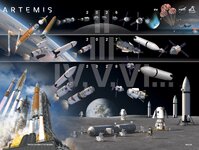

SLS was designed to push an entire landing stack to the moon, lifting about 95-100 mt to LEO. If it's now just pushing Orion / SM / ICPS, that is only about 50 mt to LEO. If the "standardized" upper stage is a Centaur derivative, that required mass to LEO would be even less.
The announced changes to the Artemis program include:
- Cancellation of the Exploration Upper Stage and Block IB upgrade for SLS rocket
- Artemis II and Artemis III missions will use the SLS rocket with existing upper stage
- Artemis IV, V (and any additional missions, should there be) will use a “standardized” upper stage
- Artemis III will no longer land on the Moon; rather Orion will launch on SLS and dock with Starship and/or Blue Moon landers in low-Earth orbit
- Artemis IV is now the first lunar landing mission
- NASA will seek to fly Artemis missions annually, starting with Artemis III in “mid” 2027, followed by at least one lunar landing in 2028
- NASA is working with SpaceX and Blue Origin to accelerate their development of commercial lunar landers for Artemis IV and beyond
If these numbers are correct, the SLS is now even a bigger waste of money and time than it was yesterday, and that is saying something. Falcon Heavy can put 65 mt into LEO. New Glenn can push about 45 mt to LEO.
What a mess.
EDIT: I really wonder if this was literally a 48-hour-turnaround knee-jerk reaction to the Starliner report outlining Boeing's engineering failures, and they wanted to cut Boeing's EUS out of the program?
Last edited:
- Joined
- Feb 4, 2008
- Messages
- 9,758
- Reaction score
- 1,028
- Points
- 203
Not it wasn't. That was never the plan. SLS never had that capability, it was always short hence the requirement of the Gateway Station in NHRO for Orion to dock to. Gateway would serve as hibernation point for Orion while the crew went to the lunar surface and back again in the HLS lander. Orion doesn't have the delta V capability in the ESM for a lunar orbit insertion and subsequent Trans-Earth Injection like the Apollo CSM did. Even in the old Constellation Program the plan was for Orion to launch separately from the Earth Departure Stage (EDS) which would have also delivered the Altair lunar lander. Altair would have performed the LOI burn and the subsequent landing burns leaving Orion to perform the TEI burn.SLS was designed to push an entire landing stack to the moon,
When CxP was cancelled and Orion subsequently revived, Orion was left without the capability of entering and leaving lunar orbit. It could do one but not both. So to overcome this serious shortfall, the Gateway Station was devised and placed in a favorable orbit. SLS is not the Saturn V revived, despite what early PR renders made it look like.

dennis.krenz
Well-known member
I agree, the only case for the SLS is a bigger upper stage, not a smaller. Industry can build better heavy launchers, that is no extreme economic risk anymore.If these numbers are correct, the SLS is now even a bigger waste of money and time than it was yesterday, and that is saying something. Falcon Heavy can put 65 mt into LEO. New Glenn can push about 45 mt to LEO.
EDIT: I really wonder if this was literally a 48-hour-turnaround knee-jerk reaction to the Starliner report outlining Boeing's engineering failures, and they wanted to cut Boeing's EUS out of the program?
I would say so. Corporate Boeing has proven on multiple accounts, that it can please shareholders, but not deliver flawless hardware.
- Joined
- Feb 4, 2008
- Messages
- 9,758
- Reaction score
- 1,028
- Points
- 203
Well, so far both SLS Core Stages and ICPS's have been flawless. The hydrogen leaks are a Ground Support Equipment (GSE) problem, not a flight hardware problem. The helium problem encountered with the Artemis-1 ICPS was that a ground-side seal got blown into the ICPS helium system and prevented a checkvalve from working and right now it looks like this is the same problem that is affecting the Artemis-2 ICPS. If you want blame someone for this, blame Bechtel who put the Mobile Launcher and it's umbilicals together.I agree, the only case for the SLS is a bigger upper stage, not a smaller. Industry can build better heavy launchers, that is no extreme economic risk anymore.
I would say so. Corporate Boeing has proven on multiple accounts, that it can please shareholders, but not deliver flawless hardware.
dennis.krenz
Well-known member
Well, so far both SLS Core Stages and ICPS's have been flawless. The hydrogen leaks are a Ground Support Equipment (GSE) problem, not a flight hardware problem. The helium problem encountered with the Artemis-1 ICPS was that a ground-side seal got blown into the ICPS helium system and prevented a checkvalve from working and right now it looks like this is the same problem that is affecting the Artemis-2 ICPS. If you want blame someone for this, blame Bechtel who put the Mobile Launcher and it's umbilicals together.
That is likely wrong, the ground half of the umbilicals themselves should be part of Boeings contract, too, not Bechtel. Bechtels contract ends at the access arms, AFAIR.
Before long the shareholders will be less than pleased.Corporate Boeing has proven on multiple accounts, that it can please shareholders, but not deliver flawless hardware.
dennis.krenz
Well-known member
Before long the shareholders will be less than pleased.
They will react as usual. Improve the quality just enough to make customers return again. And then find out how much the quality can drop again before they run away.

richfororbit
Active member
While it is correct that the Orion craft would've of launched in the old programme on its own.
During Barack's term, the Orion was to travel on the space launch system, to an asteroid, so it wasn't intended to go to the moon or the rocket wasn't really seen as being used to go to the moon on a few missions, or even Mars, as after that mission, Mars was on the horizon. Only Trump changed the policy, which many support as it was the most realistic.
Mars was a good destination, but it is too far away as we all are aware, and there is no clear or tested plan in order to get there, at least until the Space Exploration technologies designed their own rocket to attempt to get there which has yet to even demonstrate that workable mission.
During Barack's term, the Orion was to travel on the space launch system, to an asteroid, so it wasn't intended to go to the moon or the rocket wasn't really seen as being used to go to the moon on a few missions, or even Mars, as after that mission, Mars was on the horizon. Only Trump changed the policy, which many support as it was the most realistic.
Mars was a good destination, but it is too far away as we all are aware, and there is no clear or tested plan in order to get there, at least until the Space Exploration technologies designed their own rocket to attempt to get there which has yet to even demonstrate that workable mission.
dennis.krenz
Well-known member
During Baracks terms, Orion was also much lighter.... If I remember correctly, the original CEV was supposed to weight 10 tons less than Orion does today.

During Baracks terms, Orion was also much lighter.... If I remember correctly, the original CEV was supposed to weight 10 tons less than Orion does today.
Yeah, that's one problem. The thing is that it happened during the Apollo program, but the Saturn LV was developped in coordination with Apollo/LEM R&D, not as a bureaucratic abstract thing...
 Sure, they had Wernher to push things around...
- Joined
- Mar 23, 2008
- Messages
- 1,326
- Reaction score
- 1,656
- Points
- 128
- Website
- francisdrakex.deviantart.com
I think using a Centaur V-type upper stage would be beneficial to the program.
- Artemis IV, V (and any additional missions, should there be) will use a “standardized” upper stage
The Centaur V is an in-production upper stage and has performed well on Vulcan launches.
You only need to develop an interface to the SLS-core, and a payload interface to the Orion.
If the SLS core stage could lift an Orion + Centaur stack into LEO, the delta-V would be around 3.9 km/s.
Even if a bit of Centaur-propulsion is necessary for a LEO circularization burn, this stage has
enough punch to send the Orion to the Moon.
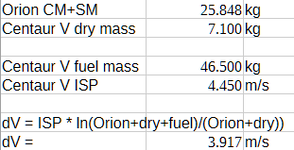
Period (.) is here a thousands-separator.
Attachments

gamer19
Well-known member
- Joined
- Jul 16, 2016
- Messages
- 372
- Reaction score
- 541
- Points
- 108
yes, they do make nice graphicsNice graphic!
I think using a Centaur V-type upper stage would be beneficial to the program.
The Centaur V is an in-production upper stage and has performed well on Vulcan launches.
You only need to develop an interface to the SLS-core, and a payload interface to the Orion.
If the SLS core stage could lift an Orion + Centaur stack into LEO, the delta-V would be around 3.9 km/s.
Even if a bit of Centaur-propulsion is necessary for a LEO circularization burn, this stage has
enough punch to send the Orion to the Moon.
View attachment 47717
Period (.) is here a thousands-separator.
Yes, but it isn't manufactured by Musk or Bezos, so forget about it.

Similar threads


- Replies
- 21
- Views
- 19K


- Replies
- 0
- Views
- 5K


- Replies
- 1
- Views
- 9K
