Project Bases for the Solar System

LadyCroussette

Quebec City's Resident Base Builder
Addon Developer
Donator
Joined
Jan 26, 2013
Messages
346
Reaction score
1,155
Points
108
Location
Quebec City
Preferred Pronouns
She/Her
Hello!

At the beginning of the summer, I made 4 bases for the moon: Sword Edge, Moscoviense, Armstrong Station and Yuegong.

I don't want to stop there. I want to make at least one base for every planetary system of the Solar System (excluding Venus). So one on Mercury, one (or two) on Mars, some on the moons of Jupiter, of Saturn, etc.

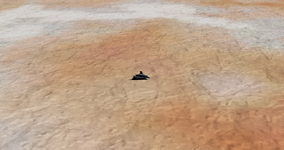
The first base I want to make is for the Jupiter moon of Europa. I already made some ground tiles and some unique microtextures for Europa. Temporarily named Clarke (after Arthur C. Clarke), I think the base should be some sort of refuelling outpost where ice is turned into fuel. I think a good way to do this would be to design a module where 3 big pipes are seen "going through" the ice to suck up some water to convert into rocket fuel. Only problem is that, I'm left wondering "How does a Europa base look like"?
1723462504060.png

Which made me realize I have no idea how any base should look like!

When I made the moon bases, I inspired myself from concept arts and renders found online. I designed these bases so that they all had their own distinct look. Yes, some parts and modules were reused between them but, when you look at them, they all have a unique appearance. I want to do the same for the other bases of the solar system. I want them to all have some difference depending on their environment and their distance from Earth. In my opinion, it will make them much more interesting to visit if there is always something new and unique to see with each base.

However, I'm at a bit of a loss as to how to design these new bases while giving them a unique look. I don't want to just reuse the same assets as I used for the Moon bases. It would make things easier, sure, but it wouldn't make visiting the bases as interesting.

I want each base to look like they belong on their planet/moon. I want people to look at one and say "Oh yes, this is a Ganymede base" or "This is a proper Mars base". For the case of Mars itself, there are plenty of concepts and renders online to get inspiration from, just like for the Moon. But for everything else? How does a Io base look like? How does a Iapetus base look like? Should they be big, or small? I don't know! I have ideas for some unique designs for some planets/moons, but not all of them.

For instance, I think a Mercury base would have some sort of structure to protect the base from the sun, a Mars base would have a greenhouse to grow plants for food, etc. And, the more Delta-V is required to reach that base from Earth, the lighter and smaller the base would be. So, a base on Mars could be made of fifteen modules and include many structures, while a base on Triton would only be made of 3-4 inflatable modules. Something like that.

But for the smaller details? Like the shape and size of habitable modules, the layouts, the textures? I just don't know.

So, here's why I made this thread. I need ideas. Ideas on how the bases should look like. Where they should be located on their planet/moon, what names they should have, etc. I already made some quick drawings of ideas for Europa, Mars and Ganymede. I will start with these ones. But, I need more ideas. So if you have any, let me know!

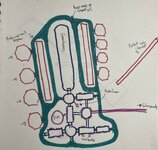
Here are the three "plans" I drew so far:

First, the Mars base. It's most distinct feature is the long greenhouse. The rest of the base is connected on its southern entrance. The pads are on both sides of the greenhouse, with walls to protect it from the blast of the ships.
1723462800765.jpeg

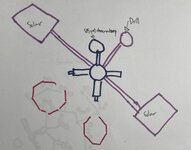
Here, my first plan for a Europa base. The initial purpose of this base was to drill down a hole through the surface to access the ocean. But, excluding the fact the surface is many kilometres thick (certainly too much for a surface drill to drill through), a cryobot would be much more effective at this task. Since then, I opted to make this base about turning ice into fuel and refuelling, so it will need a redesign, and an expansion. This version is too small for this purpose.
1723462993444.jpeg
Lastly, Ganymede. My idea was to make this base a radio telescope to observe the universe with away from the interference of radio emissions on Earth. Though since I drew it, I came to wonder if it would even be worth it, if it was made in real life. Interference may not even be a big problem in reality, not enough to justify putting a base on Ganymede. It would have worked better as a Moon base idea I think. Oh well, I guess I will find a new design!
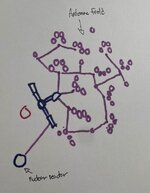
1723463172078.jpeg
 
First, why not Venus!? Think how exciting it would be to land on a suspended airstrip 50 km above the surface. And then do "dive" into hell for resource extraction.


I think the only addon that had successfully provided a solar system wide network of bases was World of 2001. You rarely run out of things to do with so many vessels and bases all around. Unfortunately, the addon hasn't aged very well, and could definitely use a facelift. It is also limited to the inner solar system with no bases past Mars (IIRC).

It takes a bit of world building to create a network of bases in the solar system. Each base must be built for a purpose. As you saw yourself, a radio-telescope on Ganymede wouldn't make much sense. Neither would solar panels on Europa due to the low intensity of the sunlight.

Here is what ChatGPT responded to a related question for a closed loop in the Jovian system:

  • Io:
    • Primary Resource: Volcanic activity.
    • Economic Role:
      • Energy Production: Harness geothermal energy and volcanic heat. This energy could be converted into electricity and distributed to other moons via advanced energy transmission technologies (e.g., microwave power beaming).
      • Mining Operations: Extract sulfur, silicon, and other volcanic minerals. These materials can be used in various industrial processes, including the production of solar panels, electronics, and construction materials.
  • Europa:
    • Primary Resource: Subsurface ocean.
    • Economic Role:
      • Water and Oxygen: Extract water from the subsurface ocean for life support and hydrogen/oxygen fuel production. Oxygen can be supplied to all colonies, while hydrogen can be used as fuel.
      • Biotech Research: Study potential microbial life in Europa's ocean to advance biotechnology, pharmaceuticals, and astrobiology research. If life is discovered, it could lead to breakthroughs in medicine and biological engineering.
  • Ganymede:
    • Primary Resource: Largest moon with a magnetic field.
    • Economic Role:
      • Agriculture: Ganymede's relatively stable environment and magnetic field make it suitable for large-scale agriculture. Domed farms can produce food for all four moons, utilizing hydroponic and aquaponic systems powered by Io's energy.
      • Manufacturing Hub: With its large surface area, Ganymede can host manufacturing facilities, particularly those that produce complex machinery, habitats, and spacecraft. The moon's magnetic field provides some protection from radiation, making it ideal for long-term human habitation and industrial activities.
  • Callisto:
    • Primary Resource: Least geologically active, with a thick ice layer.
    • Economic Role:
      • Mining and Storage: Focus on mining ice for water, storing resources, and acting as a logistics hub. Callisto's low radiation levels make it a safe location for storing volatile materials and processing resources that are mined from the other moons.
      • Spaceport: Serve as the primary spaceport and hub for interplanetary trade and transport, given its relative safety and distance from Jupiter's intense radiation belts. Callisto could be the central node for transport between the moons and to/from Earth.

2. Resource Flow and Trade

Each moon would trade its specialized resources with the others, creating a symbiotic relationship:

  • Energy from Io: Distributed to Europa, Ganymede, and Callisto, powering their operations, habitats, and industrial activities.
  • Water and Oxygen from Europa: Supplied to Io, Ganymede, and Callisto for life support and as a base for fuel production.
  • Food from Ganymede: Exported to Io, Europa, and Callisto, supporting the colonies' sustenance needs.
  • Raw Materials from Callisto: Processed on Callisto and shipped to Io for construction, Europa for research facilities, and Ganymede for manufacturing.

3. Waste Recycling and Environmental Management

  • Closed-Loop Recycling: Waste materials, including organics, metals, and gases, would be recycled at the point of origin. For example, organic waste from Ganymede's farms would be composted or converted into biofuels. Industrial waste from Io’s mining operations would be reprocessed into new materials or safely disposed of on Callisto.
  • Atmospheric Control: Each colony would have advanced systems for air and water recycling. Gases released during industrial processes on Io, Ganymede, and Callisto would be captured, purified, and reused.
  • Radiation Shielding Materials: Waste materials like slag from Io’s mining operations could be repurposed into radiation shielding for habitats on the other moons.

4. Transportation and Communication Network

  • Inter-Moon Transport: Establish a robust transportation network using nuclear-powered spacecraft, which could shuttle resources, goods, and people between the moons. A magnetic levitation rail system or space elevator could be developed on Ganymede and Callisto for efficient surface-to-orbit transport.
  • Communication Infrastructure: A network of satellites orbiting each moon and Jupiter would provide constant communication between the colonies, facilitating coordination and trade.

5. Governance and Economic Integration

  • Unified Governance: A governing body representing all four colonies could be established to oversee resource allocation, trade agreements, and environmental protection. This body would ensure equitable resource distribution and manage disputes or challenges.
  • Economic Currency: Introduce a unified currency or a barter system backed by resources like water, energy, and rare materials, ensuring fair trade between the moons. This could be managed by a central economic authority under the unified governance structure.

6. Long-Term Sustainability and Expansion

  • Research and Development: Continuous R&D across the moons, particularly on Europa and Ganymede, would focus on improving closed-loop systems, developing new technologies for resource extraction, and enhancing life support systems.
  • Expansion to Other Moons and Asteroids: Once the closed-loop ecosystem on the Galilean moons is stable, the colonies could expand to other Jovian moons (like Metis or Amalthea) or even to nearby asteroids, incorporating them into the economic network for additional resources.

7. Cultural Exchange and Social Integration

  • Cultural Exchange: Regular exchange programs between the moons to promote a sense of unity and shared purpose among colonists. Art, music, and cultural festivals could be held to foster a strong, cohesive society.
  • Education and Training: Develop educational systems across the moons, focusing on skills needed for maintaining the closed-loop economy and ensuring that each colony has the expertise required to thrive.
This closed-loop economy across the Galilean moons would be a highly interdependent system, where each moon’s unique characteristics and resources are leveraged to support the others. The success of this ecosystem would depend on careful planning, advanced technology, and a strong commitment to sustainability and cooperation.

And here is a plan for the whole solar system:

1. Mercury

  • Base: "Hermes Station"
  • Purpose: Solar energy harvesting and material science research.
  • Location: Near the terminator (boundary between day and night) to manage extreme temperature differences.
  • Role in Solar System: Provides abundant solar energy for solar power stations, which could beam energy to other parts of the Solar System, especially inner planets. Also serves as a research hub for studying extreme temperature materials and solar phenomena.

2. Venus

  • Base: "Cloud City"
  • Purpose: Atmospheric research and resource extraction.
  • Location: Floating city in the upper atmosphere (~50 km altitude).
  • Role in Solar System: Studies Venus's atmosphere to understand greenhouse effects and potential terraforming techniques. Extracts gases (e.g., sulfuric acid) for industrial uses. Serves as a model for future habitability projects in harsh environments.

3. Earth

  • Base: "Luna Gateway"
  • Purpose: Space exploration hub and staging ground for deeper space missions.
  • Location: Lunar surface, ideally near the lunar poles.
  • Role in Solar System: Acts as the primary logistics hub for all Solar System activities. Facilitates space missions by serving as a launch point, fuel depot, and research center. Key for testing technologies for living off Earth.

4. Moon (Luna)

  • Base: "Artemis Base"
  • Purpose: Research, mining, and as a waypoint for deeper space exploration.
  • Location: Shackleton Crater (South Pole) for potential water ice.
  • Role in Solar System: Provides raw materials (e.g., Helium-3, regolith) for space construction and fuel. Acts as a training and staging ground for missions to Mars and beyond.

5. Mars

  • Base: "Olympus Colony"
  • Purpose: Human settlement, agriculture, and resource extraction.
  • Location: Near Olympus Mons for geothermal energy and subsurface ice.
  • Role in Solar System: First major human settlement beyond Earth, focusing on self-sufficiency, terraforming research, and as a launch site for missions to the asteroid belt and outer planets.

6. Phobos & Deimos (Martian Moons)

  • Base: "Deimos Station"
  • Purpose: Communication relay and defense station.
  • Location: Surface of Deimos, with minimal surface infrastructure.
  • Role in Solar System: Acts as a strategic point for communication between Mars and the rest of the Solar System. May also serve as a defense outpost for detecting and mitigating potential asteroid threats.

7. Asteroid Belt (Ceres)

  • Base: "Ceres Outpost"
  • Purpose: Mining, water extraction, and deep space exploration.
  • Location: Surface of Ceres, near the bright spots in Occator Crater.
  • Role in Solar System: Provides essential raw materials (metals, water) for construction and fuel. Serves as a key resupply and refueling station for missions heading to the outer planets.

8. Jupiter (Galilean Moons)

  • Base: "Ganymede Research Colony"
  • Purpose: Research, energy production, and as a supply base for the outer Solar System.
  • Location: Subsurface habitats under Ganymede's ice crust.
  • Role in Solar System: Central hub for outer Solar System exploration. Studies the moon's potential for life, produces energy (possibly from tidal forces), and supplies missions to Saturn, Uranus, and beyond.

9. Saturn (Titan)

  • Base: "Titan Haven"
  • Purpose: Atmospheric research, hydrocarbon extraction, and human habitation.
  • Location: Surface base near methane lakes.
  • Role in Solar System: A major center for studying prebiotic chemistry and life origins. Extracts hydrocarbons for fuel. Acts as a key outpost for exploring Saturn's moons and preparing for missions to Uranus and Neptune.

10. Uranus

  • Base: "Miranda Station"
  • Purpose: Scientific research and outer Solar System observation.
  • Location: Miranda, due to its geological diversity.
  • Role in Solar System: Focuses on studying Uranus's unique magnetic field and atmospheric dynamics. Serves as an observation point for outer Solar System bodies and interstellar space.

11. Neptune (Triton)

  • Base: "Triton Base"
  • Purpose: Research and monitoring of the Kuiper Belt.
  • Location: Subsurface habitat on Triton.
  • Role in Solar System: Studies Triton’s geysers and retrograde orbit, providing insights into the Kuiper Belt. Monitors and prepares for future missions to trans-Neptunian objects and interstellar exploration.

IMO the first step is to create elevation tiles for the bodies that don't support them. Even fictional elevations are better than nothing.
 
Yes, @LordCroussette, please keep going with your bases!
I want to make at least one base for every planetary system of the Solar System (excluding Venus).
[...]
First, why not Venus!? Think how exciting it would be to land on a suspended airstrip 50 km above the surface. And then do "dive" into hell for resource extraction.
I only can second that!
Hope you'll get many inputs. I'll read your first post more carefully later.
Reminder:
 
First, why not Venus!? Think how exciting it would be to land on a suspended airstrip 50 km above the surface. And then do "dive" into hell for resource extraction.
Err... is that even possible? How do you even do a floating base you can actually land on? I mean, it would sure be cool, but I have no idea how that is even possible.
First, why not Venus!? Think how exciting it would be to land on a suspended airstrip 50 km above the surface. And then do "dive" into hell for resource extraction.


I think the only addon that had successfully provided a solar system wide network of bases was World of 2001. You rarely run out of things to do with so many vessels and bases all around. Unfortunately, the addon hasn't aged very well, and could definitely use a facelift. It is also limited to the inner solar system with no bases past Mars (IIRC).

It takes a bit of world building to create a network of bases in the solar system. Each base must be built for a purpose. As you saw yourself, a radio-telescope on Ganymede wouldn't make much sense. Neither would solar panels on Europa due to the low intensity of the sunlight.

Here is what ChatGPT responded to a related question for a closed loop in the Jovian system:

  • Io:
    • Primary Resource: Volcanic activity.
    • Economic Role:
      • Energy Production: Harness geothermal energy and volcanic heat. This energy could be converted into electricity and distributed to other moons via advanced energy transmission technologies (e.g., microwave power beaming).
      • Mining Operations: Extract sulfur, silicon, and other volcanic minerals. These materials can be used in various industrial processes, including the production of solar panels, electronics, and construction materials.
  • Europa:
    • Primary Resource: Subsurface ocean.
    • Economic Role:
      • Water and Oxygen: Extract water from the subsurface ocean for life support and hydrogen/oxygen fuel production. Oxygen can be supplied to all colonies, while hydrogen can be used as fuel.
      • Biotech Research: Study potential microbial life in Europa's ocean to advance biotechnology, pharmaceuticals, and astrobiology research. If life is discovered, it could lead to breakthroughs in medicine and biological engineering.
  • Ganymede:
    • Primary Resource: Largest moon with a magnetic field.
    • Economic Role:
      • Agriculture: Ganymede's relatively stable environment and magnetic field make it suitable for large-scale agriculture. Domed farms can produce food for all four moons, utilizing hydroponic and aquaponic systems powered by Io's energy.
      • Manufacturing Hub: With its large surface area, Ganymede can host manufacturing facilities, particularly those that produce complex machinery, habitats, and spacecraft. The moon's magnetic field provides some protection from radiation, making it ideal for long-term human habitation and industrial activities.
  • Callisto:
    • Primary Resource: Least geologically active, with a thick ice layer.
    • Economic Role:
      • Mining and Storage: Focus on mining ice for water, storing resources, and acting as a logistics hub. Callisto's low radiation levels make it a safe location for storing volatile materials and processing resources that are mined from the other moons.
      • Spaceport: Serve as the primary spaceport and hub for interplanetary trade and transport, given its relative safety and distance from Jupiter's intense radiation belts. Callisto could be the central node for transport between the moons and to/from Earth.
Not bad for an AI! I have a better idea how to design bases for all these moons now.
IMO the first step is to create elevation tiles for the bodies that don't support them. Even fictional elevations are better than nothing.
In all honesty: I don't know how to make elevation tiles. Usually, I just use the ground flattening feature of the D3D9 client if I need to edit the terrain in any shape or form. I know tileedit.exe in the Utils folder exist, but I never managed to make it work. It always freezes when I try to do anything (and yes, I do have the MATLAB R2015a runtime package installed).
  • did you solve the Lunar bases' textures not showing in non-D3D9 O2016?
Uhhh... I completely forgot x)

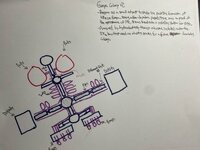
Anyway, I have an update on the base. I completely redrew the base and came up with this plan, which I much prefer:
1723588658195.jpeg
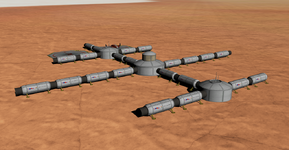
And here is the base slowly taking shape:
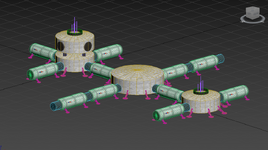
1723588684683.png
I doubled the number of sideways modules on the model because I thought it would better fit the profile of the base drawn on paper, but I don't think it was the right call. It feels too big for a Europa base. I think I'll reduce its size tomorrow when I continue working on it.
 
Err... is that even possible? How do you even do a floating base you can actually land on? I mean, it would sure be cool, but I have no idea how that is even possible.


If someone can create a good mesh for it, we'll make it possible.

In all honesty: I don't know how to make elevation tiles
I regret to say that I don't either. I can work with existing ones, but haven't looked into how to create a tiles for a whole planet/moon. With the radiation levels at Europa, a reasonable base site would be under several meters of ice or in a chasm somewhere for shielding. Same goes for almost any other base on almost all bodies (except venus and perhaps Titan). That's why I am mentioning elevation tiles or at least a custom mesh that gives the impression that some of the base is under the surface.

1723591635672.png

I doubled the number of sideways modules on the model because I thought it would better fit the profile of the base drawn on paper, but I don't think it was the right call. It feels too big for a Europa base. I think I'll reduce its size tomorrow when I continue working on it.

It does look a bit big for Europa.
 
And here is the base slowly taking shape:
1723588684683.png

I doubled the number of sideways modules on the model because I thought it would better fit the profile of the base drawn on paper, but I don't think it was the right call. It feels too big for a Europa base. I think I'll reduce its size tomorrow when I continue working on it.
Agree, you'd better stick to the initial number of modules.
Additionaly, the "tower" on the middle node would better go closer to the pad (to top-left node), with an hemispherical opening (cupola-kind) to also look to Zenith
 
RE: venus bases, it has been done before.


@Artlav iirc, uses his collision SDK for this.
 
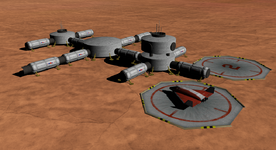
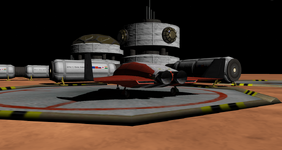
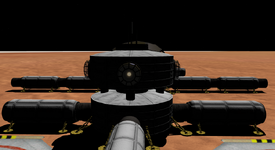
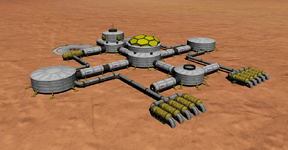
So, I did reduce the number of modules back to the original one. I also remodelled the "spherical" modules. Now, they are textured to look like inflatable modules. I decided to implement Boxx's idea of the "tower" being closer to the pad with a cupola by putting a second round module on top of another. The cupolas aren't modelled yet, but there will be one pointing in each direction (they will be connected to the black circles)
1723656193575.png
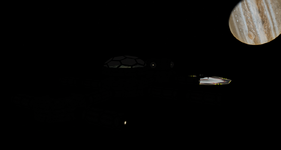
In Orbiter:
1723656340737.png
I want to put something on top of the larger, central spherical hub module, but I don't know what. Should it be a big antenna to transmit back to Earth? A greenhouse to grow some food?

Oh yeah, for some reason, the base disappears when time warp is at x100000. I don't know why it does that, but it does. Here, I have a video of the glitch in question.

Also my FPS drop to 10FPS/sec the moment the Delta-glider start moving on the ground. It's probably a sign that I need to make myself a new, clean Orbiter install when things like that start happening x)
 
Also my FPS drop to 10FPS/sec the moment the Delta-glider start moving on the ground. It's probably a sign that I need to make myself a new, clean Orbiter install when things like that start happening x)

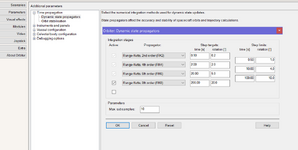
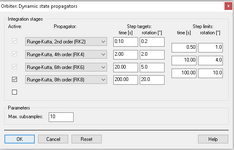
Did you increase the number of substeps in the integrator settings? That can have this effect.
 
Did you increase the number of substeps in the integrator settings? That can have this effect.
I don't think I did, I don't know how to change it. Where is that setting?

Also I should specify the lag only happens on Europa. I mean, I didn't try it out on every other body, but I know it doesn't glitch on Earth or the Moon.
 
View attachment 40120
I want to put something on top of the larger, central spherical hub module, but I don't know what. Should it be a big antenna to transmit back to Earth? A greenhouse to grow some food?
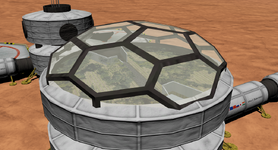
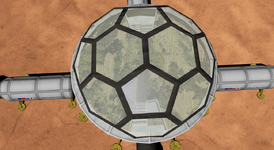
I'd vote for a greenhouse => with Jupiter's radiations and under-surface water, it should grow quick and provide potatoes :D

The base is getting cosy ;) BTW: if you plan "taxiways" from pads to habs, make sure that the pad number heads toward the taxiway, not opposite, otherwise it's weird.
 
I'd vote for a greenhouse => with Jupiter's radiations and under-surface water, it should grow quick and provide potatoes :D
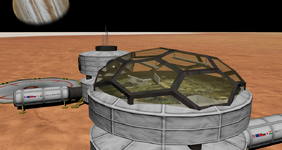
I agree with you. So that's what I did.

For my first ever greenhouse modelled, I really like the result!
1723732857414.png
1723732865929.png
1723732870963.png
1723732875948.png

Now next up is to make the pumps that melt the ice and suck up the water, and the "distilleries" (or whatever they are called) that convert water into rocket fuel! And after, only the smaller details will be left, like the pipes, the cables, tanks, antennas, and every other small thing.
 
Yes, at least I haven't changed these settings.
 
for some reason, the base disappears when time warp is at x100000. I don't know why it does that, but it does. Here, I have a video of the glitch in question.

Also my FPS drop to 10FPS/sec the moment the Delta-glider start moving on the ground. It's probably a sign that I need to make myself a new, clean Orbiter install when things like that start happening x)
My 2-cent: as the graphic engine does not use the same material properties when it draws illuminated and not-illuminated material, maybe alternating sun light & no sun at high speed makes the GPU crazy... but it should be the same problem with the Earth or the Moon (unless Europa's textures are different and request more GPU?).
 
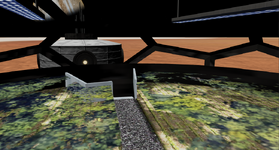
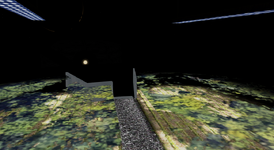
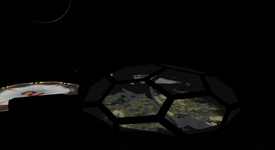
Another update (and likely final for today, I do want to do other stuff too! x) ) for the base: First, I added some emissive lighting inside the greenhouse. Now, it looks like two LED panels are lighting it up.
1723739654869.png
It's not very visible during the day. But at night? Oulala!
1723739678705.png
1723739690186.png
I also changed the emissiveness (is that a word?) of the glass, since it was too shiny at night. It also makes it look way better during the day, and gives it a small gold-ish tint that matches with the colour palette of the rest of the base.
1723739766735.png
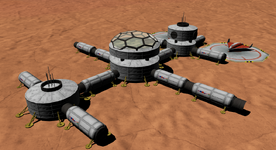
Lastly, I added the cupolas!
1723739788996.png
1723739794892.png
1723739802143.png
Even at this state the base look amazing. I can't wait for all the small details to be added, the result will be fantastic.

But first, I need to figure out how to model the distilleries. 🤔

My 2-cent: as the graphic engine does not use the same material properties when it draws illuminated and not-illuminated material, maybe alternating sun light & no sun at high speed makes the GPU crazy... but it should be the same problem with the Earth or the Moon (unless Europa's textures are different and request more GPU?).
Maybe, I'll need to try it out to see if it happens. And install this version of the base on a clean install too to also see if it happens.
 
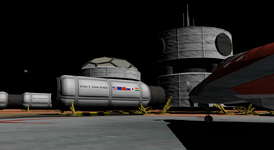
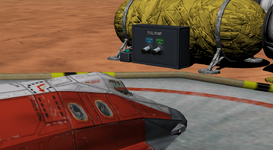
The fuel pumps are done! And the distilleries by using my favourite base design technique: just use a regular module and pretend everything is hidden inside lol.
1723826702414.png
1723826709742.png
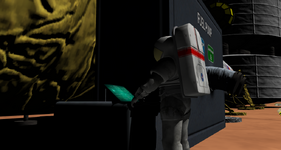
Buying fuel at the fuel pump.
1723826728419.png
 
Back
Top