OHM FalconHeavy for Orbiter2016

If it's on an escape trajectory, NORAD TLEs and sites that track them such as n2yo are not going to be relevant for long, since these are meant for earth orbit.

 
I would like to note, that deflection smokes could be much longer sustained. In my multistage2015 experiments I made particles with long life times (16 secs), and FPS did not suffer on my moderate PC
Hi Marg, I'll have another go at improving the particle streams when I get some time, but my PC doesn't react well to lots of particles, so I tend to keep it minimal.

Couldn't find any orbital elements on that n2yo page - did anybody grab them?

Cheers,
Brian
 
Couldn't find any orbital elements on that n2yo page - did anybody grab them?

Check out these Twitter accounts:
https://twitter.com/planet4589
https://twitter.com/marco_langbroek

---------- Post added at 04:55 PM ---------- Previous post was at 04:45 PM ----------

Hello Brian,

The launch indeed was very memorable. I really enjoyed all the excitement leading up to it.

I did a few lauches afterwards to check how events did match up against the SpaceX webcast and I noticed that they do not sync up as good as the Falcon9 did.

Booster separation of the real FH was at 2:34 into the launch at 60km altitude. Even with less than minimal reserve fuel, the FH in Orbiter seperates the boosters 14 seconds before at 50km.

I am not sure why that is. It seems the throttle of the side-boosters was varied quite a bit during the launch. I am not sure if that explains it, because I would expect an altitude above 60km if that's the explanation. I tried correcting for this by using negative crossfeed, but that's not an option.

Any ideas on this?
 
Booster separation of the real FH was at 2:34 into the launch at 60km altitude. Even with less than minimal reserve fuel, the FH in Orbiter seperates the boosters 14 seconds before at 50km.

I am not sure why that is. It seems the throttle of the side-boosters was varied quite a bit during the launch. I am not sure if that explains it, because I would expect an altitude above 60km if that's the explanation. I tried correcting for this by using negative crossfeed, but that's not an option.

Any ideas on this?

While I don't have an answer to the question why events don't sync, here are my observations (I set apogee and perigee to 250 km in the config window).

In the video engines started to ignite about 5-6 seconds before the liftoff and I'm not sure but it seems that the center core was working at less thrust than the side cores from the beginning of the ascent. In Orbiter liftoff starts almost immediately after ignition and at full thrust, and it takes less time (4 vs 6 seconds, at double speed) for the vessel to ascend past the tower. This should already give some difference in the amount of fuel burned.

The simulated vessel is gaining speed and altitude at higher rate than the real. That should mean that side cores throttled down too while in Orbiter only the center core is throttled down. At the moment of boosters separation the speed and altitude roughly match the values in the video, but in Orbiter it occurs 15 seconds earlier.

At T + 3 minutes the simulated vehicle's speed is higher by 900 km/h and altitude is higher by 20 km.

At MECO the speed is higher by 2000 km/h, altitude by 45 km. In the sim MECO occurs 15 seconds later this time than in the video. So while side cores work less time, the center core works longer than in the real launch. Should it mean that they throttled down the center core to a lesser extent (maybe to 70%) and at the same time the rocket produced much less than the full thrust?
 
Hi,
remember there isn't much info from SpaceX - most parameters I'm using for the add-on are garnered from comments dropped at presentations, and (probably quite good) guesses from people who know about this stuff.

I concur with the observations re:timing/alt/vel of booster separation.

I heard a call-out for side-boosters throttle down ~20s before sep., so that would increase the burn time/alt at separation, compared to 100% throttle all the way. Indeed, possible the side-boosters were at ~95% all the way. Or some throttle variation. Or maybe they were using less fuel-reserve than I estimate. Or some combination of above.

Core-booster may have been using more fuel-reserve than I estimate, 100000kg works well timing wise for my add-on, or may have had a higher throttle setting pre- side-booster separation.

Certainly no shortage of dV for this payload, so they could have used a lot more fuel-reserve for boostbacks.

There is a also the staggered start-up at T-5, which is different to the add-on.

It also looks to me like the FH does the initial pitch-over before it rolls out to "boosters level" attitude, difficult to tell from camera angles though.

And I still have no real idea of the actual boostback strategy - minimum energy return trajectory?(that's what I do) Minimum engine impulse to return trajectory? etc. so that impacts on how much fuel reserve you need.

And why put the ASDS where they did? Why not further down-range, so you don't need to kill ALL forward vel.?

I might have a go at implementing a side-booster throttle down for all or last part of the flight. Also, staggered start-up. And maybe do the pitch-over to roll-out sequence a bit different. Feel free to make your own tweaks to the code. Or fly it manually and see what works, etc.

Cheers,
Brian
 
And why put the ASDS where they did? Why not further down-range, so you don't need to kill ALL forward vel.?
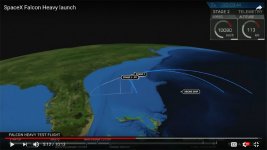
This image from the original webcast is useful. 30 sec post core sep. and the boostback burn is well under way, about half-way to the ASDS (so it is fairly far downrange for Spacex) Plenty to consider :-)
fh_prof.jpg
 
Absolutely fantastic addon and I get more impressed every time I run the demo from last Tuesday.

Just having one slight problem and I'm not sure what I am doing wrong. When both boosters and the core land they sink a little into the ground/barge and lose their shadows:


Not sure if I've missed something or it's just another quirk of running in Linux.
 
Thanks, hope you have some fun with it.
Just having one slight problem and I'm not sure what I am doing wrong. When both boosters and the core land they sink a little into the ground/barge and lose their shadows.
I don't think you're doing anything wrong.

The "sinking" problem I think is largely due to how the vessel's "Touchdown Points" are defined, specifically the stiffness and damping parameters. At least the boosters don't bounce around too much - best I could do.

The landing pads/ASDS are defined as vessels - Orbiter doesn't show shadows "on" them.

Cheers,
Brian
 
I don't think you're doing anything wrong.

The "sinking" problem I think is largely due to how the vessel's "Touchdown Points" are defined, specifically the stiffness and damping parameters. At least the boosters don't bounce around too much - best I could do.

The landing pads/ASDS are defined as vessels - Orbiter doesn't show shadows "on" them.

Cheers,
Brian

That's great - thanks Brian.

Boosters don't bounce at all for me. It was the fact that everything else (and I mean everything) works so perfectly and replicates the actual launch so well that made me think I had something wrong.
 
Running the scenarios I have no sound (except MCC staging callouts)...:shrug:
 
Running the scenarios I have no sound (except MCC staging callouts)...:shrug:

I found that all sounds worked very well but had crashes just as the boosters came into land every time. Think it's OrbiterSound just not being compatible.

Sound disabled and it works perfectly so I just listen to some good music as the launch runs.
 
Thanks to this mod I was able to simulate the launch and fly it into an intercept with the actual orbit of the vehicle that I calculated from my own telescopic observations of the second stage in deep space.
Can't thank you enough for this awesome mod, BrianJ.
 
Epic vid. I'm always impressed by folks who can do their own orbit determination!
 
Thanks Brian,

I have been slow with feedback.
I run Orbiter on a Mac with WineHQ. I expect the HiRes textures don't render well.
I will verify with my PC.
 
Hello Brian :tiphat:
have you planned an update of your ADDON for the recovery of the caps of the FH as for the Falcon9 ? :hmm:
 
Yes, it will not be difficult to transfer the recoverable fairings to FalconHeavy.
But I am not sure if it will be implemented by SpaceX in reality - if you try the Falcon9 "Expendable" configuration, the fairings already have high reentry temp/pressure. The FalconHeavy will be more extreme - so I wonder if it is possible.
I await more info from SpaceX (and I have other Orbiter projects to play with ;-).
So, maybe some time in future.
Cheers,
Brian
 
Hello "brianj"
I saw the recovery of the fairings on the profile of SpaceX published before the launch of the FH.


But it's true on the drawing there are no parachutes with fairings ...

Thanks again
 
Last edited:
Ah! Thanks. I must have seen that graphic already, but had forgotten it included fairing recovery. I will add it to the FalconHeavy when I have some time.

Maybe I need to look again at the fairing aerodynamics.

With the Falcon9 fairings, when using "Expendable" mode for the booster, the fairings already hit high dynamic pressure and generate "reentry plasma/flames". It doesn't seem survivable unless the fairings have some heat-shielding - but that is just my guess.

Perhaps the fairings need more drag at velocity > Mach2 ?

I will have a look at it.

Cheers,
Brian

---------- Post added at 05:32 PM ---------- Previous post was at 05:21 PM ----------

But it's true on the drawing there are no parachutes with fairings ...
But there is a vessel with "Fairing Recovery" tag, so I think it must be part of the plan.

BTW I am surprised SpaceX have opted for the parafoil->net method.
I would have thought that a "mid-air helicopter intercept" (like Genesis mission) would be safer.

They must have great confidence in the parafoil guidance - you don't want 900kg smashing into your ship at 40mph!

Well, I guess they must have considered all this ;-)

Cheers,
Brian
 
Back
Top