Science Is "time travel" possible?

Is it possible?

  • yes

    Votes: 6 14.0%
  • yes, but with limitations

    Votes: 21 48.8%
  • no

    Votes: 7 16.3%
  • define "time"

    Votes: 16 37.2%

  • Total voters
    43
What do you propose then, as the reason why things aren't all happening at once?
Perception!
Today you remember than yesterday you didn't knew about what happened today, but yesterday you didn't remember what would happen tomorrow.

From here we have a feel of time flowing - we can remember the past and imagine the future.
 
woah, loads of replies :D

well, i should have mentioned that i meant jumping through time at a different rate at which we take as standard progression

and i know about time dilation due to speed, and the slight effect that high mass bodies have on time, but i mean the ABSOLUTE travelling in time.

and i found the name of the file i saw: Dejá Vú (or something like that)

from what i see, it seems most people believe in the time dilation theory, where we can move forward in time by dilating time relative to ourselves.
 
from what i see, it seems most people believe in the time dilation theory, where we can move forward in time by dilating time relative to ourselves.
It's not a matter of belief - relativistic time dilation have been observed countless times.
 
Perception!
Today you remember than yesterday you didn't knew about what happened today, but yesterday you didn't remember what would happen tomorrow.

From here we have a feel of time flowing - we can remember the past and imagine the future.

Soooo... any hard evidence for everything being simultaneous and time being an illusion?

I'm pretty sure I've heard of stuff that requires time as we know it to work as we know it to.
 
Time travel is possible and already done.

But this not a Time line jump. This is an explained consequence of the effects of acceleration and high velocities would have on our physical being.

It's effects would still be in the confines of this time line and always propagates to the future.

In this sense it would be a major alteration to our normal perception of time passing.
 
Soooo... any hard evidence for everything being simultaneous and time being an illusion?

I'm pretty sure I've heard of stuff that requires time as we know it to work as we know it to.
Can you prove the opposite?
And why simultaneous?

Unfortunately, if there were any hard evidence about time, there would be a whole lot less questions unanswered in both physics and philosophy.
 
Am I claiming something that fits into our understanding less than other possible solutions?
 
For all we know...Time could be nothing more than series of Quantum jumps from one static universe to another connected by some common causality. But we are definitly outside Physics at this point.
 
Last edited:
Suppose time travel would be possible in a very hollywood-esque fashion.

If one moves a month into the future or the past, for example, the Earth would have moved in this time around it's orbit, and so would have the sun, and so forth.
Even moving in time for one second would see oneself "displaced" by about 30km. How comes nearly no-one thought about this?

Apparently they have (from Wikipedia article):

An objection that is sometimes raised against the concept of time machines in science fiction is that they ignore the motion of the Earth between the date the time machine departs and the date it returns. The idea that a traveler can go into a machine that sends him or her to 1865 and step out into the exact same spot on Earth might be said to ignore the issue that Earth is moving through space around the Sun, which is moving in the galaxy, and so on, so that advocates of this argument imagine that "realistically" the time machine should actually reappear in space far away from the Earth's position at that date. However, the theory of relativity rejects the idea of absolute time and space; in relativity there can be no universal truth about the spatial distance between events which occur at different times (such as an event on Earth today and an event on Earth in 1865), and thus no objective truth about which point in space at one time is at the "same position" that the Earth was at another time.
 
What we can exclude is time travel from the future to the past - if it would be possible on just a single day in the future, we would already observe people messing with our time line.

No, we can't exclude it. General Relativity does not rule out time travel into the past, but one thing that it *does* say about time travel is that you can't use a time machine to go back to a time before the time machine existed, or forward beyond the point where the time machine is destroyed (Time machines in GR actually resemble *roads* to the past or future more than vehicles that can go backwards and forwards in time. The creation and destruction of a time machine are simply the endpoints of such a road). So the builder of the first time machine will be able to take it into the future, but not the past. His descendants, however, will be able to use it to visit him.

Thus, if the first future-to-past time machine has yet to be built, we won't observe people messing with our time line any more than if time machines are in fact impossible.
 
General Relativity does not rule out time travel into the past, but one thing that it *does* say about time travel is that you can't use a time machine to go back to a time before the time machine existed

Wait a moment, I have to shortly gather all of my incomplete knowledge about the subject in the same corner of my brain.

I assume you are talking about wormholes with their openings in different frames, which is about the only kind of time travel from general relativity I am aware of (which does not mean that there couldn't be another kind).

For wormholes the statement "can't use to go back to before it existed" is technically correct, but still conveys a wrong message. The truth is, that ending and starting point are fixed in a frame and can only travel forward in their own frame (as anything can only travel forward in its frame). It's not the type of time machine you can *choose* your favoured arrival time. You'll get out at the point in time the other end of the wormhole is currently fixed in, and that point will be moving forward. As such it isn't a road, it's a tunnel: you can't get on or of whenever out like.

But as I said, maybe you were talking about something different, or there's something I'm missing here.
 
Regardless of whether it is in fact possible or not, this is my way of looking at the "kill your grandparents" paradox...

If you think of time as a 4th dimension, it might not be a stretch to think of a "possibility space" as a 5th (and onwards) dimension...

So, we're not only "falling" through the 4th dimension of time, we're also weaving our way in this 5th possibility space dimension as we go... meaning everything is possible until the exact instant when it happens in one way and not in another.

So, if you travel back in time, and prevent yourself from breaking your arm, or kill your parents before you are born, nothing will in fact happen to you... What you've done is divert the flow of time into another path in the possibility space, and created a branch of history, basically, along different lines...

Now, provided you can go back to your own time, nothing will have changed... you've forked time back then when you killed your parents, so in some other possibility space, you don't exist... But not in your own.

Well, that's how I've started to look at it... it might be (and probably is) wholly unfounded, but it does solve the paradox... And I think I remember seeing some guy on the Discovery channel explaining basically the same thing... only, he used the term "parallel universes" instead of "possibility space", which I find to be more likely...

So, this would also mean that travelling in time implies also shifting away from your own possibility space, so chances are that when you get there to kill your parents, they might not even be there, since in that possibility space things may have happened differently, and themselves, not even born ;)

Ok, this is starting to sound like the crazy ramblings of some apocalypse prophet or a spaced-out dude in the 70's, and given I have no intention of being either, let's cut it short here ;)

Cheers
 
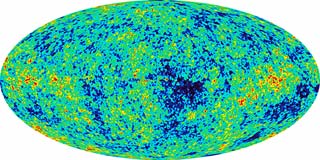
Time travel in to the past is impossible due to the cosmic microwave background (CMB) radiation. (also CMBR, CBR, MBR, and relic radiation)

wmap.jpg


I can't think of a good metaphor right now (where are star trek scrip writers when you need them), so I will describe what actually happens. And hope you understand.

Lets say you open a wormhole to the past. There it is. A wormhole in the year 2711, taking you to a point in the past. In the year 1980. So we have that. Now, lets take look at the cosmic background radiation (CBR). Let's assign it a value, so we can understand better just what is going to happen now. In the year 2711 the CBR is 0.02 and in the year 1980 the CBR is 0.03.

Moving on, we now go to the "present" year 2711, with our wormhole, ourselves, and the CBR of 0.02. We now step trough the wormhole, and we are in the year 1980. What comes trough? We do. And so does our CBR of 0.02. What happens now? That's right. The CBR that we brought with ourselves adds to the 1980's CBR. This means that the 1980's CBR is now 0.02 + 0.03 = 0.05. What does this mean? It means that we now changed the past, and therefore the future. Meaning, that the 2711's CBR is now somewhere around 0.04

Now we are in the year 2711, just before even having opened the wormhole to go back in to the past, with out BCR of 0.04, we now open the wormhole and go back to 1980, and their CBR of 0.05, and now once we step trough, we - once again - increase their CBR this time to 0.09. And therefore increase our present 2711 BCR to 0.08.

What do we have here? Feedback.

We just created a feedback of CBR trough the wormhole. The instant a wormhole is established in to the past, so is the feedback. And this feedback grows exponentially and very fast. As a matter of fact, this feedback would increase so fast, that you would never get a chance to step trough the wormhole. It would reach near infinity in the same moment the wormhole is created. Thus collapsing it, and causing it to never have existed in the first place.


mind-blown.jpg


I just happened to have remembered a good analogy to this.

Our wormhole is speaker wire.
Our wormhole mouth in the present is, a microphone.
Our wormhole mouth in the past is, a speaker.
Our background cosmic radiation is, background sound.

The background sound from the present enters the microphone, exiting in the speaker, thus increasing the overall background sound. Which now enters the microphone again, and exiting the speaker again, therefore increasing the background sound again. Creating feedback.

Now switch the words;

The background radiation from the present enters the wormhole mouth in the present, exiting in the wormhole mouth in the past, thus increasing the overall background radiation. Which now enters the wormhole mouth in the present again, and exiting the wormhole mouth in the past again, therefore increasing the background radiation again. Creating feedback.


So as you can see, nature has a way of preserving itself.


:thumbup:

 
The CBR that we brought with ourselves adds to the 1980's CBR.
WTF?
Why would it?

It means that we now changed the past, and therefore the future.
WTF?
How could past affect the future or future affect the past?
Are you proposing there is a causality that transcends everything at once at infinite speed?
 
Good Point Turbinator.

But, One could also make the point that a wormhole in the same Time-Space Universe would not constitute/create a Time Line Jump because both ends of the wormhole would be in the same Time Line.

By traveling through the wormhole to a past time would put you in another Place-Time. In another place in the same universe.

So, what has happened in the past Place-Time has already influenced the future Place-Time and would be unconnectable even if your journey began at the future end of the wormhole.
 
Last edited:
However, time travel in to the future is very much so possible. And as a matter of fact, we do this on a daily basis. Think of our satellites, orbiting our planet. Do to their very high speed, they are ever so slightly by an insurmountably minuscule amount of time, time travelling in to the future. This is due to the theory of relativity, and the fact that time passes by slower for objects that move faster. The closer an object (or person, inside an object) gets to the speed of light itself, the SLOWER the time gets, for the object (and the person inside) that is moving at that speed.

When viewed from the surface of the Earth, the clocks on the satellites appear to be ticking faster than identical clocks on the ground. A calculation using General Relativity predicts that the clocks in each GPS satellite should get ahead of ground-based clocks by 45 microseconds per day.

For for ever 1.0 seconds per 100 years of time that passes by on earth, only 0.2751 seconds pass by for the satellite, or the International Space Station. For Voyager 1 and 2, the effect is even greater.

This relativistic effect was tested and confirmed by previous experiments, and is experienced by GPS satellite atomic clocks, and an atomic clock installed on the International Space Station called RACE that is stable within 1 part in 1017. RACE will keeps time so well that if it ran for three billion years it would lose less than 1 second.


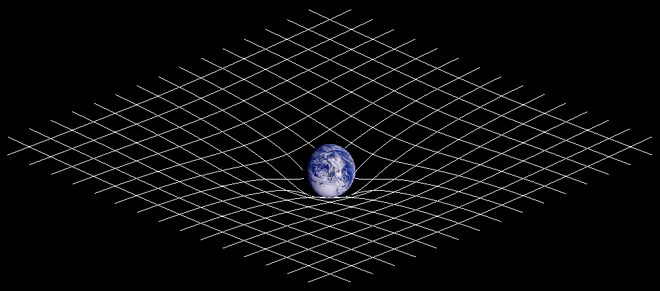
There is another kind of time travel in to the future, that also affects our satellites, ever so slightly. Large bodies of mass bend space-time. The more massive a body is, the more it bends space-time. The more this space-time is bent, the slower the time in it passes. Earth bends space-time ever so slightly, our Sun bends space-time a LOT more. And a black hole mega bends space-time.

Spacetime_curvature.png


This space-time bending effect was measured and confirmed by a science satellite called Gravity Probe B, which launched on 20 April 2004. The spaceflight phase lasted until 2005; its aim was to measure space-time curvature near Earth, and thereby the stress–energy tensor (which is related to the distribution and the motion of matter in space) in and near Earth. This provided a test of general relativity, gravitomagnetism and related models. Initial results confirmed the expected geodetic effect to an accuracy of about 1%.


.
 
Last edited:
Wait a moment, I have to shortly gather all of my incomplete knowledge about the subject in the same corner of my brain.

I assume you are talking about wormholes with their openings in different frames, which is about the only kind of time travel from general relativity I am aware of (which does not mean that there couldn't be another kind).

For wormholes the statement "can't use to go back to before it existed" is technically correct, but still conveys a wrong message. The truth is, that ending and starting point are fixed in a frame and can only travel forward in their own frame (as anything can only travel forward in its frame). It's not the type of time machine you can *choose* your favoured arrival time. You'll get out at the point in time the other end of the wormhole is currently fixed in, and that point will be moving forward. As such it isn't a road, it's a tunnel: you can't get on or of whenever out like.

With wormholes, that is true (though you can still go back/forward arbitrarily far (within the lifetime of the wormhole) by making multiple trips), but I'm pretty sure there are structures permitted by GR that allow travel to arbitrary points in time during the lifetime of the structure with just one trip, such as the Tipler cylinder.

But the point is that, whatever method of time travel you use under GR, you can't go back to a time before your time travel structure existed.
 
Last edited:
However, time travel in to the future is very much so possible. And as a matter of fact, we do this on a daily basis. Think of our satellites, orbiting our planet. Do to their very high speed, they are ever so slightly by an insurmountably minuscule amount of time, time travelling in to the future. This is due to the theory of relativity, and the fact that time passes by slower for objects that move faster. The closer an object (or person, inside an object) gets to the speed of light itself, the SLOWER the time gets, for the object (and the person inside) that is moving at that speed.

When viewed from the surface of the Earth, the clocks on the satellites appear to be ticking faster than identical clocks on the ground. A calculation using General Relativity predicts that the clocks in each GPS satellite should get ahead of ground-based clocks by 45 microseconds per day.

For for ever 1.0 seconds per 100 years of time that passes by on earth, only 0.2751 seconds pass by for the satellite, or the International Space Station. For Voyager 1 and 2, the effect is even greater.

This relativistic effect was tested and confirmed by previous experiments, and is experienced by GPS satellite atomic clocks, and an atomic clock installed on the International Space Station called RACE that is stable within 1 part in 1017. RACE will keeps time so well that if it ran for three billion years it would lose less than 1 second.


There is another kind of time travel in to the future, that also affects our satellites, ever so slightly. Large bodies of mass bend space-time. The more massive a body is, the more it bends space-time. The more this space-time is bent, the slower the time in it passes. Earth bends space-time ever so slightly, our Sun bends space-time a LOT more. And a black hole mega bends space-time.

Spacetime_curvature.png


This space-time bending effect was measured and confirmed by a science satellite called Gravity Probe B, which launched on 20 April 2004. The spaceflight phase lasted until 2005; its aim was to measure space-time curvature near Earth, and thereby the stress–energy tensor (which is related to the distribution and the motion of matter in space) in and near Earth. This provided a test of general relativity, gravitomagnetism and related models. Initial results confirmed the expected geodetic effect to an accuracy of about 1%.


.

There is definitely a time discontinuity based on the two reference points, observer vrs. traveler in this scenario.

All you have presented is true and in the realm of known Physics.

The main issue, it seems is a clear path of continuous Causality to stay in the confines of known Physics and what we know to be this universe.
 
Back
Top