
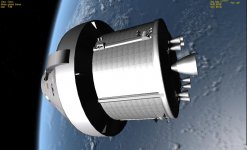
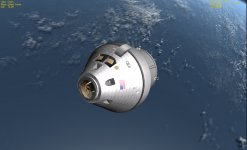
She looks good with Skylab II:




**** Orbiter.log
Build Aug 30 2010 [v.100830]
Timer precision: 6.98413e-008 sec
Found 1 joystick(s)
Devices enumerated: 2
Devices accepted: 2
==> RGB Emulation
==> Direct3D HAL
Module AtlantisConfig.dll .... [Build 100830, API 100830]
Module AtmConfig.dll ......... [Build 100830, API 100830]
Module DGConfigurator.dll .... [Build 100830, API 100830]
Module ScnEditor.dll ......... [Build 100830, API 100830]
Module Rcontrol.dll .......... [Build 100830, API 100830]
Module ExtMFD.dll ............ [Build 100830, API 100830]
Module ScreenCapture.dll ..... [Build ******, API 060425]
Module CustomMFD.dll ......... [Build 100830, API 100830]
Module Meshdebug.dll ......... [Build 100830, API 100830]
Module GPCMFD.dll ............ [Build 131213, API 100830]
Module AttitudeMFD.dll ....... [Build ******, API 060425]
---------------------------------------------------------------
>>> WARNING: Obsolete API function used: oapiRegisterMFDMode
At least one active module is accessing an obsolete interface function.
Addons which rely on obsolete functions may not be compatible with
future versions of Orbiter.
---------------------------------------------------------------
Module AutoFCS.dll ........... [Build ******, API 050206]
Error loading module Modules\Plugin\OUIPC.dll (code 126)
Error loading module Modules\Plugin\GuidanceMFD.dll (code 126)
Error loading module Modules\Plugin\RendezvousMFD.dll (code 126)
Error loading module Modules\Plugin\WarpDriveMFD-Mk2.dll (code 126)
Error loading module Modules\Plugin\LunarTransferMFD.dll (code 126)
Error loading module Modules\Plugin\LolaMFD.dll (code 126)

**** Creating simulation session
DirectDraw interface OK
Direct3D interface OK
Graphics: Viewport: Window 1434 x 874 x 32
Graphics: Hardware T&L capability: No
Graphics: Z-buffer depth: 32 bit
Graphics: Active lights supported: -1
Loading 15382 records from star database
Joystick throttle: Z-AXIS
Joystick throttle control detected
Module Sun.dll ............... [Build 100830, API 100830]
VSOP87(E) Sun: Precision 1e-006, Terms 554/6634
Module Mercury.dll ........... [Build 100830, API 100830]
VSOP87(B) Mercury: Precision 1e-005, Terms 167/7123
Module Venus.dll ............. [Build 100830, API 100830]
Module VenusAtm2006.dll ...... [Build 100830, API 100830]
VSOP87(B) Venus: Precision 1e-005, Terms 79/1710
Module Earth.dll ............. [Build 100830, API 100830]
Module EarthAtmJ71G.dll ...... [Build 100830, API 100830]
VSOP87(B) Earth: Precision 1e-008, Terms 2564/2564
Module Moon.dll .............. [Build 100830, API 100830]
ELP82: Precision 1e-005, Terms 116/829
Module Mars.dll .............. [Build 100830, API 100830]
Module MarsAtm2006.dll ....... [Build 100830, API 100830]
VSOP87(B) Mars: Precision 1e-005, Terms 405/6400
Module Phobos.dll ............ [Build ******, API 060425]
Module Deimos.dll ............ [Build ******, API 060425]
Module Galsat.dll ............ [Build 100217, API 100215]
Module Jupiter.dll ........... [Build 100830, API 100830]
VSOP87(B) Jupiter: Precision 1e-006, Terms 1624/3625
Module Io.dll ................ [Build 100217, API 100215]
Module Europa.dll ............ [Build 100217, API 100215]
Module Ganymede.dll .......... [Build 100217, API 100215]
Module Callisto.dll .......... [Build 100217, API 100215]
Module Satsat.dll ............ [Build 100215, API 100212]
Module Saturn.dll ............ [Build 100830, API 100830]
VSOP87(B) Saturn: Precision 1e-006, Terms 2904/6365
Module Mimas.dll ............. [Build 100215, API 100212]
SATSAT Mimas: Terms 113
Module Enceladus.dll ......... [Build 100215, API 100212]
SATSAT Enceladus: Terms 33
Module Tethys.dll ............ [Build 100215, API 100212]
SATSAT Tethys: Terms 101
Module Dione.dll ............. [Build 100215, API 100212]
SATSAT Dione: Terms 59
Module Rhea.dll .............. [Build 100215, API 100212]
SATSAT Rhea: Terms 68
Module Titan.dll ............. [Build 100215, API 100212]
SATSAT Titan: Terms 100
Module Iapetus.dll ........... [Build 100215, API 100212]
SATSAT Iapetus: Terms 605
Module Uranus.dll ............ [Build 100830, API 100830]
VSOP87(B) Uranus: Precision 1e-006, Terms 1827/5269
Module Miranda.dll ........... [Build ******, API 060425]
Module Ariel.dll ............. [Build ******, API 060425]
Module Umbriel.dll ........... [Build ******, API 060425]
Module Titania.dll ........... [Build ******, API 060425]
Module Oberon.dll ............ [Build ******, API 060425]
Module Neptune.dll ........... [Build 100830, API 100830]
VSOP87(B) Neptune: Precision 1e-006, Terms 391/2024
Finished initialising world
---------------------------------------------------------------
>>> WARNING: Obsolete API function used: VESSEL::SetBankMomentScale
At least one active module is accessing an obsolete interface function.
Addons which rely on obsolete functions may not be compatible with
future versions of Orbiter.
---------------------------------------------------------------
Module ISS20A.dll ............ [Build 131228, API 100830]
Module CMG2.dll .............. [Build 110727, API 100830]
Module SoyuzTMA.dll .......... [Build 100702, API 100606]
Module ProgressM1.dll ........ [Build 100626, API 100606]
Finished initialising status
Finished initialising camera
Finished initialising panels
Finished setting up render state


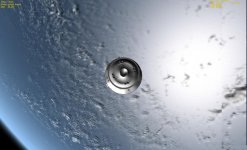
Just a few more photo ops. Thanks to francisdrake for tips of re-entry with Orion MPCV on Re-entering with Orion thread. Why does Orion re-enter the atmosphere twice, instead of once?
Skip reentry is a reentry technique involving one or more successive "skips" off the atmosphere to achieve greater entry range or to slow the spacecraft before final entry, which helps to dissipate the huge amount of heat that is usually generated on faster descents. The range modulation made possible by skip entry allows a spacecraft to reach a wider landing area, or to reach a designated landing point from a wider range of possible entry times, which is especially important in abort situations. Like aerocapture, skip reentry requires precise guidance. An overly shallow entry angle will result in the spacecraft retaining too much of its velocity, possibly escaping into space permanently if this is more than escape velocity. An overly steep entry, on the other hand, results in more intense heating and stress that could exceed the design limits of the spacecraft, potentially destroying it.


