• ORBITER-FORUM will be temporarily closed at 2026-07-23 18:00 UTC while we complete some OF maintenance tasks. The amount of downtime is expected to take up to one hour, but probably less.

Strange Blue World: Alien Planet's True Color Revealed, a First

This is incorrect. The planet would not appear blue, but rather a blinding white; it would be very brightly illuminated by the local sun. At such temperatures, the farside would also visibly glow red from the planet's heat.

It would be more accurate to say that it would appear blue if an appropriate light-blocking filter were placed in front of the eye/lens viewing it. ;)

This is pretty interesting, also goes against the predicted colour in the Sudarsky model, which is that planets above 900 Kelvin should be brownish due to a haze of alkali metals and have a low albedo, and that planets over 1400 K would have a higher albedo due to silicate clouds. It will be interesting to see why the model gets this wrong, and what, if any, relation the colouration of this planet has with the predicted appearance of planets between 350-800 K under the Sudarsky model (featureless blue and albedo of ~0.12 due to lack of clouds).
 
Last edited:
I'm not sure that this is a first, actually.

I remember chatting about this with one of my professors at university a few years back, but I don't remember if it was for a small companion star or a planet...
 
Not the one we're searching for anyway. Ridiculously close to its star, gas giant, it should have a decent ranking in the "most inhospitable worlds of the Milky Way" contest. We're still the losers by a comfortable margin.
 
Not the one we're searching for anyway. Ridiculously close to its star, gas giant, it should have a decent ranking in the "most inhospitable worlds of the Milky Way" contest. We're still the losers by a comfortable margin.

What does that have to do with anything?
 
What does that have to do with anything?

The quest of planets comparable to Earth is the main motivation beyond the hunt for exoplanets. The question is not even about the possibility to get there - but about the possibility of other worlds able to harbor life. I've seen some newspaper articles about it today and the first thing pointed is the blue color (like our blue planet). Good thing they also pointed it was a gas giant or "hot Jupiter" orbiting closely from its star.
 
No, I think there is a pure science element behind it, too. Knowing what color a hot Jupiter is to know what color it is, without any connection to the search for life.

Knowing that this is completely different to anything that we have in our solar system, is very cool, I think.
 
It would be more accurate to say that it would appear blue if an appropriate light-blocking filter were placed in front of the eye/lens viewing it.

I can make anything look blue with an appropriate light blocking filter... :lol:
 
I can make anything look blue with an appropriate light blocking filter...

Derp, I really didn't think that through. :P

What I meant was not a blue-colour filter, but something more like the glass used in welding helmets.
 
Derp, I really didn't think that through. :P

What I meant was not a blue-colour filter, but something more like the glass used in welding helmets.

No, the planet actually would look blue. But you wouldn't have to look at it through any filters, just from far enough away.

You know how certain stars in the night sky look red, others white and some blue? ;)

The peak of the spectrum is shifted towards the blue and violet, so there's more blue color than all others.
 
SpaceflightNow : Hubble finds true blue planet

[FONT=VERDANA, ARIAL, HELVETICA, SANS-SERIF][SIZE=+2]Hubble finds true blue planet [/SIZE][/FONT]
[FONT=VERDANA, ARIAL, HELVETICA, SANS-SERIF][SIZE=-2]HUBBLE PHOTO RELEASE

[/SIZE][/FONT]The Hubble Space Telescope has deduced a planet orbiting another star 63 light-years away, known as planet HD 189733b, is blue in color.

12blueplanet400293.jpg

[FONT=Verdana, Arial, Helvetica, sans-serif][SIZE=-3]Credit: NASA, ESA, and G. Bacon (STScI)

[/SIZE][/FONT]The visible-light observations were made of this distant world, which is one of the closest exoplanets that can be seen crossing the face of its star. Hubble's Imaging Spectrograph measured changes in the color of light from the planet before, during and after a pass behind its star. There was a small drop in light and a slight change in the color of the light.

"We saw the light becoming less bright in the blue but not in the green or red. Light was missing in the blue but not in the red when it was hidden," said research team member Frederic Pont of the University of Exeter in South West England. "This means that the object that disappeared was blue."

Earlier observations have reported evidence for scattering of blue light on the planet. The latest Hubble observation confirms the evidence.
If seen directly, this planet would look like a deep blue dot, reminiscent of Earth's color as seen from space. That is where the comparison ends.

On this turbulent alien world, the daytime temperature is nearly 2,000 degrees Fahrenheit, and it possibly rains glass -- sideways -- in howling, 4,500-mph winds. The cobalt blue color comes not from the reflection of a tropical ocean as it does on Earth, but rather a hazy, blow-torched atmosphere containing high clouds laced with silicate particles. Silicates condensing in the heat could form very small drops of glass that scatter blue light more than red light.

Hubble and other observatories have made intensive studies of HD 189733b and found its atmosphere to be changeable and exotic.

HD 189733b is among a bizarre class of planets called hot Jupiters, which orbit precariously close to their parent stars. The observations yield new insights into the chemical composition and cloud structure of the entire class.

Clouds often play key roles in planetary atmospheres. Detecting the presence and importance of clouds in hot Jupiters is crucial to astronomers’ understanding of the physics and climatology of other planets.

HD 189733b was discovered in 2005. It is only 2.9 million miles from its parent star, so close that it is gravitationally locked. One side always faces the star and the other side is always dark.

In 2007, NASA's Spitzer Space Telescope measured the infrared light, or heat, from the planet, leading to one of the first temperature maps for an exoplanet. The map shows day side and night side temperatures on HD 189733b differ by about 500 degrees Fahrenheit. This should cause fierce winds to roar from the day side to the night side.
 
Interesting, so it might be the silica particles themselves causing the blue colour. I wonder what phenomenon would be at play if that were the case, perhaps Mie Scattering.

Also, I prefer the artwork with the article on Space.com, the image from the article posted by N_Molson looks like it stepped out of the early 2000s (or out of my Blender projects file :P ).

HD-189733b-1600.jpg


If seen directly, this planet would look like a deep blue dot, reminiscent of Earth's color as seen from space.

:facepalm:
 
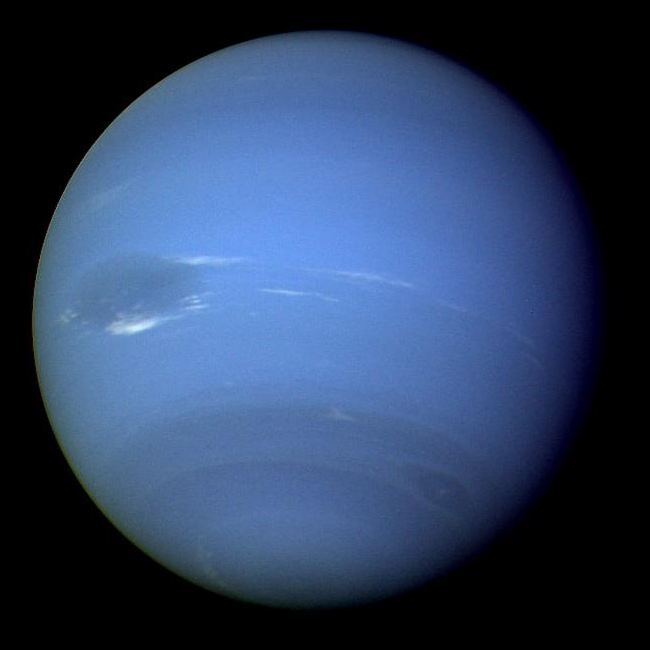
I think someone has to tell them about Neptune...

Actually, part of why this is interesting is that this planet appears to be very blue, not just slightly blue like Neptune or Earth.
 
Yes, as they say in the article and like you can see on the image in it, the best depiction of the color is cobalt blue, a pigment widely used in clothing :

ColbatBlue_2.jpg


12blueplanet400293.jpg


Neptune is definitively "wearing" a lighter blue :

Neptune.jpg


Edit : less "purple". Which means less red in the mix. Except near the terminator line.
 
Last edited:
Back
Top