
Humor The purpose of Buran uncovered

SiberianTiger

News Sifter
News Reporter
Donator
Joined
Feb 13, 2008
Messages
5,398
Reaction score
8
Points
0
Location
Khimki
Website
tigerofsiberia.livejournal.com
http://www.russiatoday.com/Art_and_...ut_NASA.html?gclid=CNP2l43hg5sCFQIfswodqjR9nQ

Magomet Talboev was one of the pilots who test-flew the shuttle without going into orbit. He said the Soviet authorities had high hopes for the multi-billion dollar spacecraft.


“The Energia-Buran programme was started to get the capability to attack the United States, just like the shuttle was able to attack the USSR. We also wanted to take the Skylab space station from orbit. Buran was supposed to put it in its cargo bay and deliver it back to Earth for studies,” Tolboev said.
 
And NASA could have saved the $700 littering fine...


That they still owe.
 
The USSR surpassed the Americans in technology – U.S. shuttles can only be landed by humans, while the Buran lands automatically,
Not actually true. The Shuttle is quite capable of landing itself; it's just always been landed by people. Part of the hot-shot American cowboy stereotype, maybe?

Moreover, I don't see how the idea presented in that article is even remotely feasible. None of the Buran shuttles are in anything remotely resembling a flyable condition; moreover, none of the infrastructure exists anymore.
 
Haha, So that's what happens to all our stations under high time accell ;). I can't picture it being practical though. A station is little more than a trophy. Better to keep it to yourself in orbit.
 
Moreover, I don't see how the idea presented in that article is even remotely feasible. None of the Buran shuttles are in anything remotely resembling a flyable condition; moreover, none of the infrastructure exists anymore.


Just mind the Buran's possible payload return mass is a bit not enough. ;)
 
ptichka1.jpg

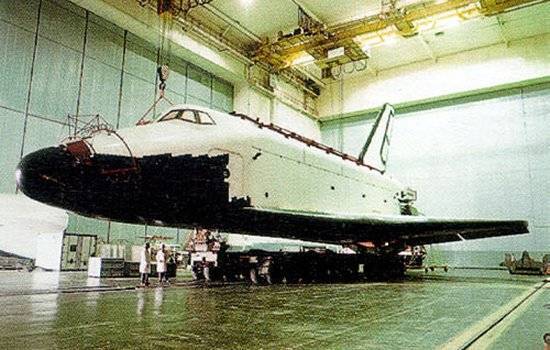
Soviet Shuttle 'Pitchka' was pretty close to being finished when they canceled the program.
 
Soviet Shuttle 'Pitchka' was pretty close to being finished when they canceled the program.

Shouldn't that have been "Pinchedka"?...;)

N.
 
Not actually true. The Shuttle is quite capable of landing itself; it's just always been landed by people. Part of the hot-shot American cowboy stereotype, maybe?

Actually not. It is NOW capable of landing itself, after some modifications to connect the remote command receiver to the various switches of the Shuttle. If you look at the internals of the modification, it is pretty sure, that the Shuttle was NEVER meant to be landed unmanned or automatic. It just has to be able to do this now, and if this means to unplug the cables into switches and plug them into a huge bundle of new cables.

The guidance can do an acceptable landing on a long runway automatically, but human pilots can get more out of the limited capabilities of the Shuttle.

The difference to Buran is, that Buran was from the start designed to fly unmanned. For that, it had guidance features and navigation antennas, which the shuttle lacks.
 
Not actually true. The Shuttle is quite capable of landing itself; it's just always been landed by people. Part of the hot-shot American cowboy stereotype, maybe?

Moreover, I don't see how the idea presented in that article is even remotely feasible. None of the Buran shuttles are in anything remotely resembling a flyable condition; moreover, none of the infrastructure exists anymore.


Soviets don't trust individuales.

Americans dont trust computers.
 
In all fairness the Air Force had about as much interest in the STS's payload return as its launch capability. (of course the shuttle development process and politics present were quite complex)

Being able to steal a working satellite would be a boon to the victor. You see the enemy's best electronics, their hardware encryption, software. Aside from technological gains from reverse engineering, you have the potential to intercept enemy communications using his own technology.
 
To expand on Eagle's point, I recall that the USAF had a fantasy mission in which a shuttle launches on a polar orbit, grabs a Soviet satellite, and lands on the next pass. I think this was an idea thought up back in the DynaSoar days.

That the USSR thought STS was a weapons system is not as silly as it seems today; STS and NASA were and are closely connected to the USAF, and several STS missions were military in nature and classified.

STS would make a very poor bomber, of course, and it's capabilities and construction is no secret, but its payloads are another story. That said, STS cannot "attack" anything, and a manned space weapons system was an obsolete idea by the 1970s.

Also, the notion of using Buran to retrieve Skylab, which was a converted S-IVB stage, is ridiculous and ruins the credibility of the speaker.
 
To expand on Eagle's point, I recall that the USAF had a fantasy mission in which a shuttle launches on a polar orbit, grabs a Soviet satellite, and lands on the next pass. I think this was an idea thought up back in the DynaSoar days.
Wasn't a fantasy mission. It was a real driver behind the design of the orbiter, especially the wings. The orbiter needed those delta-wings so it could negate the cross-range that hand built-up between the orbit and the Vandenberg AFB so it could land there on the next orbit.
 
But not grapple another satellite. Instead it was meant to transport a spy payload itself over the soviet union and return on the same orbit.
 
Am I reading that quote right...? They thought they could get SKYLAB in the payload bay????? Skylab was an entire S-V upper stage, with a modified LEM as the solar observatory. No *way* that would have fit into a 15X50-foot payload bay...

(In pieces, maybe... but it wouldn't have been very useful to study in that condition... :rofl:)
 
Actually not. It is NOW capable of landing itself, after some modifications to connect the remote command receiver to the various switches of the Shuttle. If you look at the internals of the modification, it is pretty sure, that the Shuttle was NEVER meant to be landed unmanned or automatic. It just has to be able to do this now, and if this means to unplug the cables into switches and plug them into a huge bundle of new cables.

The guidance can do an acceptable landing on a long runway automatically, but human pilots can get more out of the limited capabilities of the Shuttle.

The difference to Buran is, that Buran was from the start designed to fly unmanned. For that, it had guidance features and navigation antennas, which the shuttle lacks.
I did not say "capable of landing unmanned"--I said "capable of landing itself." AFAIK, the shuttle has always had an autoland ability, but it's the sort of thing that people on board need to monitor/activate.

I'm not 100% sure though, but one thing is for sure--STS was designed in the 60s, Buran was designed in the 80s. I sure hope that Buran was more technologically advanced...
 
Skylab was an entire S-V upper stage, with a modified LEM as the solar observatory. No *way* that would have fit into a 15X50-foot payload bay...

You haven't seen the giant can crusher they were going to take up with them :).
 
This is the usual try to glorify something that actually has no glory.

I sure hope that Buran was more technologically advanced...

Many hope so and claim that, while almost anybody knows that this was not the case. Just have a look at the flight deck. And what you can not see is the Soyuz software used for Buran as far as I know, not quite developed for something like Buran.

I don't think it was just budget and political circumstances which stoped the program, but also another certain reasons...
 
I don't think it was just budget and political circumstances which stoped the program, but also another certain reasons...

Certainly due to the lack of a frog-based guidance system. :lol:

This is the usual try to glorify something that actually has no glory.

Perhaps something that has no glory to you- some people actually glorify technological achievments instead of ugly crafts such as the Saturn IB or Apollo spacecraft.
 
Back
Top