Humor The purpose of Buran uncovered

Not really. Enegria + Buran had tall plans of use, mostly for military space applications. Also, Buran was essential to the USSR's independent effort to build a next generation modular space station.

I know there was big plans as usual. But I can't imagine they were not aware of the massive efforts and costs. The program was huge, maybe a little bit too huge at the end combined with pressure of time.

The reason why Buran was able to fly unmanned was rather simple: The Soviet spaceflight testing rules, which said that the first test flight has to be unmanned.

The Space Shuttle performed its first orbital test flight manned almost perfectly. It was the first time ever that a vehicle lifted off manned on its first test flight into orbit as far as I know. Another amazing STS fact I think.

The Soviet philosophy generally was more torwards automatic and remote control stuff rather than controllability by crews. As far as I know US astronauts were much closer onvolved in development and decisions than cosmonauts.

To perform test flights unmanned certainly is not a bad concept, but also not an advantage or real requirement. But it's an advantage if you know there are still certain potential issues here and there after you had to multiply money, personal and after loosing time...

Had a much higher specific impulse and was less dangerous in accidents, as the propellants did not ignite on contact.

The reason why such a technology is not used is also simple: It is expensive and not common. And not even especially flight-proven. It is hard to justify it's use, just look how long it took electrical thrusters to become accepted.

I don't think there was an accident with exploding RCS involved until today. At least I don't know of.

I don't know about the Russian intentions, but NASA is not going to use such an RCS for Orion and so within the next decades. They might in future, but for now it does not look so.

Well, according to the manufacturer, yes. But the only reliable claim is that the tiles are better placed on Buran, as their corners follow the air flow.

And they solved the tile loss during testing much faster than NASA did.

But still, Buran looked almost as twice as old as the Shuttles look today, and that after its first entry already!

Also Buran has better aerodynamics, it has a much better hypersonic L/D.

On the other hand, they had problems with digital fly-by-wire and used an analog system instead as far as I know.

Buran had better values here and there, at least basically on the paper. But it was not a technological achievement compared to the US Shuttle.
 
The Space Shuttle performed its first orbital test flight manned almost perfectly. It was the first time ever that a vehicle lifted off manned on its first test flight into orbit as far as I know. Another amazing STS fact I think.

Ahem. You are aware, that STS-1 was almost a catastrophic failure? Almost perfectly is something else. The anomaly list during STS-1 is extremely long and contains also events like the ignition blast of the SRBs nearly putting the important body flap out of order.

The astronauts, BTW, had been aware of the known problems and did not fly very happily. STS-1 turned out better in their eyes, than expected, but they actually expected a lot of more problems on it. Just watch the shuttle episode on the Discovery Channel DVD set "When we left Earth". Young is a pretty calm person, but that makes his memories on the concerns before launch not less serious - rather the opposite.


The Soviet philosophy generally was more torwards automatic and remote control stuff rather than controllability by crews. As far as I know US astronauts were much closer onvolved in development and decisions than cosmonauts.

Yes, but the cosmonauts had also a large influence on the spacecraft. They just had a different mentality in general.

To perform test flights unmanned certainly is not a bad concept, but also not an advantage or real requirement. But it's an advantage if you know there are still certain potential issues here and there after you had to multiply money, personal and after loosing time...

Unmanned tests are always good. Losing a flight crew is more expensive in the long term, than just loosing a prototype.

I don't think there was an accident with exploding RCS involved until today. At least I don't know of.

Happens mostly with satellites, but you also had the Salyut-6 (or was it 7?) accident with a fuel leak, which was a pretty dire situation.

I don't know about the Russian intentions, but NASA is not going to use such an RCS for Orion and so within the next decades. They might in future, but for now it does not look so.

Actually, NASA wanted to use Methane + GOX in one early design and the Lockheed-Martin lifting body CEV had a Alcohol + GOX RCS.

The reduction of the plans down to Apollo 2.0 meant also using cheaper RCS components. Which is no problem as the RCS is OK if you handle the spacecraft like raw eggs.

And they solved the tile loss during testing much faster than NASA did.

Of course. They read the NASA reports on the tile shedding during the ALT tests and the STS-1 launch. ;) Also, they lost less tiles by having the drag of the tiles reduced.

But still, Buran looked almost as twice as old as the Shuttles look today, and that after its first entry already.

Actually, aerodynamically and technically, it was more modern - only the computers had been pretty outdated, but that was a national problem.

On the other hand, they had problems with digital fly-by-wire and used an analog system instead as far as I know.

No. Was already digital. "Analog" was the brand for the jet engine equipped glider version, which was an aerodynamic analogy for the orbital version.

Buran had better values here and there, at least basically on the paper. But it was not a technological achievement compared to the US Shuttle.

Compared to Brazils, Germanys national football team is also nothing special. Both Shuttles had been technologically the peak of their nation. Maybe even ahead of their time.
 
The Soviet philosophy generally was more torwards automatic and remote control stuff rather than controllability by crews. As far as I know US astronauts were much closer onvolved in development and decisions than cosmonauts.

I am sorry, but this is a phony story. In Soviet designed spacecrafts Cosmonauts don't do actually steer the vehicle during the last kilometres of descent, but if you think a bit about it, this is the only difference from a Space Shuttle. During all the other phases of a flight the crew are working quite much: during an ascent, for instance, they have to summarize and relay information to the ground and they are serving a hot backup for automatics in case something goes wrong. And they are risking their necks just like Americans in the Shuttle (maybe a bit less due to having an escape tower).

If Soyuz accidents pressing the crews to intervene don't happen very often, this is good, I dare to think.

Speaking of the dockings and orbital operations, manual ones happen quite often. Flyarounds are performed manually, too.

I believe if Apollo creators had less pressing deadlines, or the program would get developing further, they would have intergated some more automatics into their spacecraft too.

Running a space station is a different story altogether, and I believe that both sides can now claim a roughly equal score in space construction and servicing.

---------- Post added at 22:54 ---------- Previous post was at 22:52 ----------

Compared to Brazils, Germanys national football team is also nothing special. Both Shuttles had been technologically the peak of their nation. Maybe even ahead of their time.

Well, passing a peak implies getting to a downslope. Wooo-hoooo!...
 
Wow I´m fascinated which direction this discussion took:)

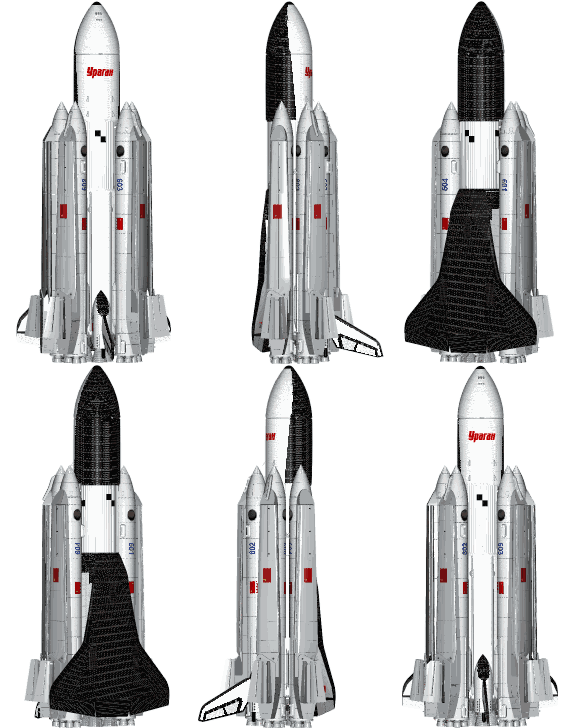
Say wasn´t the whole Buran & Energia system meant to be reusable. Which is one thing the shuttle dont have.
 
Just watch the shuttle episode on the Discovery Channel DVD set "When we left Earth". Young is a pretty calm person, but that makes his memories on the concerns before launch not less serious - rather the opposite.

I've seen it about 10 times already.

I know Young and what he says about the risks and early concerns regarding STS-1 but even Apollo and other missions he flew. He always likes to play the calm and cool hero, not only in When we left Earth ;)

Anyway, Young and Crippen were asked, they responded, and they did it regardless of the known risks, because they loved their jobs. Regarding Eugene Kranz, STS-1 was almost a perfect mission, better as they could have ever executed, which he also remarks in When we left Earth.

Unmanned tests are always good. Losing a flight crew is more expensive in the long term, than just loosing a prototype.

Of course. But STS-1 was not lost ;)

Actually, aerodynamically and technically, it was more modern - only the computers had been pretty outdated, but that was a national problem.

Allegedly the life support system had issues as well. And less than ever the flight deck was anything but more modern than that of the US Shuttle. The sparse instrumentation tells a lot, which is definitely not more modern. It looks almost like a 1950's airplane cockpit, to be honest. What's left? I don't see that it was more modern than the US Shuttle, beside different aerodynamic values and payload capabilities. It even never became a manned vehicle.
 
Say wasn´t the whole Buran & Energia system meant to be reusable. Which is one thing the shuttle dont have.

Only in one possible development prospect, called Uragan (meaning Hurricane):

gk-175.gif


Energia as it was, would only have reusable 1st stage boosters, like the Shuttle does.
 
The problem of Buran was that it was a hurried race. Just an answer to the US Shuttle. I don't think that there was ever serious intentions in the long term. It was a big show to demonstrate comparable capabilities to that of the USA. At the end, the part of the Buran program which was a real achievement, as I mentioned earlier already, was the Energija system indeed. But the orbiter itself is not something people all over the world look at and point on it with much astonishment, for certain reasons. There is actually not much to argue about it. Beside claims that it was meant for stealing Skylab or people who like the look of Buran...

Considering the sheer time and energy spent on the program, you cannot be serious about the Soviet Union not having serious intentions for Buran.

Just a comparison between the number of airframes built shows that the USSR meant business.

You are right about Energia being an achievement, but it was canned along with Buran, so it must not have been that much greater than Buran.

The fact is that Buran came in the last years of the USSR, which basically went bankrupt for various reasons. No bucks, no Buck Rogers. Russia was fortunate enough, and wise enough, to retain Soyuz, which is a proven and reliable system that doesn't break the bank.

And it's operational, not an experimental shot in the dark, making it even cheaper.

Going back a few pages to the argument that Buran was technologically more advance than STS: that will remain a big fat what-if in space history. It's like saying my grandmother would've made a better wagon if only she had wheels instead of feet. Didn't happen, so doesn't matter.
 
Back
Top