Delta-V for "direct descent" to the lunar surface?

Thanks for the info and links. I gather for that landing delta-V you are using the equation discussed in the thread Numbers in the appendix of Arthur C. Clarke's 1945 classic paper.
That result seems too high to me though. The delta-v for the ascent or descent to lunar orbit is about 1,870 m/s. This only about a gravity loss of 200 m/s. The gravity loss is given by the gravitational acceleration times the time of the burn. I don't think the burn time would be that much greater for this case compared to the orbital case.


Bob Clark

Don't underestimate the effect of flight path angle. You forget that lunar orbit means that you already have slowed down for entering orbit. Entering this orbit is also done with less gravity losses, since you are burning with only small angles from the ideal tangent, while a direct descent means that you start with a pretty high flight path angle, that approaches 90° along the way, while a normal landing from lunar orbit starts at 0° FPA and then slowly approaches 90° as the velocity and altitude drops.

Much more coarse fact check: You start at 2491 m/s and are vertically descending. Your engine gives you an acceleration of 20 m/s², gravity accelerates you downward by 1.6 m/s².

This means you need [math]\frac{2491}{20 - 1.6} = 135[/math] seconds for slowing down to zero. Makes 2707 m/s... which is pretty close to [math]2491 \times 1.08 [/math] ... and you need to start slowing down already in 167.67 km altitude.
 
Thanks for the info and links. I gather for that landing delta-V you are using the equation discussed in the thread Numbers in the appendix of Arthur C. Clarke's 1945 classic paper.
That result seems too high to me though.

Yeah, that calculation was clumsy to say the least. Here is some better data from the descent. Remember that this is a coplanar lunar transfer, reaching the Moon at the apoapsis of its orbit around the Earth, aiming for the center.
Moon's velocity relative to Earth: 967.5 m/s
Periapsis of spacecraft relative to the Moon: -1738 km


Lunar descent/impact
Alt. (Km) | (1*)Vel. (m/s) | (2*)Vel. (m/s) | Acc. (m/s²)
1000​
|
2039​
|
2078​
|
0.65​
750​
|
2125​
|
2163​
|
0.79​
500​
|
2226​
|
2262​
|
0.98​
250​
|
2347​
|
2381​
|
1.24​
200​
|
2374​
|
2407​
|
1.30​
150​
|
2402​
|
2435​
|
1.37​
100​
|
2431​
|
2464​
|
1.45​
75​
|
2446​
|
2479​
|
1.49​
50​
|
2461​
|
2494​
|
1.53​
25​
|
2477​
|
2510​
|
1.57​
10​
|
2487​
|
2519​
|
1.60​
0​
|
2492​
|
2525​
|
1.62​

EDIT: Table updated with data from an impact at lunar periapsis (Moon's Vel = 1078 m/s)

(*1) Impact at lunar apoapsis
(*2) Impact at lunar periapsis

---------- Post added at 10:55 PM ---------- Previous post was at 01:24 PM ----------

Let me try and make a more "correct" calculation this time using the data from the impact at lunar apoapsis.

I'll start with the velocity and acceleration at 150 km and take the averages. I'll also use the data from the DG, in the scenario I set up for the engine deccelaration. This should help get an idea of what to expect.

Deceleration of DG at full thrust for a 2500 m/s burn was 26.4 m/s² at the beginning of the burn and 28.1 m/s² at the end. Average: 27.25 m/s²(a)

Velocity at 150 km alt. 2402 m/s and 2492 m/s at 0 alt. Average: 2447 m/s (Vo)

Acceleration at 150 km: 1.37 m/s² and 1.62 m/s² at 0 alt. Average: 1.495 m/s² (g)

[math]T_{burn} = \frac{V_0}{a-g} = \frac{2447}{27.25-1.495} = 95 sec[/math]

During those 95 seconds the velocity increase will be 1.495*95=142 m/s

So the total Δv should be 2447+142 = 2589 m/s (approximation). Adding the 3150 m/s for the transfer and corrections we get a total of 5740 m/s (rounded) for a trip from a 300km x 300km LEO to the lunar surface.

For comparison the total Δv for this flight from the "traditional" method is 3150 + 800 + 1900 = 5850 m/s (transfer with correction+LOI+landing)

If that's the case, then the savings from the direct descent method are ~100 m/s. (:hmm: I wasn't expecting any savings).

The downside is that the transfer trajectory has to be exactly for the center of the moon (PeA -1738km, Ecc: 1.0), otherwise you get an additional horizontal velocity during the deceleration burn.

I'll do some testing to see how much Δv is actually used and the altitude at which to start the burn.
 
Last edited:
...
If that's the case, then the savings from the direct descent method are ~100 m/s. (:hmm: I wasn't expecting any savings).
The downside is that the transfer trajectory has to be exactly for the center of the moon (PeA -1738km, Ecc: 1.0), otherwise you get an additional horizontal velocity during the deceleration burn.
I'll do some testing to see how much Δv is actually used and the altitude at which to start the burn.

Thanks for that. Found this after a web search:

Lunar Base Studies in the 1990s.
1993: Early Lunar Access (ELA).
by Marcus Lindroos
To save fuel, the LEV makes a direct landing rather than enter an intermediate lunar parking orbit as Apollo did. The vehicle retains sufficient propellant to perform a later ascent burn to return the crew to Earth. For unmanned cargo missions, the LEV carries a heavier payload and uses up all its fuel for landing.
http://www.nss.org/settlement/moon/ELA.html

I still need to find out how much they were able to save with their trajectory.

Bob Clark
 
Rather than start a new thread I'm curious about another lunar trajectory question. The lunar transport craft the Aries 1B from 2001: A Space Odyssey used nuclear propulsion to cut the travel time from the three days of a Hohmann minimal delta-v flight to only 1 day.

Suppose we had 9 km/s delta-v available to us at LEO with a chemical propulsion craft by refueling at an orbital propellant depot. How short could we cut the travel time to the Moon when you consider you also have to leave sufficient propellant reserve to slow down from the higher arrival speed you would get from a higher departure speed, in addition to the propellant reserve needed to land.

Suppose we have propellant depots in lunar orbit. Then we only need to slow down to get into lunar orbit. We don't also need propellant to land. This should allow us higher departure speed in that case, and a shorter travel time in that case.

Bob Clark
 
Last edited:
Suppose we had 9 km/s delta-v available to us at LEO with a chemical propulsion craft by refueling at an orbital propellant depot. How short could we cut the travel time to the Moon when you consider you also have to leave sufficient propellant reserve to slow down from the higher arrival speed you would get from a higher departure speed, as well as to land.

24h trip requires 6.8 km/s of delta-v.

See Fig. 7 in this paper: http://trajectory.grc.nasa.gov/aboutus/papers/AIAA-97-2956.pdf
 
{snip} to cut the travel time from the three days of a Hohmann minimal delta-v flight {...snip}

A minimum dV Hohmann transfer to the Moon takes approximately 5 days, not 3.

Suppose we had 9 km/s delta-v available to us at LEO with a chemical propulsion craft by refueling at an orbital propellant depot. How short could we cut the travel time to the Moon when you consider you also have to leave sufficient propellant reserve to slow down from the higher arrival speed you would get from a higher departure speed, as well as to land.

Suppose we have propellant depots in lunar orbit. Then we only need to slow down to get into lunar orbit. We don't also need propellant to land. This should allow us higher departure speed in that case, and a shorter travel time in that case.

Bob Clark

Disclaimer: It's been a while since my last fast transfer to the Moon, so the numbers below should be checked. IIRC these where the results:

24 hours transfer → 6.9 km/s
15.5 hours transfer → 10.5 km/s

Those dV results are for the TLI and LOI burns. The 24 hour flight had a 3.85 km/s TLI and a 3.05 km/s LOI.

The 15.5 hours one was at 5 km/s TLI and 5.5 km/s LOI.

Departure orbit was 300x300 km at Earth and arrival at 100x100 km at the Moon.

With a 9 km/s budget and without refueling at lunar orbit you can do the 24 hour transfer.
If you refuel at lunar orbit, the transfer time for the same budget should be at around the 20 hour mark.
 
A minimum dV Hohmann transfer to the Moon takes approximately 5 days, not 3.
Disclaimer: It's been a while since my last fast transfer to the Moon, so the numbers below should be checked. IIRC these where the results:
24 hours transfer → 6.9 km/s
15.5 hours transfer → 10.5 km/s
Those dV results are for the TLI and LOI burns. The 24 hour flight had a 3.85 km/s TLI and a 3.05 km/s LOI.
The 15.5 hours one was at 5 km/s TLI and 5.5 km/s LOI.
Departure orbit was 300x300 km at Earth and arrival at 100x100 km at the Moon.
With a 9 km/s budget and without refueling at lunar orbit you can do the 24 hour transfer.
If you refuel at lunar orbit, the transfer time for the same budget should be at around the 20 hour mark.

Thanks for that. For the Hohmann transfer at a 5 day flight time, how much is the departure delta-v? I thought it was the 3.1 km/s used for example by the Apollo missions.

Bob Clark

---------- Post added at 12:35 AM ---------- Previous post was at 12:33 AM ----------

24h trip requires 6.8 km/s of delta-v.

See Fig. 7 in this paper: http://trajectory.grc.nasa.gov/aboutus/papers/AIAA-97-2956.pdf

Thanks for the link.

Bob Clark
 
Thanks for that. For the Hohmann transfer at a 5 day flight time, how much is the departure delta-v? I thought it was the 3.1 km/s used for example by the Apollo missions.

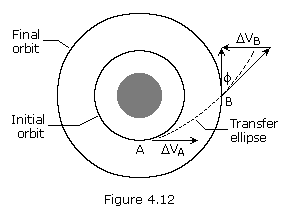
I guess it depends on where you round off your numbers. The Apollo missions used one-tangent (f.4.12) burns to get into slightly faster transfer time trajectories than the minimum dV Hohmann transfer.
In order to do that you extend the apoapsis of the transfer orbit past the orbital altitude of the target, thus having a greater semi major axis than the Hohmann transfer. One could think that since the semi major axis is greater, that means that the transfer time is greater, but you have to remember that the rendezvous with the target happens well below the apogee of the transfer trajectory.

fig4-12.gif


The difference of a 3.5 day Apollo style transfer and a minimum dV 5 day Hohmann transfer is not that big, a few tens of m/s.

Apollo 11 used 3,182 m/s , so the correct rounding is ~ 3.2 km/s. Source
According to Post Launch Mission Report No. M-932-69-11, the actual TLI DV was 10,441 ft/s (3,182 m/s)

The minimum dV Hohmann transfer is in the 3,130 m/s region.
From a 200x200 km orbit, a burn of exactly 3,100 m/s will take you to an apogee altitude of 275,700 km, almost 100,000 km short of the Moon's mean orbital altitude around Earth.

By looking at the escape dV from a 200x200 km orbit (3,226 m/s) you can see why such small differences in the region of 3,100-3,200 m/s can lead to such vast differences in the semi major axis of the transfer trajectory.
 
...
The minimum dV Hohmann transfer is in the 3,130 m/s region.
From a 200x200 km orbit, a burn of exactly 3,100 m/s will take you to an apogee altitude of 275,700 km, almost 100,000 km short of the Moon's mean orbital altitude around Earth.
By looking at the escape dV from a 200x200 km orbit (3,226 m/s) you can see why such small differences in the region of 3,100-3,200 m/s can lead to such vast differences in the semi major axis of the transfer trajectory.

Surprising such a small increase in delta-v, a few tens of m/s, would have such a large decrease in travel time, two days, at around the escape velocity.
Also surprising it takes a correspondingly large amount of delta-v to cut the travel time down again by two days, to a 1 day flight.

So the one day flight could be done by chemical propulsion using LEO refueling since 9 km/s is what launchers can now achieve for flights to LEO. However, we would want our transport to be reusable, and this becomes more complicated for a multi-stage craft.

You could have the first stage of the transport go a little below TLI velocity so it would return to Earth by the effect of gravity. Or you could have it go to TLI velocity and let it do a free return to Earth after looping around the Moon.

The upper stage that lands on the Moon probably would not need the first stage on return, since the delta-v to lift off from the Moon and return to Earth is only around 2,740 m/s if you do aerobraking on return to Earth. This though is for a 3-day return flight a la Apollo. But since the upper stage of a rocket launcher to LEO typically has a delta-v of 6,000 m/s quite likely such an upper stage used for this lunar transport role could also have sufficient delta-v to make this return flight in a day or less.

For this reusable multi-stage launcher used also for a lunar transport you couldn't use the same lower stage as when launched from Earth because this doesn't reach orbit. An advantage then of an SSTO is the very same stage could be used to launch from Earth, and on refueling in LEO be used to do the 1 day, one-way flight to the Moon.


Bob Clark
 
Back
Top