glide re-entry question

snoman314

New member
Joined
Feb 27, 2011
Messages
3
Reaction score
0
Points
0
Using the AerobrakeMFD and Deltaglider or XR2, I've carried out re-entries that took hours and had very low peak heat flux.
I was wondering if anyone could comment on the realism of this. How about a future craft with active cooling to deal with the extended heat soak? Could you really glide in over a period of several hours as Orbiter allows at the moment? If not why not?

TIA
 
I doubt it...

XR2 has a very high lift to drag ratio... just under 8. Space Shuttle at 40° angle of attack has around 1...

On the other hand of the spectrum is DGIV, with 0...
 
I think you got it wrong. He wasn't saying that he did that at 40 degrees AoA. I did this kind of thing too... I kept an AoA of maximum 10 degrees... unless something went wrong. Fun times.

Off topic: I loved changing planes this way. Much more fuel efficient. I need to try it in the Shuttle.
 
I think you got it wrong. He wasn't saying that he did that at 40 degrees AoA. I did this kind of thing too... I kept an AoA of maximum 10 degrees... unless something went wrong. Fun times.
Even so, the L/D ratio of the shuttle at lower angles of attack (approx 10-15° on approach IIRC) is about 4.5.

The trouble is that at hypersonic velocites, a low drag body does not keep the shock wave away from the vehicle - your overall heat flux (as displayed by Aerobrake MFD) might be lower but that heat is more easily conducted into the vehicle. That heat is very difficult to cope with using materials that are suitable (light, robust, etc) for other aspects of flight.
 
So with sufficiently low drag/good L/D ratio then the main problem is cumulative heat buildup? BTW I am trying to base a hard-SF based craft in as much reality as possible here.
By how long might such a craft extend re-entry by descending in this manner?
 
So with sufficiently low drag/good L/D ratio then the main problem is cumulative heat buildup?
More that you have very high temperatures in a small area - the small area makes it more difficult for the active cooling to work (the heat transferred is proportional to the area of the material in contact with the coolant).

By how long might such a craft extend re-entry by descending in this manner?
:shrug: All depends on the L/D. You say several hours - that sounds plausible if you can accept the fictional L/D that it implies.
 
I think the premise of doing a 40 degree AoA re-entry is to distribute the heat across a larger surface area of the vehicle.

Correct my limited understanding of exo-atmospheric flight if I'm wrong, but it might be more efficient to have a craft fly a "skipping stone" type flight profile on the upper atmosphere, bouncing off and coming back down again until enough speed has been bled off to transition to fixed wing flight. If I did this in Orbiter I could deploy the XR's radiators after each aerobraking session preventing an overheat if I just flew in a nose-first aerobraking profile 1/4 around the world.

I think this flight profile was related to a WW2 German special weapon project for a global range bomber that flew once around the Earth suborbital and re-entered back over Germany after such a "stone skipping over pond" profile.

What might be related to the original poster's concept here is that with access to sci fi propulsion like XR spaceplanes' standard settings, I rarely commence re-entry without first using hover and main engine thrust to setup a favourable and very relaxed re-entry trajectory, sometimes as low as 4-5km/s. Using advanced engines in such a manner might make possible lighter spacecraft with less heat shielding. No ballistic re-entries but with special flight profiles, hull heating might be minimised.

Disclaimer: Might not be 100% relevant to this topic, but still, sci fi re-entry oriented.
 
The rule is: The sharper the nose a body or part of this is, for example a wing, the higher the heat flux at supersonic speeds. The why is pretty easy to understand: The blunter body creates one large shock that slows the air down behind it and has this shock (and the supersonic airflow) further away from the hull, while the sharper body creates softer shocks that don't slow the airflow down as much, and also the airflow closer to the hull.

That is also why a blunt body at supersonic speeds has a really huge drag - a typical capsule reaches an Cd around 2.5, that is even a tiny bit more than a parachute produces at subsonic speeds.

The same also happens at the space shuttle - by the 40° AOA, the air cushion that forms below it pushes most heat away from the spacecraft, so that only very few places need the expensive best heat protection.

Carmen A: This bomber was called Saenger after its inventor or Silbervogel/Silver Bird.

http://www.astronautix.com/lvs/saenger.htm

It is related to Saenger I and Saenger II, two later concepts for German space planes. Sadly none of them was ever build... while it was really hard to beat the costs of the Ariane 5 with Saenger II, 30% less costs was still more than just a good start, remembering that the Ariane 5 is a pretty cost effective launcher.
 
Last edited:
Thanks for refreshing my memory Urwumpe, it's much appreciated :)

Blunt body - I'm reminded of the XR5 with its surprisingly "plump" design. Last month I wondered if that wing design would ever survive supersonic (much less hyper-s) flight because the wings don't fit into the Mach shock cone or whatever it's called.

The Bell X-1 had issues breaking the sound barrier, due to the straight wings protruding outside that shock cone.

Maybe the round nose of the XR5 is a method of diverting the shockwave further from the fuselage/hull but even so, at the expense of huge drag. Would a sleeker XR5 be a more practical venture for a low orbit transport? Judging by the wing design, that is.
 
Actually, you have to remember that behind the front shock, the air flow is much slower and can on a bad day even be subsonic already (Bad day, because slowing air to subsonic speed always comes with a lot of drag) - and slower airflow at the control surfaces means less force by them - you can't control your vessel well anymore. It is often better to have the control surfaces extend out into the faster air flow for more torque.

A blunter aircraft isn't really worse, it just has the problem that it also gets much more drag that way, and much higher forces acting on the vessel. If you have just air breathing turbofan engines, every bit of drag is bad...if you have rocket engines, you can tolerate it.
 
Indeed, fuel efficiency is not really a priority, if the XR5 with fuel modules in the payload bay can have as much fuel as suspension of belief allows (ground pressure of a tricycle landing gear with 1 kiloton vehicle weight is a different matter).

Apologies in advance for derailing the thread; hope the original poster gets some alternative ideas for a prolonged re-entry sequence.

I just thought up an idea for crossbreeding the XR2 and Deltaglider EX for a "sleeker" evolution of the Vanguard, but that I'll post up for fun/discussion later after reading the community's XR7 concept writeups I saw a couple weeks back.
 
What about Skylon spaceplane? It has very sharp nose so it should heat to high temperature during ascent and reentry. Skylon has to be aerodynamic to fly efficiently in airbreathing mode meaning the designers can't use more blunt hull form like shuttle. How are they planning to deal with excessive heat buildup during reentry?
 
What about Skylon spaceplane? It has very sharp nose so it should heat to high temperature during ascent and reentry. Skylon has to be aerodynamic to fly efficiently in airbreathing mode meaning the designers can't use more blunt hull form like shuttle. How are they planning to deal with excessive heat buildup during reentry?

They have a smaller problem with this, because their vessel is mostly empty tanks during reentry. Lighter vessels slow down at higher altitudes and get less heating. At a ballistic reentry, lighter vessels get the same peak deceleration as heavier vessels (but at a sooner time), gliding reentry depends on the L/D.
 
According to Reaction Engines:
The propellant is intended to be kept at low pressure to minimise stress; a vehicle that is both large and light has an easier time during atmospheric reentry compared to other vehicles due to a low ballistic coefficient. Because of the low ballistic coefficient, Skylon would end up slowing down at higher altitudes where the air is thinner, meaning the skin of the vehicle would only reach 1100 Kelvin (K). In contrast, the smaller Space Shuttle is heated to 2000 K on its leading edge, and so employs an extremely heat-resistant but extremely fragile silica thermal protection system. The Skylon design need not use such a system, instead opting for using a far thinner yet durable reinforced ceramic skin. However, due to turbulent flow around the wings during re-entry, some parts of Skylon would need to be actively cooled.
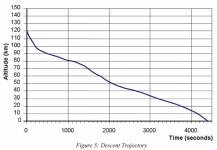
FWIW, the Users' Guide lists peak load in the +Z direction as < 2g. It also gives this re-entry profile:
SKYLON_User_ Manual_Figure5.png

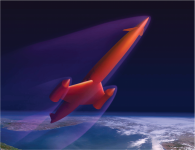
I can't find anything about its angle of attack during re-entry but it looks pretty high in the rendering (to be taken with an appropriately large grain of salt):
SKYLON_User_ Manual_reenty_graphic.png
 
OK Thanks everyone, that gives me a rough idea of the problems involved I think.
 
Back
Top