
-
ORBITER-FORUM will be temporarily closed at 2026-07-23 18:00 UTC while we complete some OF maintenance tasks. The amount of downtime is expected to take up to one hour, but probably less.
You are using an out of date browser. It may not display this or other websites correctly.
You should upgrade or use an alternative browser.
You should upgrade or use an alternative browser.
Project Nova HLV
- Thread starter K_Jameson
- Start date

K_Jameson
Well-known member
- Joined
- Dec 30, 2009
- Messages
- 1,228
- Reaction score
- 239
- Points
- 78
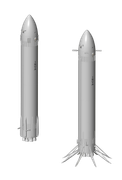
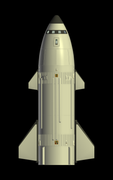
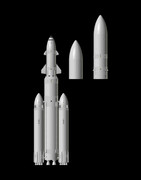
Here, the "Argo", my interpretation of the Starship. It is a much smaller vehicle, and runs on hydrolox instead of metholox. Tailored for Earth-Moon trips. A large lunar lander, named "Auriga", is also in development.
K_Jameson
Well-known member
- Joined
- Dec 30, 2009
- Messages
- 1,228
- Reaction score
- 239
- Points
- 78
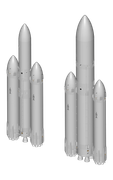
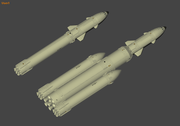
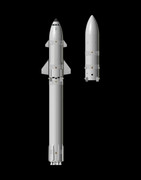
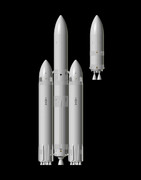
The two configurations above with the Argo spacecraft, tentatively named Nova IB and Nova VB, will be used respectively for LEO and lunar operations. Like in the Starship/Superheavy, opened interstages for exhaust venting are used. Unlike Starship, hot staging will not be used routinely, but only in case of an abort.
K_Jameson
Well-known member
- Joined
- Dec 30, 2009
- Messages
- 1,228
- Reaction score
- 239
- Points
- 78
The core stage remains expendable, but I have already planned a way to use it: as an orbital refueling station, periodically filled with multiple flights of special tanker versions of the Argo spacecraft.
K_Jameson
Well-known member
- Joined
- Dec 30, 2009
- Messages
- 1,228
- Reaction score
- 239
- Points
- 78
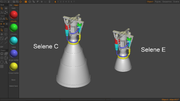
As said, the Argo spacecraft is far smaller than Starship, with a dry weight of about 28,000 kg and a full weight around 124,000 kg. It runs on hydrolox, with seven SELENE-E, expanded bleed engines, adapted to be operated both in vacuum and at sea level.
In the Nova IB configuration, the fully reusable Argo spacecraft will be able to carry a crew of four and some 2,300 kg of cargo to the ISS, or 4,000 kg in cargo-only configuration. The tanker version will be able to transport about 8,500 kg of Lox/LH2 to a resupply depot in LEO.
In the Nova VB configuration, the spacecraft will have enough delta V to perform TLI, LOI and TEI maneuvres. Due to the higher entry speed, the lunar version will have a partially ablative heat shield, for which I expect an additional dry weight of approximately 5-6 tons.
In the Nova IB configuration, the fully reusable Argo spacecraft will be able to carry a crew of four and some 2,300 kg of cargo to the ISS, or 4,000 kg in cargo-only configuration. The tanker version will be able to transport about 8,500 kg of Lox/LH2 to a resupply depot in LEO.
In the Nova VB configuration, the spacecraft will have enough delta V to perform TLI, LOI and TEI maneuvres. Due to the higher entry speed, the lunar version will have a partially ablative heat shield, for which I expect an additional dry weight of approximately 5-6 tons.
Last edited:
K_Jameson
Well-known member
- Joined
- Dec 30, 2009
- Messages
- 1,228
- Reaction score
- 239
- Points
- 78
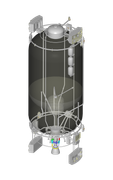
The arrangement of the crew seats aboard the Argo. In the cargobay, the (removable) airlock with docking port is showed.
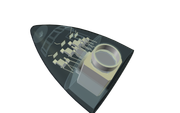
Here a first look of the Auriga lunar lander, conceived around the same basic shell, 5.8 meters in diameter, shorter and in aluminium and carbon fiber instead of stainless steel. The lander will be in a single stage and reusable. The crew quarters will have two floors; the lower floor will have an elevator in order to transport cargo and astronauts to the surface. Design still in progress; the landing legs are only notional.
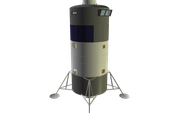
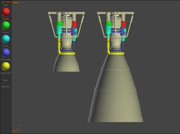
The engine is a single SELENE-D, a closed espanded variant of the SELENE-C, with less thrust but more isp and throttleability. As a backup, four smaller engines, still hydrolox (the name is not yet chosen), are installed.
Here a first look of the Auriga lunar lander, conceived around the same basic shell, 5.8 meters in diameter, shorter and in aluminium and carbon fiber instead of stainless steel. The lander will be in a single stage and reusable. The crew quarters will have two floors; the lower floor will have an elevator in order to transport cargo and astronauts to the surface. Design still in progress; the landing legs are only notional.
The engine is a single SELENE-D, a closed espanded variant of the SELENE-C, with less thrust but more isp and throttleability. As a backup, four smaller engines, still hydrolox (the name is not yet chosen), are installed.
K_Jameson
Well-known member
- Joined
- Dec 30, 2009
- Messages
- 1,228
- Reaction score
- 239
- Points
- 78
Current updated stats (RTLS of first stages/boosters):
NOVA I
LEO: 17100 kg
GTO: 4800 kg
GEO: 1300 kg
LTO: 3750 kg
LLO: 1900 kg
NOVA IB
LEO: Argo spacecraft + 2400 kg
Nova II
LEO: 42800 kg
NOVA III
LEO: N/A
GTO: 27100 kg
GEO: 16200 kg
LTO: 23700 kg
LLO: 18000 kg
NOVA IV
LEO: 98900 kg
NOVA V
LEO: N/A
GTO: 66000 kg
GEO: 40100 kg
LTO: 58000 kg
LLO: 44500 kg
NOVA VB
LLO: Argo spacecraft + 600 kg
NOVA VI (speculative)
LEO: 130100 kg
NOVA I
LEO: 17100 kg
GTO: 4800 kg
GEO: 1300 kg
LTO: 3750 kg
LLO: 1900 kg
NOVA IB
LEO: Argo spacecraft + 2400 kg
Nova II
LEO: 42800 kg
NOVA III
LEO: N/A
GTO: 27100 kg
GEO: 16200 kg
LTO: 23700 kg
LLO: 18000 kg
NOVA IV
LEO: 98900 kg
NOVA V
LEO: N/A
GTO: 66000 kg
GEO: 40100 kg
LTO: 58000 kg
LLO: 44500 kg
NOVA VB
LLO: Argo spacecraft + 600 kg
NOVA VI (speculative)
LEO: 130100 kg
K_Jameson
Well-known member
- Joined
- Dec 30, 2009
- Messages
- 1,228
- Reaction score
- 239
- Points
- 78
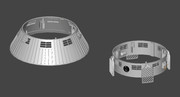
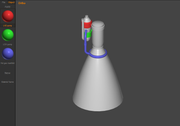
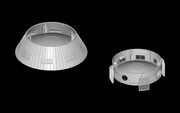
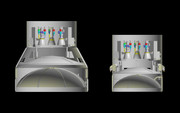
I've reworked the interstages for the manned configuration of the rocket with the Argo vehicle. Exhausts ports for the emergency hotstaging are slightly enlarged and ripositioned at the bottom of the interstage, that make more sense. Also, a flame deflector was added in order to better channel the exhausts towards the aforementioned ports, avoiding dangerous backfire. The purpose is to ensure the spacecraft is not damaged from its own exhausts during an abort, rather than protecting the booster underneath, that, if involved in an event so serious to call for an abort, it is assumed lost in any case. The deflector also acts as an additional protection shield between the spacecraft and the rocket, all at the cost of a slightly increased dry mass and therefore a slightly reduced payload. Please note the pneumatic pushers on top of the interstages.

misha.physics
Well-known member
- Joined
- Dec 22, 2021
- Messages
- 1,534
- Reaction score
- 2,326
- Points
- 128
- Location
- Lviv
- Preferred Pronouns
- he/him
Hi, sorry, I just wanted to ask. Do you model all these objects yourself in Anim8or?
misha.physics
Well-known member
- Joined
- Dec 22, 2021
- Messages
- 1,534
- Reaction score
- 2,326
- Points
- 128
- Location
- Lviv
- Preferred Pronouns
- he/him
Your meshes look amazing and detailed. Actually, I don't familiar with the Italian community. It looks you have the big experience with 3D modeling. Have you tried other 3D program, like Blender, for example?
K_Jameson
Well-known member
- Joined
- Dec 30, 2009
- Messages
- 1,228
- Reaction score
- 239
- Points
- 78
I tried, but I'm used to Anim8or. The Italian community is long gone, sadly. For this project I did a lot of research to make sure it was as realistic as possible. The gap in realism with previous works done for the Italian community is abysmal.
K_Jameson
Well-known member
- Joined
- Dec 30, 2009
- Messages
- 1,228
- Reaction score
- 239
- Points
- 78
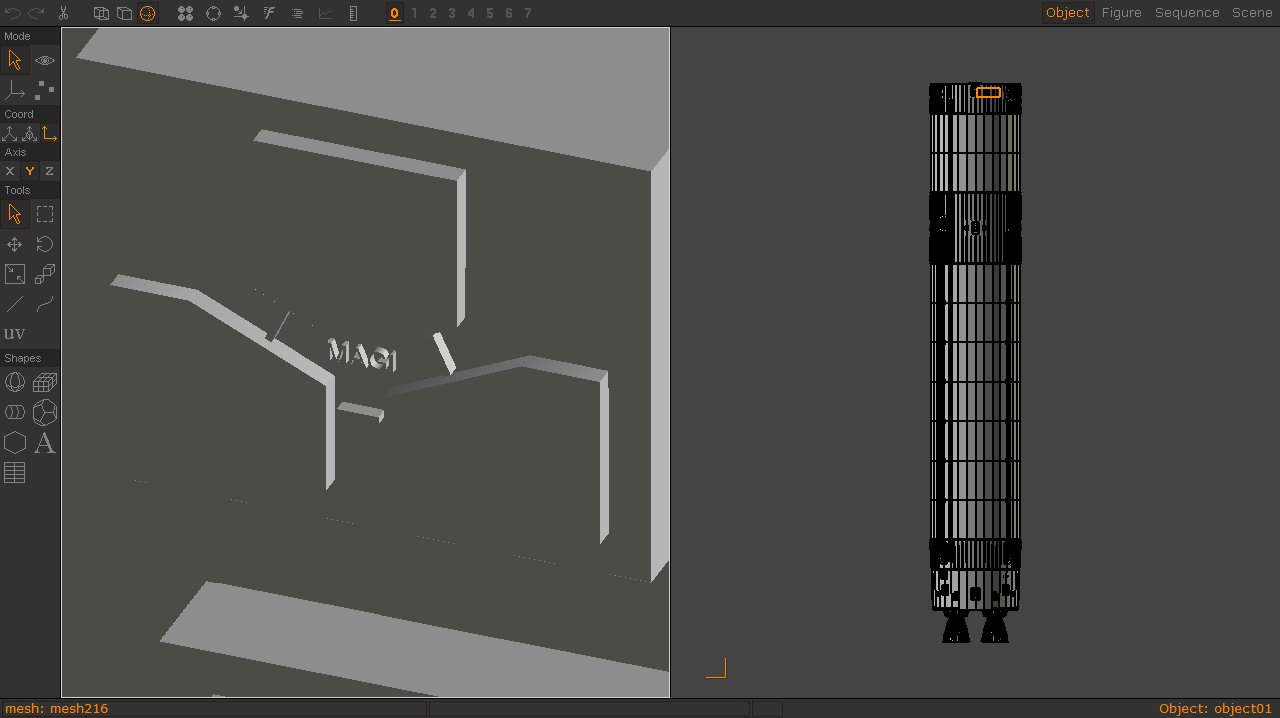
As in previous projects of mine like the Starlab station and the Galileo II probe, I had fun inserting easter eggs into the meshes. Here, the rocket flight computer. Can anyone catch the reference? It's easy 
K_Jameson
Well-known member
- Joined
- Dec 30, 2009
- Messages
- 1,228
- Reaction score
- 239
- Points
- 78
I'm reconsidering again the interstage configuration for the manned stack. I'm tempted to ditch the flame diverter just introduced, in order to save weight. Considering that the booster preservation is not a priority in case of an abort (the only instance in which the hot staging would be used), I wonder if a not-optimal, but lighter, configuration without the flame diverter could be feasible in reality or if the danger of damaging the escaping spacecraft is unacceptable. I remind the first Starship/Superheavy launch, from that then-inadequate launchpad, that ended in extensive damage but ultimately hasn't prevented the liftoff - and in my case the thrust involed is somethig like 1/50 of that.
Similar threads


- Replies
- 88
- Views
- 46K


- Replies
- 92
- Views
- 44K


- Replies
- 24
- Views
- 14K
