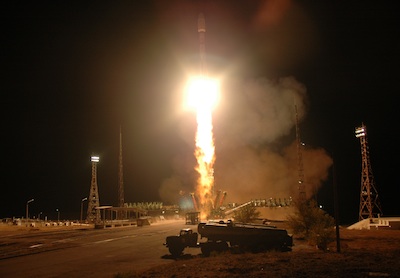
Launch News Senary Globalstar-2 atop Soyuz-2.1a/Fregat on October 19, 2010

SiberianTiger

News Sifter
News Reporter
Donator
Joined
Feb 13, 2008
Messages
5,398
Reaction score
8
Points
0
Location
Khimki
Website
tigerofsiberia.livejournal.com
heading.jpg


logo.gif
250px-Arianespace_logo_svg.png
Globalstar-Logo-Tag.jpg


Launch site:
Baikonur Launch pad no. 31/6 45°59'46.16"N, 63°33'51.29"E

Launch date: October 19, 2010

The launch time is:
23:10:59 Baikonur 19.10.2010
21:10:59 Moscow Summer 19.10.2010
17:10:59 UTC Oct 19, 2010
1:10:59 p.m. EDT Oct 19, 2010


[eventTimer]2010-10-19 17:10:59?before|after;%dd% Days %hh% Hours %mm% Minutes %ss% Seconds %c%[/eventTimer] Senary Globalstar-2 Launch


Payload: Six Globalstar-2 satellites.
globalstar-2__1.jpg


Manufacturer: Thales Alenia Space

LogoThalesAleniaSpace400.gif


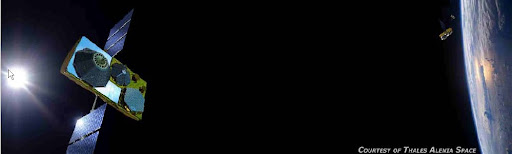
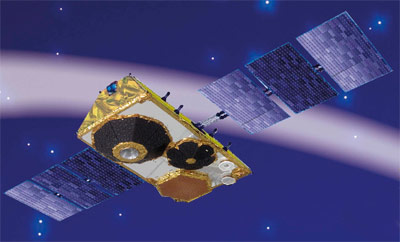
The new Globalstar second-generation low-earth-orbit (LEO) satellite is a three-axis stabilized spacecraft consisting of a trapezoidal main body with two solar arrays. In 2006 Globalstar contracted Thales Alenia Space for the design, manufacture and delivery of its second-generation constellation satellites. The first six satellites being launched were delivered to Globalstar in August of this year.

The new Globalstar spacecraft has a design life of 15 years or twice the design life of the first-generation Globalstar satellite. To help ensure the reliability of the design life, the second–generation robust architecture has placed particular emphasis on redundancy management and the radiation environment of the Globalstar operational orbit. In addition, each functional chain of the spacecraft was carefully analyzed for implementation of redundancies and tolerances to minimize single point failures.

Each second-generation Globalstar satellite weighs approximately 700 kg, offers power of 2.4 kW, is fitted with 16 transponders from C-to S-band, and 16 receivers from L- to C-band. The satellite's trapezoidal body is fabricated from rigid aluminum honeycomb panels. The trapezoidal shape was selected to conserve volume and to allow the mounting of multiple satellites under the launch vehicle's payload fairing.

The satellite operates in a body-stabilized, three-axis attitude control mode and uses sun sensors, Earth sensors, and a magnetic sensor to help maintain attitude. The satellite utilizes thrusters for orbit-raising, station-keeping maneuvers and attitude control. The spacecraft's thrusters are fueled from a single on-board propellant tank.

The two solar arrays provide the primary source of power for the Globalstar spacecraft, while batteries are used during eclipses and peak traffic periods. The solar panels automatically track the sun as the satellite orbits the Earth, providing maximum possible exposure to the sun's energy.

The heart of a Globalstar satellite is its communications systems. These systems are mounted on the Earth deck, which is the larger of the two rectangular faces on the satellite's body. There are C-band antennas for communications with Globalstar gateways, and L- and S-band antennas for communications with user terminals. Designed with the same frequencies and beam patterns which are compatible with existing gateway antenna and ground infrastructure, each second-generation satellite can be mixed seamlessly with Globalstar’s first-generation satellite operations.

Four launches of six satellites each will be conducted by Arianespace using the highly reliable Soyuz launch vehicle. The Soyuz has been used to successfully launch Globalstar satellites on eight previous occasions. Once the first six new Globalstar satellites are in operational orbit, the most immediate service improvement will benefit those customers who use the Company’s voice and Duplex data services. With each subsequent launch, these customers can expect a progressive return to the high reliability and service quality enjoyed before 2007.

The second-generation satellites are designed to support Globalstar’s current lineup of voice, Duplex and Simplex data products and services including the Company’s lineup of SPOT retail consumer products. Once the Company’s next-generation ground network is installed, the advanced constellation will also provide Globalstar customers with enhanced future services featuring increased data speeds of up to 256 kbps in a flexible Internet protocol multimedia subsystem (IMS) configuration. Products and services supported are expected to include: push-to-talk and multicasting, advanced messaging capabilities such as multimedia messaging or MMS, geo-location services, multi-band and multi-mode handsets, and data devices with GPS integration.

Globalstar-2 performances

Parameter|Value
Nation:|USA
Type / Application:|Communication
Operator:|Globalstar
Contractors:|Alcatel Alenia Space
Equipment:|16 C-to-S-band transponders, 16 L-to-C-band transponders
Power:|2 deployable solar arrays, 2.4 kW (bol), 1.7 kW (eol)
Lifetime:|15 years
Mass:|700 kg
Orbit:|1410 km x 1410 km, 52° (typical); 920 km, 52° (phasing orbit)

About Globalstar, Inc.
With over 400,000 subscribers, Globalstar is a leading provider of mobile satellite voice and data services. Globalstar offers these services to commercial customers and recreational consumers with coverage in more than 120 countries around the world. The Company's products include mobile and fixed satellite telephones, simplex and duplex satellite data modems, the SPOT Satellite GPS Messenger™ and flexible airtime service packages. Many land based and maritime industries benefit from Globalstar with increased productivity from remote areas beyond cellular and landline service. Global customer segments include: oil and gas, government, mining, forestry, commercial fishing, utilities, military, transportation, heavy construction, emergency preparedness, and business continuity as well as individual recreational users. Globalstar data solutions are ideal for various asset and personal tracking, data monitoring and SCADA applications. For more information regarding Globalstar, please visit Globalstar's web site at www.globalstar.com

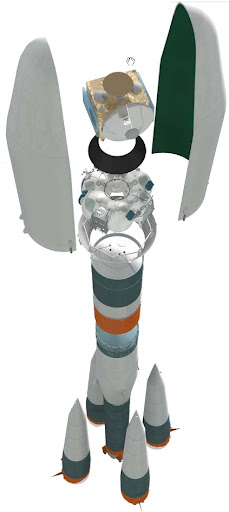
Launcher: Soyuz-2-1A with Fregat upper stage
lv.jpg
|“Soyuz-2” launch vehicle is a current generation R-7 family launch vehicle. It is a replacement for “Soyuz-U”, “Soyuz-FG” and “Molniya-M” launch vehicles. “Soyuz-2” launch vehicle with “Fregat” upper stage can launch spacecrafts to various orbits: low, medium, high elliptical, sun-synchronous, GTO and GSO. Its main distinctions from the Soyuz-FG are new injectors on Stage I-II eniges, a digital flight control system, digital data downlink, deorbitable stage III and a new payload fairing. It's capable of launches from modified R-7 launch complexes. The introduction in 2004 of the Soyuz 2-1a launch vehicle performed represents a major step in the launch vehicle evolution program. This modernized version of Soyuz, which was also used to successfully launch MetOp-A on October 19, 2006, implements a digital control system providing additional mission flexibility and will enable control of the launch vehicle with the 4.1 m ST fairing.

Manufacturer: Samara Space Centre

22460-1-.gif


Spec|Spec Value
Number of stages|3
Liftoff mass|312 tonnes
Maximum length|46.3 m
Nose Fairing diameter|2.7 m; 3.0 m; 3.3 m; 3.715 m; 4.11 m

It can deliver up to 6830 kg of payload into 220*220 km circular orbit with inclination of 62.8° when launched from Plesetsk.

The upper stage: Fregat (meaning Frigate)

fregat002.jpg


Manufacturer: NPO Lavochkin

upperstage.jpg


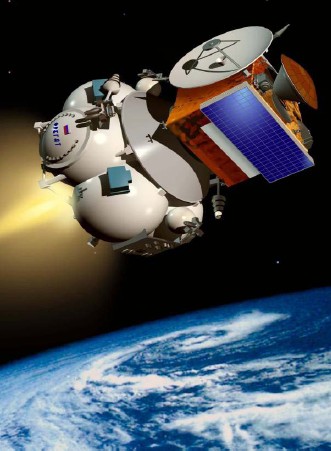
Flight qualified in 2000, the Fregat upper stage is an autonomous and flexible upper stage that is designed to operate as an orbital vehicle. It extends the capability of the lower three stages of the Soyuz vehicle to provide access to a full range of orbits (LEO, SSO, MEO, GTO, GEO and escape). In order to provide the Fregat with high initial reliability, several flight-proven subsystems and components from previous spacecraft and rockets are incorporated into the upper stage. The upper stage consists of 6 spherical tanks (4 for propellants, 2 for avionics) arrayed in a circle, with trusses passing through the tanks to provide structural support. The stage is independent from the lower three stages, having its own guidance, navigation, control, tracking, and telemetry systems. The stage uses storable propellants (UDMH/NTO) and can be restarted up to 20 times in flight, thus enabling it to carry out complex mission profiles. It can provide the customer with 3-axis stabilization or spin-up of their spacecraft.

The dry mass of a Fregat (as of October 2006) is 924 kg; with fuel the mass is up to 5350 kg. Current modification of the main engine has a specific impulse of 332 s and a thrust of 2018 kg. The reaction control system includes 12 engines, each having 5 kg thrust, 225 s Isp, using pure hydrazine, with mass up to 42 kg.

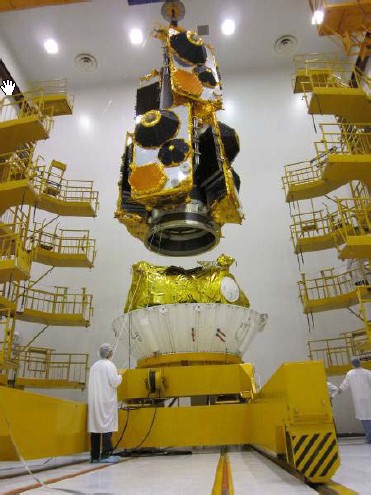
An adapter used to mate six Globalstar-2 satellites to the single upper stage:
adapter.jpg


The vehicle's reliability statistics according to http://www.spacelaunchreport.com/reliability2010.txt:

Code:
================================================================ 
Vehicle     Successes/Tries Realzd Pred  Consc. Last     Dates    
                             Rate  Rate* Succes Fail    
================================================================ 
Soyuz 2-1a/Fregat 2     3#   .67  .60      0    5/21/09  2006-
Last time, Soyuz 2-1a/Fregat stack suffered a partial failure duirng launch of Meridian satellite on May 21/22, 2009.

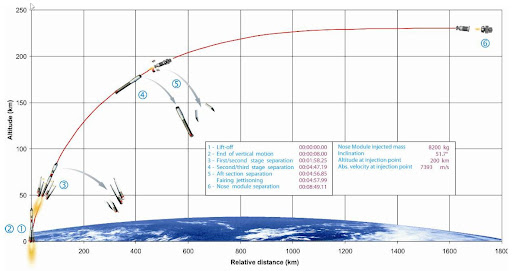
Launch Profile

ascent.jpg


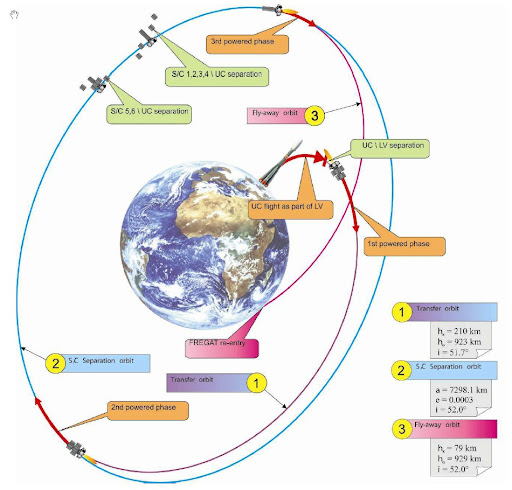
Orbital transfer chart

transfer.jpg


Weather forecast for Baikonur, Kazakhstan for October 19, 2010 (11 p.m.)

Time|Temps|Wind Chill|Heat Index|UV Index|Dew Point|Relative Humidity|Precip|Snow|Clouds|Visibility|Wind|Weather
11 PM|+6°C|+6°C|+6°C|0 Low|-1°C|56%|10%|0%|25%|16 km|N 1.34 m/s|
wx_102.png
M Clear

Sunrise/Sunset and associated twilight times for Baikonur on Tuesday, October 19, 2010

Times are local.
Event|Time
Astronomical twilight begins|06 : 29
Nautical twilight begins|07 : 04
Civil twilight begins|07 : 38
Sunrise|08 : 07
Transit (sun is at its highest)|13 : 31
Sunset|19 : 55
Civil twilight ends|20 : 24
Nautical twilight ends|21 : 24
Astronomical twilight ends|21 : 58

Watching the launch live

TSENKI video streams (Russian + English, between UTC 15:10 and UTC 18:10)
http://www.tsenki.com/broadcast/broadcast/
Arianespace Webcast
http://www.videocorner.tv/index.htm


Source References
http://www.starsem.com
http://www.globalstar.com
http://www.federalspace.ru
http://forum.nasaspaceflight.com
http://www.novosti-kosmonavtiki.ru
http://space.skyrocket.de
http://www.tvroscosmos.ru
http://www.tsenki.com
http://www.spacelaunchreport.com
http://www.intellicast.com/Local/Forecast.aspx
http://www.good-stuff.co.uk/suntimes/sunmap.php
 
Last edited:
Launch campaign history

Video: Globalstar-2 satellites are delivered to Baikonur on August 12, 2010


31.08.2010 Mating the 1st Globalstar spacecraft to dispenser:

IMG_7480.JPG


IMG_7458.JPG


IMG_7482.JPG


Associated video:
[ame="http://www.youtube.com/watch?v=a7huv-edQ9s"]YouTube - К� Globalstar. Работы в МИКе.[/ame]

07.09.2010 Tanking of Fregat upper stage

2010_09_07_fregat_2.JPG


2010_09_07_fregat_5.JPG


2010_09_07_fregat_6.JPG


24:09:2010 The payload dispenser for Arianespace’s upcoming mission with six Globalstar satellites is shown installed on the Fregat upper stage during a fit-check in the Starsem Baikonur facilities.

mission-up_ST22-3-lg.jpg.JPG


717_large.jpg


The encapsulation process in Starsem’s Upper Composite Integration Facility is detailed in these photos. At left, the payload “stack” is rotated horizontally, enabling the Soyuz ST fairing to be moved into position over it (photo at center). With the encapsulation process completed (photo at right), the payload is now ready for transfer to the Soyuz integration building for mating with the launcher.

mission-up-ST22-img1-lg.jpg


mission-up-ST22-img2-lg.jpg


mission-up-ST22-img3-lg.jpg


October 11, 2010

Arianespace...Packs Up A Six Pack Of Globalstar Sats (Launch) Imagine prepping a satellite for a launch — then imagine prepping six sats for a launch. The payload of six Globalstar satellites for Arianespace's upcoming Soyuz mission has been encapsulated in the protective ST payload fairing at Baikonur Cosmodrome, clearing the way for its integration on the launch vehicle for an October 19 liftoff.

This encapsulation process occurred during the weekend, with the activity performed in the Cosmodrome's Upper Composite Integration Facility (UCIF). The UCIF is operated by Arianespace affiliate Starsem, which is performing the Soyuz launch on behalf of Arianespace.

To start the encapsulation process, the Soyuz payload "stack" was rotated to the horizontal position. This "stack" consists of the Astrium-built dispenser system with its six integrated Globalstar satellites, along with the Fregat upper stage on which the dispenser is installed.

Once the stack was fixed in its horizontal orientation, the ST payload fairing was then moved into position, encapsulating the dispenser and its satellites. The ST payload fairing has a diameter of 4.11 meters and an overall length of 11.4 meters, and was developed for the improved Soyuz 2 launcher for the Globalstar mission, which also will be the version operated by Arianespace from the Spaceport in French Guiana.

The Globalstar payload stack is now set for its transfer to the Soyuz' launcher integration building at Baikonur Cosmodrome during the night of October 12-13, readying it for mating to the launch vehicle.

Arianespace's October 19 mission is one of four contracted by Globalstar to orbit 24 of its second-generation spacecraft, ensuring continuity for the company's mobile satellite voice and data services that are provided to businesses, governments and consumers.

Liftoff of the Soyuz 2 is scheduled for 11:10 p.m. local time at Baikonur Cosmodrome (9:10 p.m. in Moscow, 7:10 p.m. in Paris, and 10:10 a.m. at Globalstar's headquarters in Milpitas, California). The nominal mission duration from liftoff to the deployment of Globalstar's satellites is 1 hr. 40 min., with the six spacecraft being injected into a phasing orbit at an altitude of 920 km., inclined 52 deg.

Each of the satellites, built by Thales Alenia Space, has a trapezoidal-shaped main body, and weigh approximately 700 kg. The spacecraft are equipped with 16 transponders from C- to S-band and 16 receivers from L- band to C-band.

October 16, 2010

Baikonur: this morning Soyuz-2-1А rocket with Fregat upper stage and cluster of 6 Globalstar2’s was rolled out. The transportation from mounting and test facility began at 5.30 MSK. In half an hour, the LV was delivered to the launch pad. By 7 a.m., the rocket was erected vertically. Experts of Roscosmos began L-3 operations.
Final stages of Globalstar-2 launch preps are observed at Baikonur by Arianespace CEO Jean Ives Le Galle and DG of Russian-European venture Starsem Victor Nikolaev. Both attended the roll out today.
Launch of Soyuz-2-1А rocket with Fregat upper stage and cluster of 6 Globalstar2 spacecraft is slated for 21.10 MSK, Oct. 19.

IMG_4598.JPG


IMG_4620.JPG


IMG_4631.JPG
 
Spaceflight Now:
Soyuz launcher ready to restore full Globalstar service.
(Photos) Soyuz moves to pad for commercial mission.

---------- Post added at 10:35 PM ---------- Previous post was at 09:06 PM ----------

Roscosmos PAO: "Baikonur: Soyuz-2 with Cluster of 6 Globalstar's to Lift Off Today".

Baikonur space port: L-day operations are carried out with Soyuz-2-1А rocket - Fregat upper stage and cluster of 6 Globalstar2’s today at the launch pad. The operations at pad 31 have commenced at 8 a.m.
The State Board will meet at 17:15 to evaluate launch campaign results and give ‘go’ for the tanking and launch.
The launch of Soyuz-2-1А rocket with Fregat upper stage and cluster of 6 Globalstar2 spacecraft is slated for 21.10 MSK, Oct. 19.
 
Rolling out and erection video:


---------- Post added at 10:58 ---------- Previous post was at 10:36 ----------

Added Arianespace webcast link:

Arianespace Webcast
http://www.videocorner.tv/index.htm

---------- Post added at 21:26 ---------- Previous post was at 10:58 ----------

The launch has commenced! The upper composite is now in parking orbit.
 
NASASpaceFlight: Soyuz 2-1A launches with six Globalstar 2 satellites.

Spaceflight Now: :
Soyuz rocket blasts off with Globalstar's next era

Six next-generation satellites for the Globalstar mobile communications network have launched from Kazakhstan atop a Soyuz rocket today, beginning the first of four missions to replace the company's aging space fleet. Liftoff of the 100-minute climb to orbit was at 1710 GMT (1:10 p.m. EDT).

19soyuzquick_400278.jpg
 
The two most upper spacecraft have just separated from the adapter.

---------- Post added at 22:51 ---------- Previous post was at 22:50 ----------

All spacecraft are separated at the target orbit! My congratulations! :cheers:
 
Arianespace: Soyuz delivers: Six satellites are orbited for Globalstar's second-generation constellation:
The initial cluster of six Globalstar second-generation satellites was successfully orbited today on an Arianespace Soyuz mission, which was conducted by its Starsem affiliate from Baikonur Cosmodrome in Kazakhstan.

This flight delivered the six trapezoidal-shaped spacecraft into a circular phasing orbit, utilizing the improved Soyuz version that will be introduced by Arianespace at the Spaceport in French Guiana next year.
...


Spaceflight Now: Six improved Globalstar craft orbited by Soyuz rocket:
Globalstar's fleet of orbiting communications satellites received reinforcements Tuesday, when a commercial Soyuz rocket launched from Kazakhstan and deployed six advanced spacecraft to restore the company's diminished two-way voice and data services.
...


Video replay of the launch from YouTube (capture of Arianespace stream):
 

Heh, is that a fuel tanker near the huge exhaust flame? That just wouldn't happen at KSC! :lol:

---------- Post added at 10:39 PM ---------- Previous post was at 10:20 PM ----------

Roscosmos PAO: "Today's Globalstar Launch is the Next Step in Evolution of Russian-French Cooperation – Le Gall".

Today’s launch of 6 US spacecraft Globalstar by Russian rocket Soyuz facilitated by Starsem venture is to open a new page in development of Russian- French cooperation, Arianespace/Starsem CEO/President Jean Ives Le Gall stated questioned at Baikonur.
"The launch is to initiate another milestone in our cooperation. Three more launches are planned for 2011", Le Gall said.
The launch is to take place today at 21.10 MSK.
"This is the 22nd joint launch by Roscosmos and Starsem. Our major efforts are at Baikonur, and this is good", Starsem head added.
Le Gall is pleased to see that "operational quality of Baikonur improves".
Globalstar president Antony Navarra is also at the space port to witness the launch.
"We had a lot of launch options to choose, but picked Russian Soyuz as it can inject the spacecraft to the altitude of 900 km and higher, so we can put our satellites directly into the targeted orbit", Navarra noted.
He evaluates the spirit of cooperation between Russian space industry, Arianespace and Starsem highly.

---------- Post added 20th Oct 2010 at 01:20 AM ---------- Previous post was 19th Oct 2010 at 10:39 PM ----------

BBC News: "Globalstar rolls out new network".
 
The official launch video:

[ame="http://www.youtube.com/watch?v=2F8V-4DZJFk"]YouTube - Пуск РКН Союз-2-1А с шесть КА Глобалстар-2 (Globalstar)[/ame]
 
GLOBALSTAR ANNOUNCES SUCCESSFUL LAUNCH OF SIX NEW SECOND-GENERATION SATELLITES.

New constellation will position the company for growth by restoring industry leading voice and duplex data services while it further expands its award-winning SPOT-branded consumer product line.

Globalstar, Inc., a leading provider of mobile satellite voice and data services to businesses, government, and individuals today announced that six new second-generation Globalstar satellites were successfully launched from the Baikonur Cosmodrome in Kazakhstan, using the Soyuz launch vehicle.

The Globalstar satellites were launched from the Baikonur Cosmodrome in Kazakhstan on Tuesday, October 19th at 11:11 p.m. local time (5:11 p.m. UTC and 1:11 p.m. EDT), using the Soyuz-Fregat version of the Soyuz launch vehicle. This is the 1762nd successful launch of the Soyuz family launch vehicle.

Launch services provider Arianespace confirmed that the upper stage accurately injected the six-satellite dispenser into the targeted low earth orbit of approximately 920 km. Globalstar reports that all six satellites have been successfully acquired following separation of the Fregat Upper Stage and release from the satellite dispenser. Globalstar has initiated satellite in-orbit testing and the performance of all six spacecraft is nominal at this time.

“After more than four and a half years of concentrated effort we are extremely pleased to announce the successful inaugural launch of our second-generation constellation satellites,” said Tony Navarra, President of Global Operations for Globalstar, Inc. “It is with great enthusiasm and excitement that we begin initiating our second-generation satellite operations and look forward to the future services the constellation will support. With all six satellites now safely in orbit we congratulate and applaud all of our Globalstar employees world-wide and thank launch provider Arianespace as well as our satellite contractor Thales Alenia Space for this launch success.”

Peter Dalton, CEO of Globalstar, Inc., added, “Once fully deployed we expect our satellite constellation will reliably provide the world’s finest quality mobile satellite voice and fastest mobile satellite handset data services in the industry. With a fifteen year design life, the new satellite constellation will secure our space segment beyond 2025. Combined with our affordable and award-winning suite of consumer retail SPOT products, Globalstar will be positioned to offer the world’s most extensive lineup of high quality mobile satellite services to the broadest range of commercial and retail consumer customers around the globe.”

Globalstar signed a contract with satellite manufacturer Thales Alenia Space in late 2006 for the design, manufacture and delivery of its second-generation constellation satellites. A total of four launches of six satellites each will be conducted by launch services provider Arianespace using the highly reliable Soyuz launch vehicle. Globalstar plans to integrate the 24 new second-generation satellites with the eight first-generation satellites that were launched in 2007, to form a 32 satellite constellation.

Once the first six new Globalstar satellites become operational, service availability and reliability improvements will benefit those customers who use the Company’s voice and Duplex data services. With each subsequent launch, these customers can expect a progressive return to the high quality system access and data session performance metrics customers enjoyed before 2007.

The new satellites are designed to support Globalstar’s current lineup of voice, Duplex and Simplex data products and services including the Company’s lineup of SPOT retail consumer products. The advanced constellation combined with the Company’s next-generation ground network, expected to be installed by 2012, is also designed to provide Globalstar customers with enhanced future services featuring increased data speeds of up to 256 kbps in a flexible Internet protocol multimedia subsystem (IMS) configuration. Products and services supported are expected to include: push-to-talk and multicasting, advanced messaging capabilities such as multimedia messaging or MMS, geo-location services, multi-band and multi-mode handsets, and data devices with GPS integration.

About Globalstar, Inc.
With over 400,000 subscribers, Globalstar is a leading provider of mobile satellite voice and data services. Globalstar offers these services to commercial customers and recreational consumers with coverage in more than 120 countries around the world. The Company's products include mobile and fixed satellite telephones, simplex and duplex satellite data modems, the SPOT Satellite GPS Messenger™ and flexible airtime service packages. Many land based and maritime industries benefit from Globalstar with increased productivity from remote areas beyond cellular and landline service. Global customer segments include: oil and gas, government, mining, forestry, commercial fishing, utilities, military, transportation, heavy construction, emergency preparedness, and business continuity as well as individual recreational users. Globalstar data solutions are ideal for various asset and personal tracking, data monitoring and SCADA applications.

For more information regarding Globalstar, please visit Globalstar's web site at www.globalstar.com

----------

Roscosmos PAO: "More Details of Yesterday's Launch".

Director General of TsSKB-Progress Rocket Center (Samara) Alexander Kirilin commented yesterday’s launch of 6 Globalstar satellites by Soyuz rocket (Oct. 19, 21.10.59 MSK) for Roscosmos web:
- Soyuz-2.1а launcher presents the first modification of the Soyuz-2 rocket. It is equipped with principally new control system with up-to-date EEE-parts. The system is single for all three stages. In addition, the launcher is featured by digital RF TM-system, upgraded boosters of stages 1 and 2. As a result, Soyuz-2.1а has lifting capacity 300 kg more than Soyuz-U.
This was the 5th launch of Soyuz-2.1а.
 
GB2 AIT

Hello,

my name's Gianni from Roma, Italy, i've seen a lot of information about GB2, how do you collect those images and informations?
I'm working in the AIT division who's in charge to test the satellites, i've worked on all the satellites of this batch,working for the platform test.

I've seen the launch only this evening by mean your site, yesterday in Roma there was a TV connection with Baikonour but i was not there.I've seen a lot of my collegues in the pictures.
Nice job and my compliment for all the informations!
Very impressive all the FMs are in the space now!
 
Hello,

my name's Gianni from Roma, Italy, i've seen a lot of information about GB2, how do you collect those images and informations?
I'm working in the AIT division who's in charge to test the satellites, i've worked on all the satellites of this batch,working for the platform test.

I've seen the launch only this evening by mean your site, yesterday in Roma there was a TV connection with Baikonour but i was not there.I've seen a lot of my collegues in the pictures.
Nice job and my compliment for all the informations!
Very impressive all the FMs are in the space now!

Hello Gianni,

First of all, I'd like to express my deep respect for you as for one of those who was directly contributed to the mission success! :cheers:

Here on Orbiter-Forum we not only discuss Orbiter space sim, but also keep track of real life space activities. I'm kind of in charge of monitoring anything that lifts off to space from Russian soil. I gather information from several websites and forums, all of which are listed in the end of my message on the thread. If you want to have more specific links to where particular pieces of information came from, I'd be glad to provide them.
 
Back
Top