- Joined
- Feb 13, 2008
- Messages
- 5,398
- Reaction score
- 8
- Points
- 0
- Location
- Khimki
- Website
- tigerofsiberia.livejournal.com
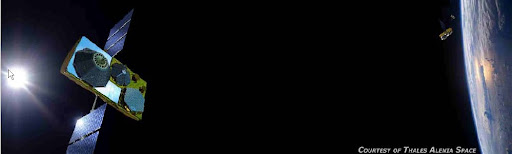


Launch site:
Baikonur Launch pad no. 31/6 45°59'46.16"N, 63°33'51.29"E
Launch date: October 19, 2010
The launch time is:
23:10:59 Baikonur 19.10.2010
21:10:59 Moscow Summer 19.10.2010
17:10:59 UTC Oct 19, 2010
1:10:59 p.m. EDT Oct 19, 2010
[eventTimer]2010-10-19 17:10:59?before|after;%dd% Days %hh% Hours %mm% Minutes %ss% Seconds %c%[/eventTimer] Senary Globalstar-2 Launch
Payload: Six Globalstar-2 satellites.
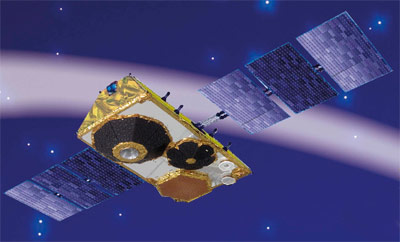
Manufacturer: Thales Alenia Space

The new Globalstar second-generation low-earth-orbit (LEO) satellite is a three-axis stabilized spacecraft consisting of a trapezoidal main body with two solar arrays. In 2006 Globalstar contracted Thales Alenia Space for the design, manufacture and delivery of its second-generation constellation satellites. The first six satellites being launched were delivered to Globalstar in August of this year.
The new Globalstar spacecraft has a design life of 15 years or twice the design life of the first-generation Globalstar satellite. To help ensure the reliability of the design life, the second–generation robust architecture has placed particular emphasis on redundancy management and the radiation environment of the Globalstar operational orbit. In addition, each functional chain of the spacecraft was carefully analyzed for implementation of redundancies and tolerances to minimize single point failures.
Each second-generation Globalstar satellite weighs approximately 700 kg, offers power of 2.4 kW, is fitted with 16 transponders from C-to S-band, and 16 receivers from L- to C-band. The satellite's trapezoidal body is fabricated from rigid aluminum honeycomb panels. The trapezoidal shape was selected to conserve volume and to allow the mounting of multiple satellites under the launch vehicle's payload fairing.
The satellite operates in a body-stabilized, three-axis attitude control mode and uses sun sensors, Earth sensors, and a magnetic sensor to help maintain attitude. The satellite utilizes thrusters for orbit-raising, station-keeping maneuvers and attitude control. The spacecraft's thrusters are fueled from a single on-board propellant tank.
The two solar arrays provide the primary source of power for the Globalstar spacecraft, while batteries are used during eclipses and peak traffic periods. The solar panels automatically track the sun as the satellite orbits the Earth, providing maximum possible exposure to the sun's energy.
The heart of a Globalstar satellite is its communications systems. These systems are mounted on the Earth deck, which is the larger of the two rectangular faces on the satellite's body. There are C-band antennas for communications with Globalstar gateways, and L- and S-band antennas for communications with user terminals. Designed with the same frequencies and beam patterns which are compatible with existing gateway antenna and ground infrastructure, each second-generation satellite can be mixed seamlessly with Globalstar’s first-generation satellite operations.
Four launches of six satellites each will be conducted by Arianespace using the highly reliable Soyuz launch vehicle. The Soyuz has been used to successfully launch Globalstar satellites on eight previous occasions. Once the first six new Globalstar satellites are in operational orbit, the most immediate service improvement will benefit those customers who use the Company’s voice and Duplex data services. With each subsequent launch, these customers can expect a progressive return to the high reliability and service quality enjoyed before 2007.
The second-generation satellites are designed to support Globalstar’s current lineup of voice, Duplex and Simplex data products and services including the Company’s lineup of SPOT retail consumer products. Once the Company’s next-generation ground network is installed, the advanced constellation will also provide Globalstar customers with enhanced future services featuring increased data speeds of up to 256 kbps in a flexible Internet protocol multimedia subsystem (IMS) configuration. Products and services supported are expected to include: push-to-talk and multicasting, advanced messaging capabilities such as multimedia messaging or MMS, geo-location services, multi-band and multi-mode handsets, and data devices with GPS integration.
Globalstar-2 performances
Nation:|USA
Type / Application:|Communication
Operator:|Globalstar
Contractors:|Alcatel Alenia Space
Equipment:|16 C-to-S-band transponders, 16 L-to-C-band transponders
Power:|2 deployable solar arrays, 2.4 kW (bol), 1.7 kW (eol)
Lifetime:|15 years
Mass:|700 kg
Orbit:|1410 km x 1410 km, 52° (typical); 920 km, 52° (phasing orbit)
About Globalstar, Inc.
With over 400,000 subscribers, Globalstar is a leading provider of mobile satellite voice and data services. Globalstar offers these services to commercial customers and recreational consumers with coverage in more than 120 countries around the world. The Company's products include mobile and fixed satellite telephones, simplex and duplex satellite data modems, the SPOT Satellite GPS Messenger™ and flexible airtime service packages. Many land based and maritime industries benefit from Globalstar with increased productivity from remote areas beyond cellular and landline service. Global customer segments include: oil and gas, government, mining, forestry, commercial fishing, utilities, military, transportation, heavy construction, emergency preparedness, and business continuity as well as individual recreational users. Globalstar data solutions are ideal for various asset and personal tracking, data monitoring and SCADA applications. For more information regarding Globalstar, please visit Globalstar's web site at www.globalstar.com
Launcher: Soyuz-2-1A with Fregat upper stage
Manufacturer: Samara Space Centre

Number of stages|3
Liftoff mass|312 tonnes
Maximum length|46.3 m
Nose Fairing diameter|2.7 m; 3.0 m; 3.3 m; 3.715 m; 4.11 m
It can deliver up to 6830 kg of payload into 220*220 km circular orbit with inclination of 62.8° when launched from Plesetsk.
The upper stage: Fregat (meaning Frigate)

Manufacturer: NPO Lavochkin
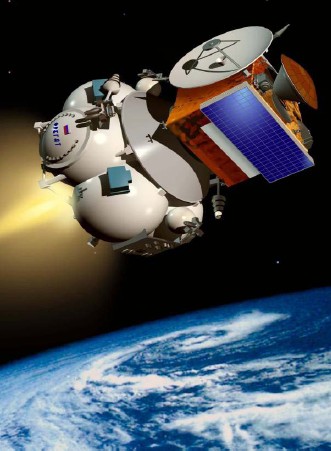
Flight qualified in 2000, the Fregat upper stage is an autonomous and flexible upper stage that is designed to operate as an orbital vehicle. It extends the capability of the lower three stages of the Soyuz vehicle to provide access to a full range of orbits (LEO, SSO, MEO, GTO, GEO and escape). In order to provide the Fregat with high initial reliability, several flight-proven subsystems and components from previous spacecraft and rockets are incorporated into the upper stage. The upper stage consists of 6 spherical tanks (4 for propellants, 2 for avionics) arrayed in a circle, with trusses passing through the tanks to provide structural support. The stage is independent from the lower three stages, having its own guidance, navigation, control, tracking, and telemetry systems. The stage uses storable propellants (UDMH/NTO) and can be restarted up to 20 times in flight, thus enabling it to carry out complex mission profiles. It can provide the customer with 3-axis stabilization or spin-up of their spacecraft.
The dry mass of a Fregat (as of October 2006) is 924 kg; with fuel the mass is up to 5350 kg. Current modification of the main engine has a specific impulse of 332 s and a thrust of 2018 kg. The reaction control system includes 12 engines, each having 5 kg thrust, 225 s Isp, using pure hydrazine, with mass up to 42 kg.
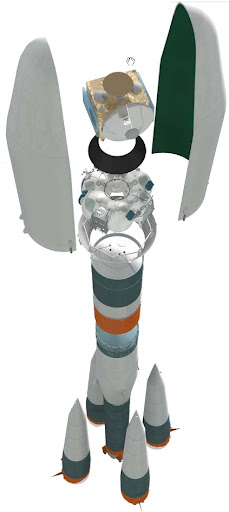
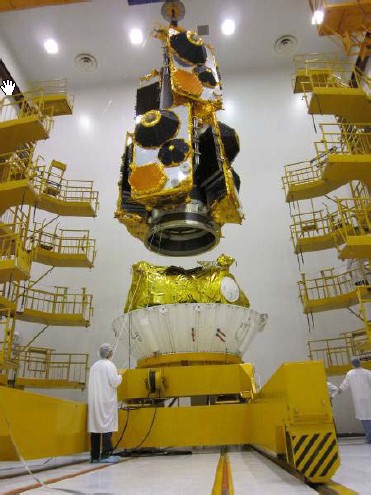
An adapter used to mate six Globalstar-2 satellites to the single upper stage:
The vehicle's reliability statistics according to http://www.spacelaunchreport.com/reliability2010.txt:
Code:
================================================================
Vehicle     Successes/Tries Realzd Pred  Consc. Last     Dates
                             Rate  Rate* Succes Fail
================================================================
Soyuz 2-1a/Fregat 2 3# .67 .60 0 5/21/09 2006-Launch Profile
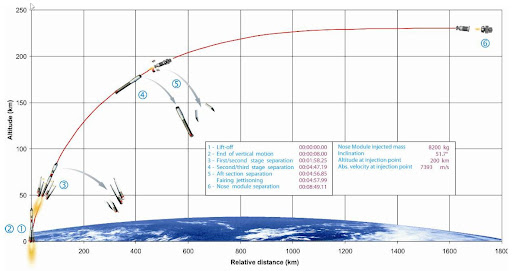
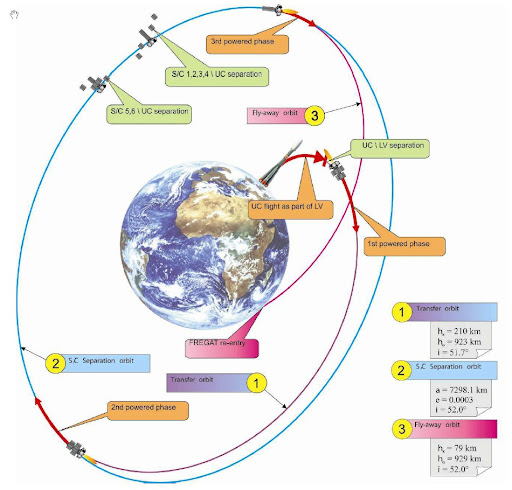
Orbital transfer chart
Weather forecast for Baikonur, Kazakhstan for October 19, 2010 (11 p.m.)
11 PM|+6°C|+6°C|+6°C|0 Low|-1°C|56%|10%|0%|25%|16 km|N 1.34 m/s|

Sunrise/Sunset and associated twilight times for Baikonur on Tuesday, October 19, 2010
Times are local.
Astronomical twilight begins|06 : 29
Nautical twilight begins|07 : 04
Civil twilight begins|07 : 38
Sunrise|08 : 07
Transit (sun is at its highest)|13 : 31
Sunset|19 : 55
Civil twilight ends|20 : 24
Nautical twilight ends|21 : 24
Astronomical twilight ends|21 : 58
Watching the launch live
TSENKI video streams (Russian + English, between UTC 15:10 and UTC 18:10)
http://www.tsenki.com/broadcast/broadcast/
Arianespace Webcast
http://www.videocorner.tv/index.htm
Source References
http://www.starsem.com
http://www.globalstar.com
http://www.federalspace.ru
http://forum.nasaspaceflight.com
http://www.novosti-kosmonavtiki.ru
http://space.skyrocket.de
http://www.tvroscosmos.ru
http://www.tsenki.com
http://www.spacelaunchreport.com
http://www.intellicast.com/Local/Forecast.aspx
http://www.good-stuff.co.uk/suntimes/sunmap.php
Last edited: