Project UMMu Hovercrafts

gattispilot

Addon Developer
Addon Developer
Joined
Oct 17, 2007
Messages
10,553
Reaction score
4,377
Points
203
Location
Dallas, TX
I am thinking about making Ummu hovercraft vessels similar to these from Jonny Quest.
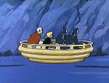
enemyhover1.gif
and
enemyhover2.gif

Any suggestion?
 
Johnny Quest... now that is a cartoon that I can remember as a kid. Sound like a great idea!
 
I will most likely put a height restriction maybe 10 meters?
 
I'm too lazy to look up the physics for a flying hovercraft but maybe a negative exponential might be useful to determine thrust v. height.

Make sure to manage boundary conditions, and it would be more realistic to have the hovercraft to be able to bounce above the max sustained height of 10m, it just won't be able to maintain enough thrust to keep it above that level for very long. Air resistance should act as a damper for oscillations (underdamped seems the most realistic).

Thrust = k * e ^ -r*h
k - maximum thrust (constant or function of air pressure)
e - mathmatical constant
r - constant of how fast the thrust drops off with height (smaller = slower)
h - height of craft

Other pretty functions exist, just be aware of boundary conditions. The boundary conditions for this function are: height:0 thrust=max thrust; Large heights: thrust -> 0 but always remains positive;height < 0: thrust > max thrust and increase exponentially as height becomes more negative.
 
I was figuring if altitude goes over then 10 then CW increase 999.
 
That could work, but it might be more fun to have it act a bit more natural.

Then again Johnny Quest hovercraft aren't the most realistic. ;)

I would play around with a couple different functions and see if you like any.

Oh and with the exponential function I gave you,
Max_hover_height is where thrust = weight so:
Max_Hover_height = ln((Spacecraft mass * gravity)/Max_Thrust)/-r

or more useful to calculate r:
r = -ln((Spacecraft mass * gravity)/Max_Thrust)/Max_Hover_Height

mass won't be constant due to fuel consumption, but you could easily find the laden hover height and empty height. But assuming your engines are airbreathing or have a sufficient specific impulse the height difference will be minimal due to a smaller mass ratio. Plus you can throw uMMUs out the back to lose mass if you're being chased. :)

I apologize in advance if I completely butchered math and did the algebra wrong. the value of r should be positive.
 
Last edited:
They may not be air breathing. If they were then they couldn't be used on the Moon,....
 
They may not be air breathing. If they were then they couldn't be used on the Moon,....

What method are we thinking then? I was assuming air cushion.

Photonic Resonance?
Excuse the techno-babble.

Expanding on the basic idea we shoot an EM beam at the ground at a frequency it should reflect at. The beam is scattered because the ground is not ideal so we get more lift the closer we are to it. (power problems, less so if we consume fuel to generate the waveforms, might fry anyone below us)
-or-
Use a molecularity heavy gas(so it doesn't sprint away into the vacuum too fast) and possibly energize it with microwaves and use a nice magnetic field to attempt to bind it into a column below the craft. (significant working gas losses, and power requirements to energize the gas and generate a magnetic field to restrict it) This would generate a little breeze of high pressure below the craft, not unlike an air cushion craft. Synchrotron radiation, but frequencies should be in safe regions.
 
Last edited:
I suppose it could also use a series of RCS style engines to generate lift.

UPDATE
Here is an image of the hovercraft.
HOVER1.jpg
I still need to get the attachment value correct. The Ummu child value is 001 010. right now the craft parent is 0-10 001. Also working on the thrust. I may just use RCS for thrust control and hover. Need to limit the height also.
 
Last edited:
Got the attachment to work. Still working on getting a height restriction.
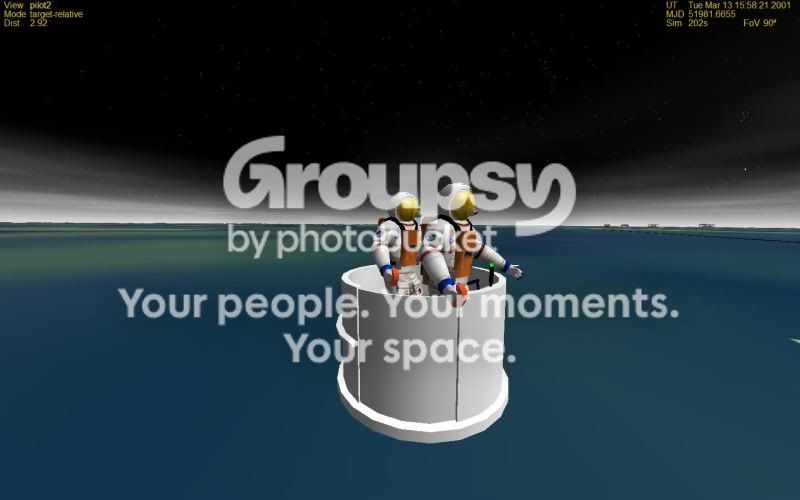
Here is ummu in the craft
HOVER2.jpg
 
This hovercraft.... will it be full of eels?


[ame="http://www.youtube.com/watch?v=G6D1YI-41ao"]YouTube - Monty Python - Dirty Hungarian Phrasebook[/ame]
 
Now 2 Ummu can ride. There are 2 attachment points for them. A joystick and lever.
hover3.jpg


Still working on the height level.
right now I have this:

VECTOR3 vWeight;
double gravity;

GetWeightVector(vWeight);
gravity = length(vWeight);
if (GetAltitude() >= 10) {
SetThrusterMax0 (th_hover ,gravity);
}
if (GetAltitude() < 10) {
SetThrusterMax0 (th_hover ,2e4);
}

And you do get a bouncing effect. on EArth it goes about 12meters and then drops to 4meters. On the moon and mars it really bounces high.
 
I'm actually a little surprised that its bouncing with that code. If thrust > 10 is equal to the vehicle weight then it should continue to climb at the same speed but slowed only by air resistance.

First I would check to make sure that your thrust vector is always positive.
Code:
gravity = length(vWeight);
needs to have the right sign. Just start up Orbiter and turn on the show forces visual so you can see the direction and magnitude of your thrusters as it goes above and below 10m.

So:

  1. Make sure the direction of thrust from your thrusters remains along the same vector (magnitude change only).
  2. Thrust above 10m should be slightly less than the force of gravity.
  3. Maybe create a buffer zone of 9.5 -> 10m where the thrust is only slightly above gravity, this will reduce bouncing. (using a negative exponential does all 3 for you automatically which is why I recommended it)
  4. Consider increasing air resistance so you can use drag to dampen the bouncing (it won't help on the moon, and has less effect on Mars)
 
I would just keep the aerodynamic properties of the hovercraft constant.
 
I'm actually a little surprised that its bouncing with that code. If thrust > 10 is equal to the vehicle weight then it should continue to climb at the same speed but slowed only by air resistance.

First I would check to make sure that your thrust vector is always positive.
Code:
gravity = length(vWeight);
needs to have the right sign. Just start up Orbiter and turn on the show forces visual so you can see the direction and magnitude of your thrusters as it goes above and below 10m.

So:

  1. Make sure the direction of thrust from your thrusters remains along the same vector (magnitude change only).
  2. Thrust above 10m should be slightly less than the force of gravity.
  3. Maybe create a buffer zone of 9.5 -> 10m where the thrust is only slightly above gravity, this will reduce bouncing. (using a negative exponential does all 3 for you automatically which is why I recommended it)
  4. Consider increasing air resistance so you can use drag to dampen the bouncing (it won't help on the moon, and has less effect on Mars)
Ok I will look at how to increase the drag/air resistance. Not sure what you mean on #3 negative exponential.
 
This is a negative exponential:
Thrust = k * e ^ -r*h
k - maximum thrust (constant or function of air pressure)
e - mathematical constant, could use other constants.
r - constant of how fast the thrust drops off with height (smaller = slower)
h - height of craft

OK this is what code I would use:
Code:
VECTOR3 vWeight;
double gravity;

GetWeightVector(vWeight);
gravity = length(vWeight);

SetThrusterMax0 (th_hover ,1.5 * gravity * pow(2,-.058*GetAltitude());
Your max acceleration is 1.5g at ground level and it hovers around 10m.
Note: the engine thrust should scale for whichever planet it is at.

EDIT: Changed -5.8 to -.058, multiplied where I should have divided. Now you should hover at 10m instead of .1m
 
Last edited:
Back
Top