
-
ORBITER-FORUM will be temporarily closed at 2026-07-23 18:00 UTC while we complete some OF maintenance tasks. The amount of downtime is expected to take up to one hour, but probably less.
You are using an out of date browser. It may not display this or other websites correctly.
You should upgrade or use an alternative browser.
You should upgrade or use an alternative browser.
Project Nova HLV
- Thread starter K_Jameson
- Start date

- Joined
- May 14, 2008
- Messages
- 10,548
- Reaction score
- 349
- Points
- 173
- Location
- East Sussex
- Website
- blog.gdwnet.com
- Preferred Pronouns
- He/Him
Looking good! I'm a big fan of your previous work, great rockets for all sorts of roles in orbiter.

K_Jameson
Well-known member
- Joined
- Dec 30, 2009
- Messages
- 1,228
- Reaction score
- 239
- Points
- 78
Ooook, I did a bit of a "reality check" on my stage weights. I wanted to be as realistic as possible because some older works, especially the Jarvis rocket, had some weights that were a bit off (e.g. the Jarvis-M core stage).
My inspection showed that the weights needed to be increased a bit. To compensate and maintain the performances I absolutely need to run the mission profiles I had envisioned, I was forced to change some materials: all parts previously made of 2219 aluminum alloy were converted to 2195 aluminum-lithium alloy, and the thrust structures for all stages were replaced with carbon fiber. The tank domes, only on the reusable stages (Modular Common Stage and Argo spacecraft), are now also in carbon fiber. I'm not sure if a tank with stainless steel sidewalls and carbon fiber domes is feasible, but I don't see it as a show-stopper and, frankly, I need the performances.
I also slightly modified the performance of the Jupiter-A, the Hydrolox engine for my core stages. It was designed to be a near 1:1 copy of the RS-25E (the expendable one), with performances halfway between that and the Russian RD-0120. I increased the ISP a bit, now rated at 454 seconds in vacuum and 368 seconds at sea level, 1-2 seconds more than the RS-25. Since it has 11% less thrust than the RS-25E, I thought that was fair, given the four decades of progress from the Shuttle main engine.
Increased ISP and thrust also for the Neptune expander-bleed upper stage engine, after more information on the BE-4U engine became available.
All of these changes helped keep performances on track.
I considered switching to subcooled fuels, but my tanks were sized for standard fuels and I didn't want to mess with the meshes anymore. I thought that sticking with standard propellants might help simplify ground procedures and thus operating costs. However, I'm keeping this option open for the upper stages.
My inspection showed that the weights needed to be increased a bit. To compensate and maintain the performances I absolutely need to run the mission profiles I had envisioned, I was forced to change some materials: all parts previously made of 2219 aluminum alloy were converted to 2195 aluminum-lithium alloy, and the thrust structures for all stages were replaced with carbon fiber. The tank domes, only on the reusable stages (Modular Common Stage and Argo spacecraft), are now also in carbon fiber. I'm not sure if a tank with stainless steel sidewalls and carbon fiber domes is feasible, but I don't see it as a show-stopper and, frankly, I need the performances.
I also slightly modified the performance of the Jupiter-A, the Hydrolox engine for my core stages. It was designed to be a near 1:1 copy of the RS-25E (the expendable one), with performances halfway between that and the Russian RD-0120. I increased the ISP a bit, now rated at 454 seconds in vacuum and 368 seconds at sea level, 1-2 seconds more than the RS-25. Since it has 11% less thrust than the RS-25E, I thought that was fair, given the four decades of progress from the Shuttle main engine.
Increased ISP and thrust also for the Neptune expander-bleed upper stage engine, after more information on the BE-4U engine became available.
All of these changes helped keep performances on track.
I considered switching to subcooled fuels, but my tanks were sized for standard fuels and I didn't want to mess with the meshes anymore. I thought that sticking with standard propellants might help simplify ground procedures and thus operating costs. However, I'm keeping this option open for the upper stages.
K_Jameson
Well-known member
- Joined
- Dec 30, 2009
- Messages
- 1,228
- Reaction score
- 239
- Points
- 78
This excellent paper clarifies a lot about propellant densification. Seems that a 5% densification of both LOX and LH2 was investigated and deemed doable with the SSME engines. Giving that my Jupiter-A core stage engines are basically expendable and slightly less powerful SSMEs, I find this appealing. A 5% densification of LH2 only was deemed even better, engine wise, but I think that the increase in fuel mass with both LH2 and LOX densification overcomes the advantage in isp and thrust that comes with LH2 densification only. Speaking of thrust, my engine also has over a 10% margin to exploit without surpassing SSME specifications, that are my upper limit. Upper stage engines also has a lot of margin due to the expanded bleed architecture, which I chose over the closed expanded system for this very reason
Densification of liquid methane for the booster engines is more tricky due to the proximity of solidification and boiling temperatures, so I would be limited to a 2 or 3% densification, or to give up densification altogether.
I think that reverting back to a moderate propellant densification allows me to reach the required performances without stretching the tanks or messing too much with materials.
Must do the math on this.
https://ntrs.nasa.gov/citations/20030006266
Densification of liquid methane for the booster engines is more tricky due to the proximity of solidification and boiling temperatures, so I would be limited to a 2 or 3% densification, or to give up densification altogether.
I think that reverting back to a moderate propellant densification allows me to reach the required performances without stretching the tanks or messing too much with materials.
Must do the math on this.
https://ntrs.nasa.gov/citations/20030006266


- Joined
- Feb 6, 2008
- Messages
- 38,938
- Reaction score
- 3,937
- Points
- 203
- Location
- Wolfsburg
- Preferred Pronouns
- Sire
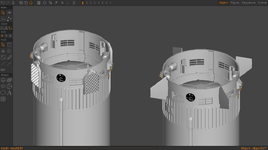
Potato mashers work better at most speeds than classic fins, but are really bad at transsonic speeds. AFAIR. Also they have a larger effective area compared the the fins you picked.
K_Jameson
Well-known member
- Joined
- Dec 30, 2009
- Messages
- 1,228
- Reaction score
- 239
- Points
- 78
Yes, absolutely. My question arises because I realized that the narrow landing legs of my rocket, when stowed, could conceivably act as fins, NG style, and coupled with the traditional flaps at the front end could probably allow a bit more glide, in theory. All this in order to lower temperatures and go back to Al-Li alloy instead of stainless steel.
Currently, I have decided to stick with steel, for durability, but I wonder what would be the most sensible choice. Just an academic discussion, of course. Probably no conclusive answer is possible without a thorough aerodynamic study, but that is largely outside the scope of my project. So, I can only decide on the "cool" factor ;-)
Currently, I have decided to stick with steel, for durability, but I wonder what would be the most sensible choice. Just an academic discussion, of course. Probably no conclusive answer is possible without a thorough aerodynamic study, but that is largely outside the scope of my project. So, I can only decide on the "cool" factor ;-)
- Joined
- Feb 6, 2008
- Messages
- 38,938
- Reaction score
- 3,937
- Points
- 203
- Location
- Wolfsburg
- Preferred Pronouns
- Sire
Yes, absolutely. My question arises because I realized that the narrow landing legs of my rocket, when stowed, could conceivably act as fins, NG style, and coupled with the traditional flaps at the front end could probably allow a bit more glide, in theory. All this in order to lower temperatures and go back to Al-Li alloy instead of stainless steel.
Currently, I have decided to stick with steel, for durability, but I wonder what would be the most sensible choice. Just an academic discussion, of course. Probably no conclusive answer is possible without a thorough aerodynamic study, but that is largely outside the scope of my project. So, I can only decide on the "cool" factor ;-)
Orbiter deserves an award for promoting STEM, doesn't it? And all we pay for it, is a bit of our lifetime.
K_Jameson
Well-known member
- Joined
- Dec 30, 2009
- Messages
- 1,228
- Reaction score
- 239
- Points
- 78
I've modified (again) the intermediate versions of the rocket (Nova II/III) because I noticed that the original core stage planned for them (hydrolox, a single Jupiter-A engine) was too weak, arguably with too much gravitational drag. Also, I wanted more standardization across the family. The new, hopefully final, version, now uses a modified version of the same MCS metholox boosters, expendable, with only three Neptune-B engines instead of nine. I've imagined that this stage is only a regular MCS booster, near the end of its service life, modified to be used for a last blaze of glory.
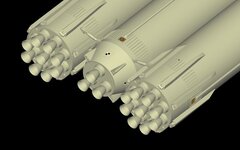
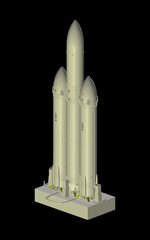
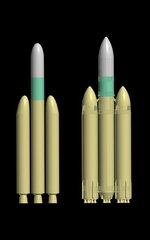
Basically I went back to the roots. Here is the comparison: original concept (2022!!!) vs. current prototype.
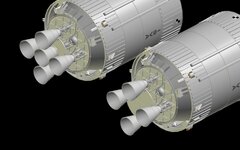
Another change was the reduction of the engines for the upper stage of the large version (Nova V), now with four Selene-C engines instead of five, after some extensive simulation testing. The stage designation changed accordingly from HES-5 to HES-4 (HES stands for "High Energy Stage"). Note the heat shield, inspired by the S-II stage of the Saturn V.
Basically I went back to the roots. Here is the comparison: original concept (2022!!!) vs. current prototype.
Another change was the reduction of the engines for the upper stage of the large version (Nova V), now with four Selene-C engines instead of five, after some extensive simulation testing. The stage designation changed accordingly from HES-5 to HES-4 (HES stands for "High Energy Stage"). Note the heat shield, inspired by the S-II stage of the Saturn V.

CurlSnout
Well-known member
I give you extra-high marks for your attention to detail on those upper stage engines. Very nice.
K_Jameson
Well-known member
- Joined
- Dec 30, 2009
- Messages
- 1,228
- Reaction score
- 239
- Points
- 78
 Thank you.
The helpful discussion with @Urwumpe in the Shoutbox prompted me to try a closed expander engine for the HES upper stages, instead of the current one, which is modeled as an expander bleed engine. The most powerful closed expander engine currently in development is the Chinese YF-79 (250,000 kN, isp around 255 sec). With a comparable engine, the lower thrust would have led to unacceptable gravitational drag, forcing me to scale down the upper stage or to keep the fifth engine. In either case, seems that the weight penalty would have mostly canceled out the benefit of the higher isp, unless you assume an isp around 460, which seems excessive to me for such a thrust.
K_Jameson
Well-known member
- Joined
- Dec 30, 2009
- Messages
- 1,228
- Reaction score
- 239
- Points
- 78
I was reading about the LE-5 engine family. I noticed that the engine has switched from gas generator cycle to expander cycle. The two cycles are probably similar enough that they could share several components with little modification, such as - perhaps - the combustion chamber and turbines, justifying the same designation for the engine. I wonder if the same would apply to a switch from expander cycle to staged combustion. Could the two share the same combustion chamber, pumps and turbines - albeit in the context of a totally different cycle - with little modification on those elements?
- Joined
- Feb 6, 2008
- Messages
- 38,938
- Reaction score
- 3,937
- Points
- 203
- Location
- Wolfsburg
- Preferred Pronouns
- Sire
Depends - going from gas generator to expander bleed cycle is actually really as simple, as the pumps in both cases require the same power. Its even simpler for going between tap-off cycle and gas generator cycle. With expander cycle or staged combustion, the trick is harder, since you have different mass flows and power requirements.
Also, for going from gas generator cycle to expander bleed, you still need to redesign the turbine to provide the same power with a colder medium. But the colder medium of course also means, that such expander cycle and expander bleed cycle engines can also reach absurdly long burn-times.
Note that the Vinci engine evolved also from the gas-generator cycle HM7B engine to expander cycle. But of course, that change wasn't easy, also many improvements from other previous engine projects became incorporated.
Also, for going from gas generator cycle to expander bleed, you still need to redesign the turbine to provide the same power with a colder medium. But the colder medium of course also means, that such expander cycle and expander bleed cycle engines can also reach absurdly long burn-times.
Note that the Vinci engine evolved also from the gas-generator cycle HM7B engine to expander cycle. But of course, that change wasn't easy, also many improvements from other previous engine projects became incorporated.
K_Jameson
Well-known member
- Joined
- Dec 30, 2009
- Messages
- 1,228
- Reaction score
- 239
- Points
- 78
Very informative, thanks. And going from an open to a closed expander? The combustion chamber would result overengineered because in a closed expander you can't exploit the high pressures it is built for, but I can imagine is better going from open to closed expander than the other way around (in that case you couldn't squeeze the additional chamber pressure, wasting the main advantage of the open expander).
K_Jameson
Well-known member
- Joined
- Dec 30, 2009
- Messages
- 1,228
- Reaction score
- 239
- Points
- 78
By the way, a site with a lot of interesting info and data not easily found elsewhere: https://b14643.eu/
K_Jameson
Well-known member
- Joined
- Dec 30, 2009
- Messages
- 1,228
- Reaction score
- 239
- Points
- 78
I've "developed" a crude spreadsheet to determine the approximate chamber pressure of the engines, given thrust and throat diameter, using RS-25 and Raptor-1 as a reference, for Lox/LH2 and Lox/LCH4 respectively, without the need to dive too deep in calculations.
The purpose is to help me mantain my fictional engines into the realm of reality when comes to technology and appearance: the basic geometry of the engine bells (overall dimensions, expansion ratio) is expected to be consistent with the claimed performance. This is only a really nerdy fixation, with little to no impact to the simulation, but here in Italy we say: "abbiamo fatto 30, facciamo 31", that rougly means "a last little effort to complete the job" (the "job" is to realize a reasonably realistic launch vehicle).
The purpose is to help me mantain my fictional engines into the realm of reality when comes to technology and appearance: the basic geometry of the engine bells (overall dimensions, expansion ratio) is expected to be consistent with the claimed performance. This is only a really nerdy fixation, with little to no impact to the simulation, but here in Italy we say: "abbiamo fatto 30, facciamo 31", that rougly means "a last little effort to complete the job" (the "job" is to realize a reasonably realistic launch vehicle).

Buck Rogers
Major Spacecadet
- Joined
- Feb 26, 2013
- Messages
- 1,231
- Reaction score
- 1,645
- Points
- 128
Sounds a bit like Akin's 3rd Law of spacecraft design:"abbiamo fatto 30, facciamo 31"
"The neccessary number of itirations is one more than the number you have currently done. This is true at any point".- U. Maryland.
Here's the rest, always a good reminder

Attachments
Similar threads


- Replies
- 88
- Views
- 46K


- Replies
- 92
- Views
- 44K


- Replies
- 24
- Views
- 14K
