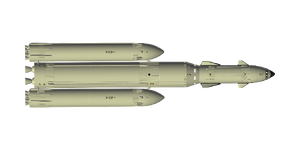
Project Nova HLV

Hinges on the TPS side are mildly concerning. Might just go with a starship chomper or Shuttle style payload bay doors

 
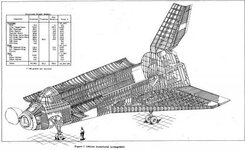
That was also my concern. This is why the Argo spacecraft, which must withstand BLEO reentry, has no openings/hinges directly on the frontal/windward side, and the docking port is dorsal (leeward). XCS-R must only withstand LEO reentry and I wanted a clean exit for payloads. It reassures me that the Grumman proposal for the Space Shuttle featured a frontal opening for the docking port. I'll think about it anyway. Thanks for the input
Hinges on the TPS side are mildly concerning. Might just go with a starship chomper or Shuttle style payload bay doors
 

Attachments

  • 34185-5620677642fa3ee053cb37ef8e088674.jpg
    34185-5620677642fa3ee053cb37ef8e088674.jpg
    38.8 KB · Views: 15
👀Grumman shuttle proposal? Need to know more about that! can you link the full document?
 
Last edited:
An updated recap of the mission profiles I've envisioned for the Moon (the delta-V budget seems to hold up but further verifications are needed).

1) Quick ascent (or "chinese" profile). Dual Nova V launch. The first one with the Auriga lander, delivered in LLO by the HES-4 stage. The second one with the Argo manned spacecraft, which performs its own TLI. Lunar orbit rendez-vous before and after surface exploration, return. Expendable parts: two XCS core stages and one HES-4 upper stage for every landing.

2) Evolved profile. As with the quick ascent, it begins with a Nova V launch with the Auriga lander. This time the lander flies "light" with only a partial fuel load. The HES-4 does't accompany it all the way to the Moon but performs the TLI and then separates. While the lander places itself in LLO, HES-4 swings by and return to Earth, to park itself again in LEO, waiting to be refueled. A fleet of Nova V-R is launched to refuel the stage. 6-8 launches are needed. Once refueled, the HES-4 departs again to the Moon to dock with the lander and refuel it, then returns again in LEO, ready for another cycle. An Argo spacecraft is launched with the crew, aboard a single-stick Nova I, and then is refueled with Nova V-R. 4 launches are needed. Then it departs to the Moon and the mission proceeds as in the quick ascent. After the exploration, the lander is ready to be refueled again with the same HES-4. In this profile, all the vehicles and rockets are fully reused, except for a single XCS core stage needed to begin the cycle. Subsequent expendable XCS will be needed from time to time when is necessary to replace the HES-4 "tug". A further expansion would be the use of a LEO depot derived from an XCS in order to streamline the refueling process.
 
Last edited:
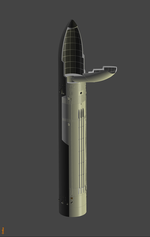
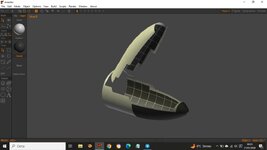
New version of the "angry alligator" cargo bay door. I've accepted the suggestion given by Spaceman 3D, leaving openable only the leeward side of the nosecone, with the windward side fixed, thus avoiding interruptions and hinges on the TPS, for more safety. I must admit that in this configuration the nose seems more solid.

Image1.jpg
 
Last edited:
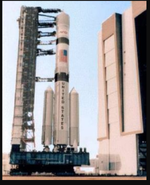
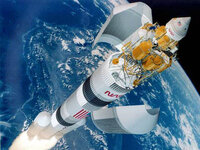
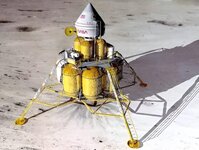
Hey this way cool to see this come to life . NASA worked on this as a follow up to the Saturn 5 It was planned for the " First Lunar Outpost" project it was being designed to fly a Moon direct mission
 

Attachments

  • A plan 2.png
    A plan 2.png
    451.8 KB · Views: 7
  • first-lunar-outpost-vehicle-ascent.jpg
    first-lunar-outpost-vehicle-ascent.jpg
    47.7 KB · Views: 7
  • first-lunar-outpost-on-moon-1.jpg
    first-lunar-outpost-on-moon-1.jpg
    94.3 KB · Views: 7
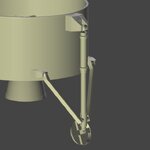
Except for some work on the upcoming Auriga lander (specifically the opening geometry of the landing legs, see below), project currently on hold because I was pondering various realism issues that arose as I studied further, particularly the hydrogen management issue. I came close to scrapping the whole thing and reconfiguring the launch vehicle as a single-stick, all-methane rocket.


Image1.jpg
 
Always thoght a Hydrolox core didn't make sense. For first stages you want dense fuel to get high TWR and mass fraction. Methane is the best there because its dense while having descent Isp. Hydrolox for Upper Stages. New Glenn, Vulcan do it that way
 
Always thoght a Hydrolox core didn't make sense. For first stages you want dense fuel to get high TWR and mass fraction. Methane is the best there because its dense while having descent Isp. Hydrolox for Upper Stages. New Glenn, Vulcan do it that way
Parallel staging is just a different philosophy than tandem staging. It allows a more compact launch vehicle, eliminates the need for altitude ignition and all the stuff related, unlocks a useful modular configuration. And Hydrogen is actually the best choice here, for a core stage.
 
Last edited:
Back
Top