
You are using an out of date browser. It may not display this or other websites correctly.
You should upgrade or use an alternative browser.
You should upgrade or use an alternative browser.
Project Nova HLV
- Thread starter K_Jameson
- Start date

K_Jameson
Well-known member
- Joined
- Dec 30, 2009
- Messages
- 1,232
- Reaction score
- 235
- Points
- 78
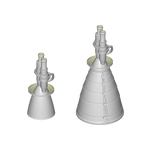
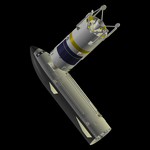
The first piece of hardware for the possible next-generation Nova rocket is ready: the vacuum-optimized methalox Neptune engine (right). They're relatively low-resolution to keep the poly count low. Presumably, a total of 24 will be needed for the first and second stage, both versions. Now that I'm starting to work with numbers and put them together with engineering plausibility, the inline solution for the rocket is becoming more and more attractive.
Attachments

Spaceman 3D
Active member

K_Jameson
Well-known member
- Joined
- Dec 30, 2009
- Messages
- 1,232
- Reaction score
- 235
- Points
- 78
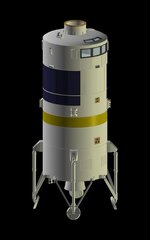
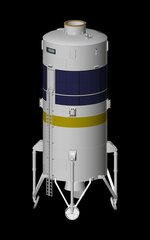
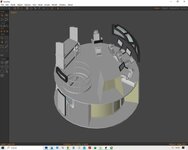
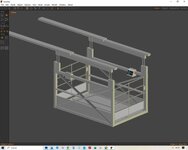
Some work is underway on the Auriga lunar lander. Access to the surface is via an elevator that extends from the front compartment, just below the main windows (still to be completed). The 10-meter ladder, equipped with a central rail for a fall arrest hook, and the hatch, located at the rear, are an emergency access point to be used if the elevator fails. The hatch will be eye-candy only (non-functional).
Spaceman 3D
Active member
cool now were is the Rocket?
K_Jameson
Well-known member
- Joined
- Dec 30, 2009
- Messages
- 1,232
- Reaction score
- 235
- Points
- 78
Work on the inline alternative is underway. I'm putting the numbers together. It is a radical changecool now were is the Rocket?

- Joined
- Jun 2, 2008
- Messages
- 2,289
- Reaction score
- 434
- Points
- 98
- Location
- Valmorea
- Website
- www.fabri91.eu
This is beautiful work! 
K_Jameson
Well-known member
- Joined
- Dec 30, 2009
- Messages
- 1,232
- Reaction score
- 235
- Points
- 78
Still pondering a name change. If the new inline iteration (which I'll unveil soon) will be adoped, the rocket family will depart significantly from the known design and appearance and this could be the occasion to change the name to distinguish it from Stoke Space Nova. A name that popped up in my mind is "Tycho". Tycho Brahe was the discoverer of the "Tycho's Nova", in the constellation of Cassiopeia, depicted from the beginning in the rocket's logo, and this would remark the continuity with the previous family.

Tycho is also the name of the lunar crater where the monolith is found in "2001: A Space Odyssey", remarking the final goal: lunar missions and lunar landing. What do you think?
Tycho is also the name of the lunar crater where the monolith is found in "2001: A Space Odyssey", remarking the final goal: lunar missions and lunar landing. What do you think?
K_Jameson
Well-known member
- Joined
- Dec 30, 2009
- Messages
- 1,232
- Reaction score
- 235
- Points
- 78
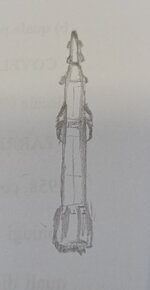
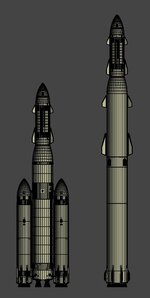
The "Tycho" inline alternative (here a sketch) is the more attractive. Simpler, fully methalox, more realistic in the light of the recent aerospace developments. The original Nova, with stretched tanks, would achieve more or less the same performances (about 60t in LEO in fully reusable configuration, 45t in LLO in partially reusable configuration with a HES-4 upper stage), but the big hydrolox core and the parallel staging configuration are not optimal for fast reuse - the core would be 65 meters in length, even without any payload bay in front. This is problematic. The second stage of the inline version, on the other hand, would be far more compact, basically an enlarged version of the Argo crew vehicle, with almost exactly the same aerodynamic configuration.
Spaceman 3D
Active member
NOICE!
you could also do a prtially reusable config with HES-5 upperstage
LH2 is really good for high engergy upper stage, while CH4 is good for first stages because of the high desity
you could also do a prtially reusable config with HES-5 upperstage
LH2 is really good for high engergy upper stage, while CH4 is good for first stages because of the high desity
K_Jameson
Well-known member
- Joined
- Dec 30, 2009
- Messages
- 1,232
- Reaction score
- 235
- Points
- 78
The HES upper stage will remain!NOICE!
you could also do a prtially reusable config with HES-5 upperstage
LH2 is really good for high engergy upper stage, while CH4 is good for first stages because of the high desity
Similar threads


- Replies
- 88
- Views
- 45K


- Replies
- 92
- Views
- 43K


- Replies
- 24
- Views
- 14K
