
-
ORBITER-FORUM will be temporarily closed at 2026-07-23 18:00 UTC while we complete some OF maintenance tasks. The amount of downtime is expected to take up to one hour, but probably less.
You are using an out of date browser. It may not display this or other websites correctly.
You should upgrade or use an alternative browser.
You should upgrade or use an alternative browser.
Project Nova HLV
- Thread starter K_Jameson
- Start date

- Joined
- Feb 6, 2008
- Messages
- 38,938
- Reaction score
- 3,937
- Points
- 203
- Location
- Wolfsburg
- Preferred Pronouns
- Sire
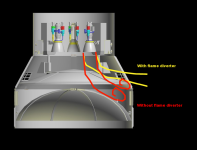
You could also consider an ablative solution, especially if the impact is only short, but you might need to take in account the overpressure during engine start as well.
- Joined
- Feb 6, 2008
- Messages
- 38,938
- Reaction score
- 3,937
- Points
- 203
- Location
- Wolfsburg
- Preferred Pronouns
- Sire
OK, then probably some measure is needed, so I should keep the flame diverter...
I believe by the distance, just some ablative foam on the tank dome is enough. the exhaust has enough room to spread out, important is just, that the pressurized tank dome doesn't lose integrity before the next stage has enough distance to it. If you include ullage motors, even better.

K_Jameson
Well-known member
- Joined
- Dec 30, 2009
- Messages
- 1,228
- Reaction score
- 239
- Points
- 78
Do you think regular foam insulation could withstand the heat even if set afire, as in the Delta IV launches? The plume impact should last a few seconds in the event of a pad abort - the Argo spacecraft's t/w ratio, with seven engines, is >= 1.2. Only 1.02/1.07 in the event of an engine failure, which is worrying. At altitude, the numbers are better: >=1.49 with seven engines, >=1.27 with six, still at least 1.06 with only five working engines. I have to admit that I didn't pay much attention to the abort modes, even though the Argo obviously has plenty of fuel - with a comfortable margin - to theoretically attempt an RTLS abort at any point during the first stage burn. During its own burn, acting as a second stage, the spacecraft has enough engine-out capability to be reasonably safe until orbit insertion.
- Joined
- Feb 6, 2008
- Messages
- 38,938
- Reaction score
- 3,937
- Points
- 203
- Location
- Wolfsburg
- Preferred Pronouns
- Sire
If the foam is really sticky and flame-retardent it should last long enough. Again, its primary job is to prevent a collapse of the tank dome, which would be catastrophic, especially IF you already have an abort.
Flame deflector buckets had been used on Gemini-Titan, they for example allowed checking out the OAMS before launch. The hot staging of Titan II happened without much protection, the heat load was low enough.
Flame deflector buckets had been used on Gemini-Titan, they for example allowed checking out the OAMS before launch. The hot staging of Titan II happened without much protection, the heat load was low enough.
K_Jameson
Well-known member
- Joined
- Dec 30, 2009
- Messages
- 1,228
- Reaction score
- 239
- Points
- 78
Well, maybe an extra layer of foam on top of the amount needed for the normal operations could do the job at the cost of only a tiny fraction of the weight of a complete flame diverter. Thank you Urwumpe, your help was invaluable!

- Joined
- Jul 7, 2012
- Messages
- 1,520
- Reaction score
- 1,553
- Points
- 128
- Location
- Monte Hermoso - Argentina
- Website
- github.com
- Preferred Pronouns
- he/him
I hadn't seen this thread, and now I found it.
The rocket looks very impressive and detailed. I remember using the Quasar launcher in Orbiter 2010, it was gigantic.
Good luck with the development of the add-on!
The rocket looks very impressive and detailed. I remember using the Quasar launcher in Orbiter 2010, it was gigantic.
Good luck with the development of the add-on!
K_Jameson
Well-known member
- Joined
- Dec 30, 2009
- Messages
- 1,228
- Reaction score
- 239
- Points
- 78
A table with the basic specifications for all the engines featured in the rockets and spacecrafts. As already stated elsewhere, there are three basic engines, the Jupiter-A (hydrolox), my analogue of the RS-25/SSME, the Neptune-B (metholox), equivalent to the Raptor 2, and the Selene (hydrolox), RL-10/Vinci class. This third engine comes in three different versions for the various tasks (C for upper stages, D for the Auriga lander, E for the Argo spacecraft,).
A fourth, small engine, now named Diana-A (also hydrolox), serves as a backup for the Auriga lander.

A fourth, small engine, now named Diana-A (also hydrolox), serves as a backup for the Auriga lander.
K_Jameson
Well-known member
- Joined
- Dec 30, 2009
- Messages
- 1,228
- Reaction score
- 239
- Points
- 78
- Joined
- Feb 6, 2008
- Messages
- 38,938
- Reaction score
- 3,937
- Points
- 203
- Location
- Wolfsburg
- Preferred Pronouns
- Sire
NASAs NTRS is a treasure trove of almost everything. Even if you can't find what you look exactly, similar things are always there. Europe should have the same public technical library IMHO. For example, while I can't find the specs for a hydrogen fueled General Electric CF6-50 turbofan, there is a document about an aircraft using a comparable hydrogen jet engine.I wasn't aware that a very small hydrolox engine, simple but with sufficient performances, was a thing; found this NASA technical memorandum that provided me the necessary technical background.
K_Jameson
Well-known member
- Joined
- Dec 30, 2009
- Messages
- 1,228
- Reaction score
- 239
- Points
- 78
Very true, Urwumpe!
(a small addendum to my previous post: since I am a dangerous sociopathic maniac, the expansion ratios given in the table are accurately reproduced in the engine meshes, even though this has absolutely no interest for the purposes of the simulation )
)
(a small addendum to my previous post: since I am a dangerous sociopathic maniac, the expansion ratios given in the table are accurately reproduced in the engine meshes, even though this has absolutely no interest for the purposes of the simulation
)
K_Jameson
Well-known member
- Joined
- Dec 30, 2009
- Messages
- 1,228
- Reaction score
- 239
- Points
- 78
I have another problem: the heat shield. The baseline Argo is equipped with a reusable heat shield, Starship-like, for which I determined, after some research, a weight of 13 kg/m2, for a total TPS weight of just over 3,500 kg.
This is good for LEO applications, but clearly cannot withstand the punishment expected for a return from the Moon. After playing for a while with the idea of a trailing ballute in order to slow the spacecraft before the final dive into the atmosphere, I decided to separate the versions: the lunar Argo must be equipped with a more substantial (ablative) heat shield.
The problem now is weight. The Apollo heat shield is at least five times heavier for square meter and, scaling for Argo, that means 17,500 kg, well over the limit. But Argo is a proportionally lighter spacecraft, being essentially a large, almost empty propellant tank at the time of reentry. Also, it is made of stainless steel instead of aluminum, so this could have a positive impact on the weight of the shield.
I tried to make a rough calculation of the total expected heat, playing with kinetic energy and Stefan-Boltzmann formula. If you only consider kinetic energy, I can assume that a 30 kg/m2 heat shield might be sufficient, but for a lunar reentry the radiative heat is substantial, because it increases with the fourth power of the temperature. I only have a narrow margin to spend on additional weight. I'm pretty stuck here
This is good for LEO applications, but clearly cannot withstand the punishment expected for a return from the Moon. After playing for a while with the idea of a trailing ballute in order to slow the spacecraft before the final dive into the atmosphere, I decided to separate the versions: the lunar Argo must be equipped with a more substantial (ablative) heat shield.
The problem now is weight. The Apollo heat shield is at least five times heavier for square meter and, scaling for Argo, that means 17,500 kg, well over the limit. But Argo is a proportionally lighter spacecraft, being essentially a large, almost empty propellant tank at the time of reentry. Also, it is made of stainless steel instead of aluminum, so this could have a positive impact on the weight of the shield.
I tried to make a rough calculation of the total expected heat, playing with kinetic energy and Stefan-Boltzmann formula. If you only consider kinetic energy, I can assume that a 30 kg/m2 heat shield might be sufficient, but for a lunar reentry the radiative heat is substantial, because it increases with the fourth power of the temperature. I only have a narrow margin to spend on additional weight. I'm pretty stuck here
K_Jameson
Well-known member
- Joined
- Dec 30, 2009
- Messages
- 1,228
- Reaction score
- 239
- Points
- 78
I was wondering if a sort of regenerative cooling was possible channelling the LH2 venting before throwing it overboard; furthermore, I'm trying to estimate how much the spacecraft's benign ballistic coefficient can attenuate the heat, allowing for a thinner heat shield.
- Joined
- Feb 6, 2008
- Messages
- 38,938
- Reaction score
- 3,937
- Points
- 203
- Location
- Wolfsburg
- Preferred Pronouns
- Sire
I was wondering if a sort of regenerative cooling was possible channelling the LH2 venting before throwing it overboard; furthermore, I'm trying to estimate how much the spacecraft's benign ballistic coefficient can attenuate the heat, allowing for a thinner heat shield.
Lower ballistic coefficient is generally good for a low total heat load, and has a small effect on peak heating if you use a gliding reentry. For skip reentries, you have to calculate for a higher peak heating, but can for example chill the heat shield between atmospheric phases.
But generally, if you want to stay realistic, any active cooling doesn't have a really good efficiency by mass. What you can try is using high-temperature heat pipes for distributing the heating more towards the cold side, but that also means a massive mass penality and a nasty complexity / MTBF rating. Keeping it simple might be better if your life depends on it, and moving the magic to subsystems that can be easily temporarily replaced by backup systems.
- Joined
- Feb 6, 2008
- Messages
- 38,938
- Reaction score
- 3,937
- Points
- 203
- Location
- Wolfsburg
- Preferred Pronouns
- Sire
I agree that simplicity is the right way, also because, in my "headcanon", the spacecraft should be able to switch from LEO to lunar duties simply by changing the heat shield.
You might also update communications, GNC or life-support for lunar missions. Maybe not so feel-able in vanilla Orbiter, but maybe you find an idea there to make it more "game-ified".
One rather unrealistic fun project idea for the future was making a simple empty modular hull for a spacecraft into which you can install any kind of module to update it or allow a different range of missions, like optimizing a spacecraft for Earth-Mars transports. And then as extension introduce stations and docks for earning the money for updates and buying different kinds of updates.... maybe also have a mechanism for dynamically creating different modules like in the old Formula 1 racing games.
K_Jameson
Well-known member
- Joined
- Dec 30, 2009
- Messages
- 1,228
- Reaction score
- 239
- Points
- 78
The cargo bay houses additional equipment needed for the task at hand, such as an airlock/docking port, high-gain antenna for long-range communications, payload dispenser, etc.You might also update communications, GNC or life-support for lunar missions. Maybe not so feel-able in vanilla Orbiter, but maybe you find an idea there to make it more "game-ified".
Similar threads


- Replies
- 88
- Views
- 46K


- Replies
- 92
- Views
- 44K


- Replies
- 24
- Views
- 14K
